Fixing Restaurant Flow: How Table Turn Times, Ticket Times, and Staffing Connect to Your Bottom Line

A four-top finishes dessert at 7:40 on a Friday. The check sits there until 8:05, because the server is slammed and no one has cleared it. That empty-but-occupied table just cost you a full seating in your best hour, and the party waiting by the host stand gave up and walked to the place next door. Restaurant table turn times are where a lot of lost revenue hides. They rarely improve on their own, and two things behind the scenes pull them in either direction: how fast tickets clear the kitchen, and how you staff the floor.
What one slow table turn costs you
Table turn time is the clock that starts when a party sits and stops when the next party could take their place. Seat, order, eat, pay, reset. If your average dinner turn runs 75 minutes and you get it to 65, a six-table section gains close to one extra seating across a busy four-hour night. Put a $42 average check and a party of three on that seating, and you are looking at a few hundred dollars a night from tables you already own.
Now hold that against the year operators are having. The National Restaurant Association's 2026 State of the Industry report found that 60 percent of operators saw traffic fall in 2025, and 42 percent said their restaurant wasn't profitable at all. Guests are still coming, just less often and with a sharper eye on the check. When fewer parties walk through the door, the revenue you can pull from the ones who do matters more.
A table you turn cleanly is money in the drawer. Leave one sitting dirty for twenty minutes, and you have sold that seating to nobody.
The loss is invisible on most reports, which is the trap. A missed seating leaves no line item behind. Sales look fine, labour looks fine, and the only trace is a wait list that got long and a few parties who quietly left. You feel it later in a soft month, without ever seeing the tables that caused it.
That is why turn time belongs on the P&L, even though most GMs still track it at the host stand. It is a throughput number, and throughput is covers divided by the seat-hours you have to sell. You raise it by clearing the two things standing between a finished plate and a fresh party: a kitchen that fell behind, and a floor without the right hands in the right spot.
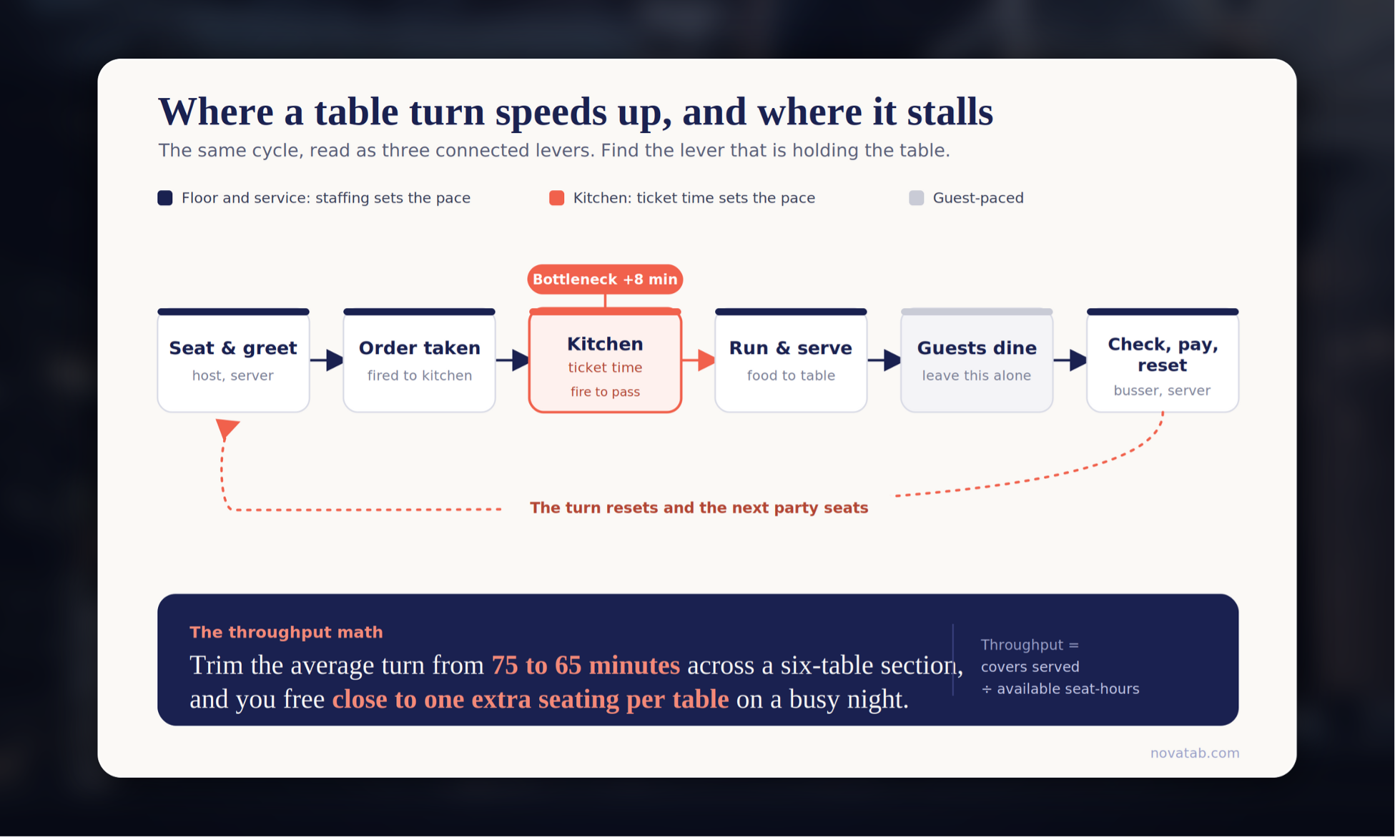
The table-turn cycle reads as three connected levers. A slow turn is a symptom; the cause sits upstream in ticket times or staffing.
How ticket times drive your table turns
A table cannot turn faster than the kitchen lets it. Ticket time is the stretch between the order firing and the food landing, and it sets the pace for everything the table does after. When tickets run long, guests sit longer, servers stop pre-bussing to go chase missing plates, and the whole section clogs behind them.
Think about what a single slow station does to your servers. When plates stack up in the window, servers hover at the pass instead of working their sections, so bussing slows, checks drop late, and tables that finished ten minutes ago still sit uncleared. One jam in the kitchen becomes four stalled tables on the floor, and none of it looks like a kitchen problem from where the host is standing.
The pain lands hardest exactly when it costs the most. On a quiet Tuesday, a ten-minute ticket barely registers. During a Friday rush, that same ten minutes stacks across every table on the line, and a kitchen four minutes behind at 7 can be twenty-five minutes behind by 8. Guests read it as a slow night. On your P&L, it shows up as seatings you never got to sell.
Long tickets also hide their own cause. Maybe one station is drowning while the others coast. Maybe a single modifier-heavy dish keeps jamming the pass at the worst moment. Without ticket-level timing, a GM sees a full floor and a growing wait, and the fix becomes a guess. With it, the slow station names itself, and you can move a body before the dining room ever feels the backup.
Where staffing quietly breaks restaurant flow
Tickets control how fast food moves. Whether the table itself turns comes down to staffing. A dialled kitchen still stalls when there is no one free to clear the plates, drop the check, run the card, and reset the top for the next party.
Both directions cost you. Understaff the rush, and tables sit dirty while a two-minute reset waits fifteen for a free set of hands. On a soft shift, the reverse bites, and you burn labour margin against covers that never arrive. The 2026 hiring picture tightens that squeeze from both sides. The National Restaurant Association counts labor among the challenges more than 9 in 10 operators call significant this year, and the pool of 16-to-24-year-olds who fill these roles keeps shrinking, so the plan you build with the team you have has to be sharp.
The lever that matters is coverage against demand, hour by hour, instead of a schedule copied from last month out of habit. A busser scheduled for the real 7-to-9 crush does more for your turn times than an extra server drifting through a dead 4 o'clock. Done well, the schedule becomes a flow tool: you know by the hour where a reset is likely to stall, and you put a body there before a table sits dirty. We go deeper on getting that balance right in the real cost of overstaffing and understaffing.
How to measure restaurant table turn times
Start with a number you can trust. At its simplest, table turn time is the average minutes a table stays occupied from seat to reset, measured across a defined service window. Pull it by day part, not as one flat daily average, because the daily figure blends your dead 3 o'clock with your do-or-die 7:30 and buries the exact window where revenue leaks.
Most of this already lives in your system if you know where to look. Your POS stamps the moment a table is seated, the moment each course fires, and the moment the check closes. The gap between those stamps is your turn, broken into pieces you can act on. The trick is reading them as they land, rather than exporting them into a spreadsheet after the shift is over and the chance to fix anything is gone.
What counts as good depends on your format. A quick-casual lunch might turn a table in 30 to 45 minutes. Full-service casual dinner tends to land somewhere around 60 to 90. Fine dining runs long by design, and chasing a fast clock there would wreck the experience you charge a premium for. Watch your own trend before you chase anyone else's benchmark, because a 10-minute gain against your own baseline is real money you can bank tonight.
One caution worth sitting with. An average can look perfectly healthy while your peak quietly bleeds. If Friday 7-to-9 turns slower than the rest of your week, that single window may hold most of your upside, and it will never surface in a report you export three weeks later. You catch a pattern like that only by watching it while it happens.
Must Read: How smart operators are turning data into profit
How to find the bottleneck in table, ticket, and staffing data
Here is where the three signals meet. A slow turn is a symptom. The cause sits upstream in the ticket times or the staffing, and the only way to tell which is to watch them next to each other while service is live.
Picture that Friday again. Your floor view shows two tables in "check dropped" for over ten minutes, so guests are ready to leave and nobody has closed them out. Two more read "needs bus." At the same moment, your ticket board shows the grill running eight minutes over target with two tickets past the line. The bottleneck is the grill. It is stranding servers at the pass and keeping them from the tables that are sitting there ready to reset. You slide a hand over to bus and reset, get a second cook on the grill, and the floor unlocks. That read takes about five seconds when the data lives on one screen, and it is close to impossible from a report you open the next morning.
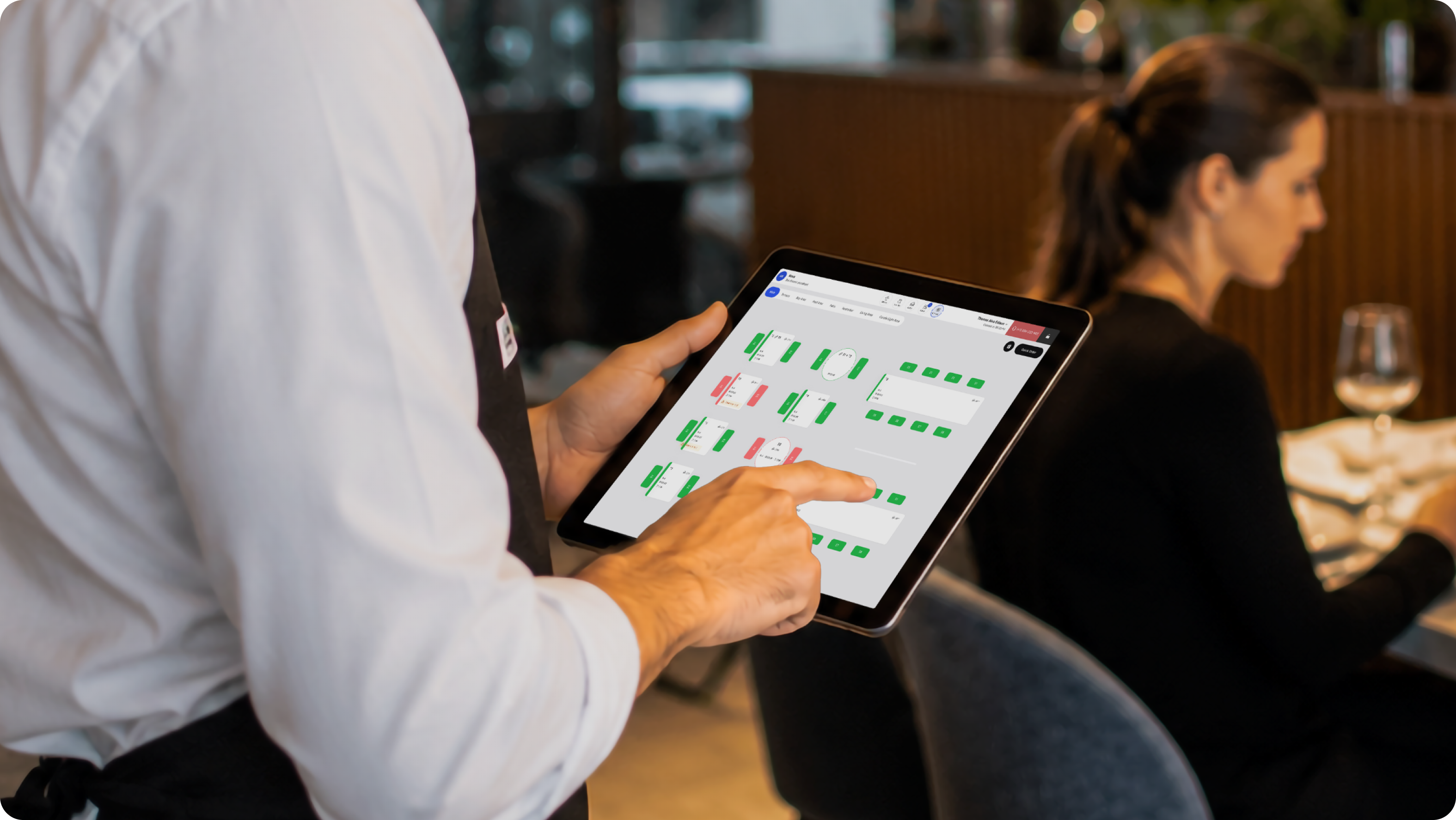
This is the exact picture Nova's real-time floor and ticket view puts in front of a manager: live table status and live ticket times side by side, so a stall announces itself while you can still do something about it. When the grill drifts over, you see it the moment the first ticket slips, before ten tables have felt it.
How to turn tables faster without rushing guests
Speed a guest can feel is the wrong kind. The goal is to strip out dead time nobody wanted, and most of it hides in two places: the gap between the last bite and a paid check, and food that sat in the window while a server was stuck somewhere else. Clear those and the table turns faster while the meal itself still feels unhurried.
A few moves that move the number:
- Pre-bus and drop the check on the table's cue, not on the server's next lap. Most lost minutes live between the last bite and the payment.
- Watch ticket times live and float a second set of hands to whatever station is drifting, before the backup reaches the dining room.
- Staff bussers and support to your real demand curve by day part, so a reset never waits on a server buried three tables away.
- Fix the reset itself. A pre-set caddy and a clean runner path can turn a two-minute reset into a forty-second one.
There is a quiet upside built into all of this. The moves that free a seating also fix the parts of a meal guests resent most: the long wait for a check and the plate that shows up cold. Better flow and a better meal come out of the same work.
None of this rushes anyone. It just clears the dead time nobody wanted. Do it well, and two things happen at once: guests get their meal hot and unhurried, and every cover you free stays in your dining room instead of walking to the place next door. That gain compounds once ticket times and table status live on one screen instead of scattered across a dozen disconnected tools. The hidden cost of disconnected restaurant software puts a number on what fragmentation alone is costing you.