The Hidden Cost of Disconnected Restaurant Software: What 12 Systems Actually Cost You

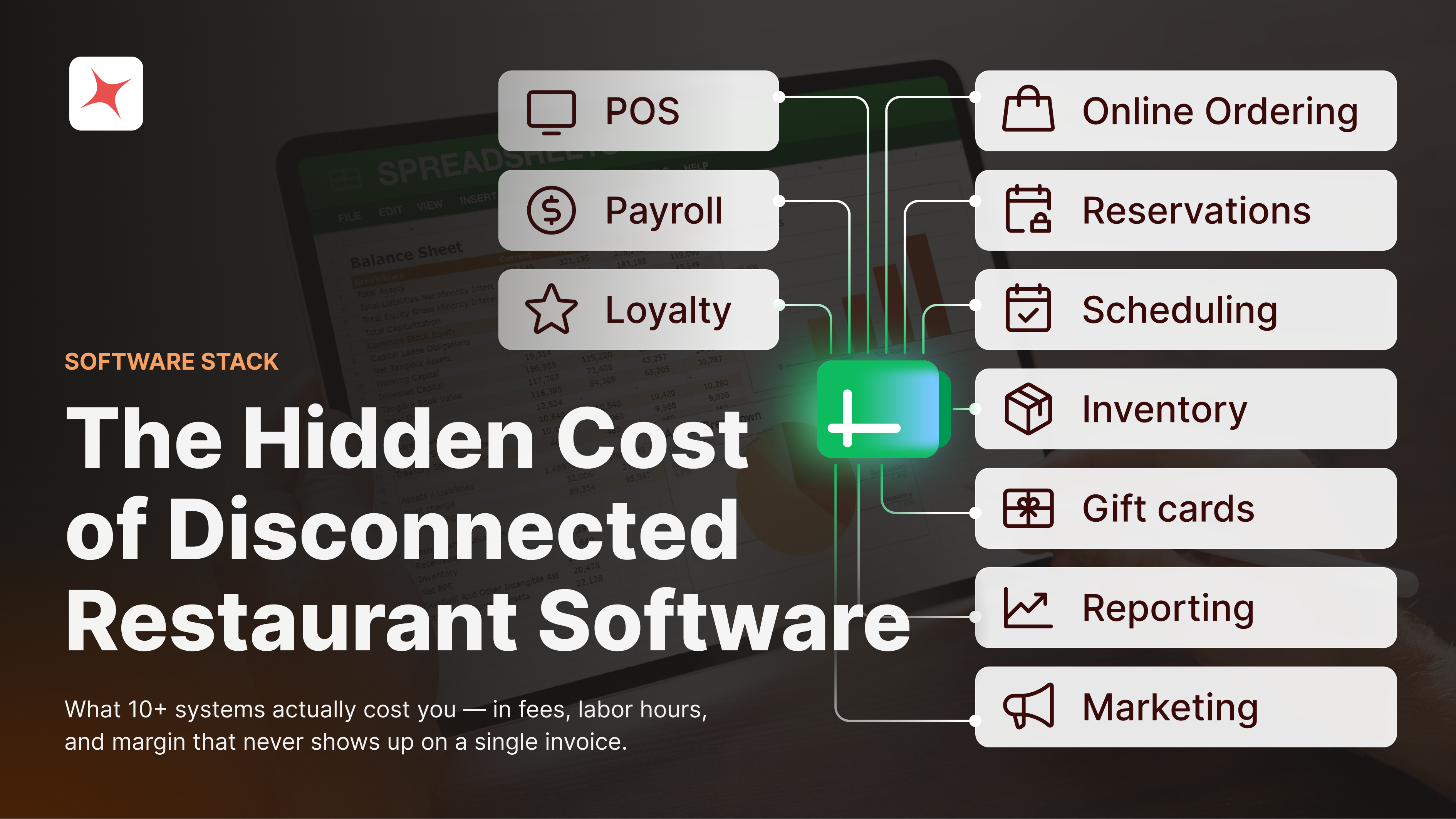
Ask a multi-unit operator how many software systems run their restaurants, and most guess low. Then they start counting: POS, online ordering, a separate app for delivery marketplaces, payroll, scheduling, inventory, a loyalty platform, reservations, a POS-adjacent gift card tool, accounting software, a reporting layer built to stitch the rest together, and whatever the last consultant recommended. Twelve is common. Eighteen is not rare. Each one showed up to solve a single problem, and each one is still billing monthly.
The subscription costs are the part everyone already tracks. The part that doesn't show up on any invoice is what fragmentation costs in labor hours, pricing errors, and decisions made three weeks too late.
What running 12 systems looks like on a Friday night
A single dinner service touches most of that stack without anyone noticing. A guest orders through a third-party app. That order lands on a tablet next to the POS rather than inside it. The kitchen enters it manually into the Kitchen display system. Inventory doesn't move because nothing told it to. At close, a manager exports sales from the POS, exports labor from the scheduling tool, and builds a spreadsheet to see whether the shift made money, because none of those systems share a database.
Multiply that by every location a chain operates in, and the manual reconciliation work scales linearly with headcount. A 40-unit chain doesn't do this once. It does it 40 times, every night, with 40 slightly different spreadsheets, because the manual process leaves room for 40 slightly different habits.
The list rarely stops at the systems everyone names first. Add a separate gift card platform, a standalone reservations tool, a marketing email tool that pulls guest data from a fourth source, and a franchise reporting portal required by the brand but built by neither the franchisor nor the operator. Each one arrived to fix a specific problem at a specific moment, usually under time pressure, and none of them were selected with the other eleven in mind. That's how a restaurant ends up with three separate places storing a guest's phone number and no single place that's authoritative.
The direct cost: subscription math nobody adds up
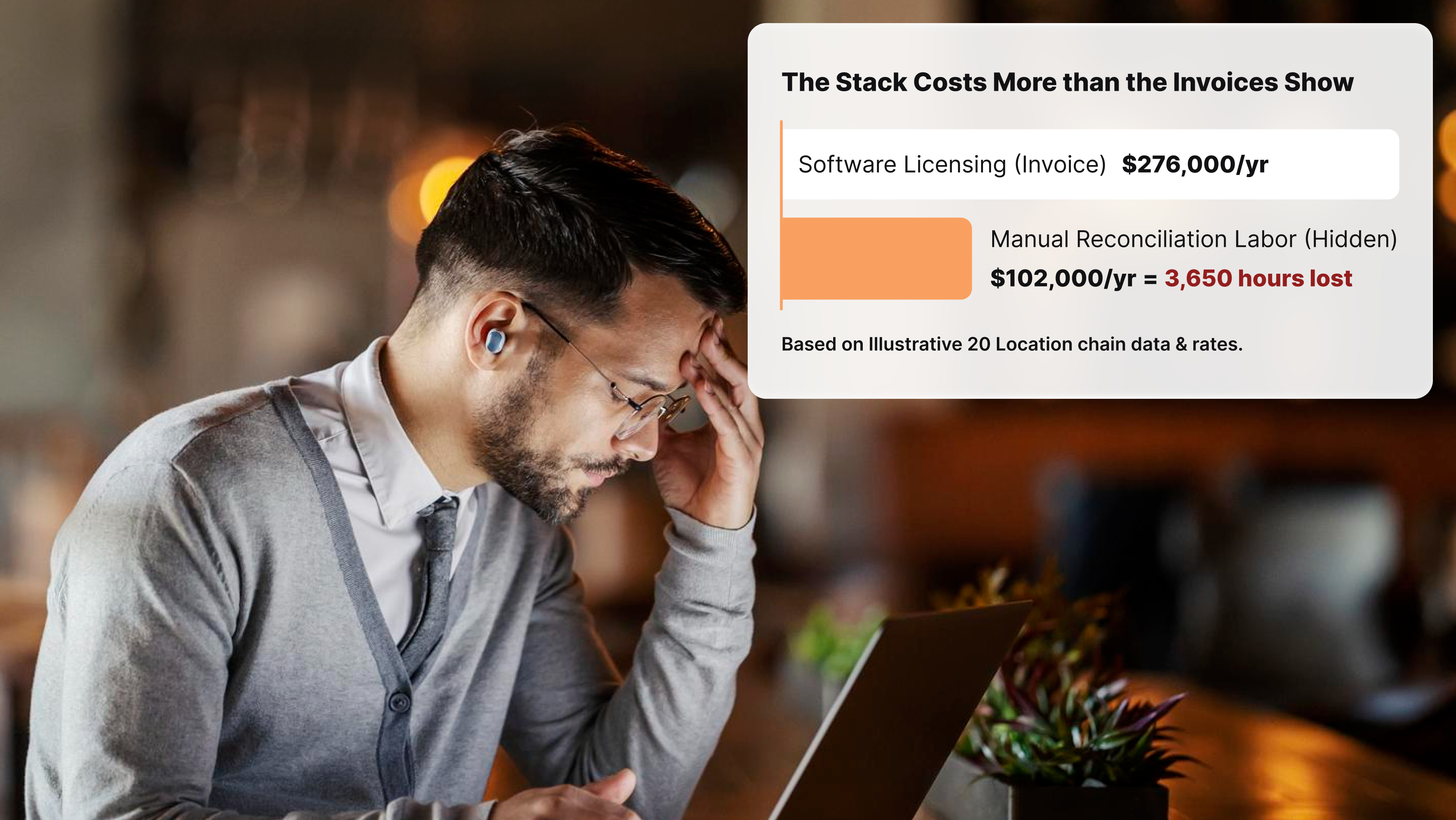
Line up the invoices, and the number gets uncomfortable fast. A modest 12-system stack, priced per location per month, commonly runs $800 to $1,500 before any transaction fees or per-user add-ons. For a 20-location chain, that's $16,000 to $30,000 a month spent on licensing before a single ingredient is purchased or a single shift is scheduled.
Some of that is unavoidable. Payroll needs to exist. A KDS needs to exist. What's avoidable is the overlap: two systems both selling “reporting,” three systems both selling “customer data,” a scheduling tool and a labor-forecasting tool that never talk to each other and therefore both guess independently. Overlap is where a stack quietly doubles its own cost.
The hidden cost: hours spent reconciling instead of operating
Interchange rates, food cost percentages, and labor cost percentages get audited constantly, because they show up on a P&L. The hours a GM spends stitching together five exports into one spreadsheet do not show up anywhere, which is exactly why they never get questioned.
A manager reconciling POS, labor, and inventory data by hand at close is a fixed nightly cost, whether or not it's booked as one. At 30 minutes a night per location, a 20-unit chain accumulates roughly 3,650 hours a year of manual reconciliation, close to two full-time roles spent entirely on making disconnected systems agree with each other rather than on running better shifts.
Errors compound the cost. A price change made in the POS but never pushed to the online ordering platform means guests order at yesterday's price until someone catches it, sometimes days later. A menu item marked 86'd in the kitchen but not in the delivery app keeps generating orders the kitchen can't fulfill, and each one becomes a refund, a bad review, or both.
None of these errors show up as a line item called “system fragmentation.” They show up scattered across a dozen smaller categories: comped orders, refunded delivery fees, a food cost variance nobody can quite explain, a guest complaint logged under customer service rather than under the software that caused it. A finance team auditing the P&L sees the symptoms one at a time and treats each as its own small problem, when the actual cause is structural and repeats every single week.
The margin cost: decisions made on stale data
The real damage isn't the labor hours. It's what disconnected systems do to decision speed. When sales, labor, and inventory data all live in separate systems, nobody sees the full picture in real time. They see it a day later, a week later, or at month's end, once someone has manually assembled it.
That delay is expensive in a business built on thin margins. A restaurant running 3% to 5% net margin can't afford to discover an overstaffed Tuesday two weeks after it happened. It needs to know Tuesday morning, while there's still time to adjust the schedule. It can't afford to learn that a menu item's food cost crept up 4 points only when the monthly P&L lands. It needs that signal the week the vendor price changed.
Multi-location operators feel this hardest. A regional manager overseeing 15 locations, each reporting through a slightly different combination of systems, isn't comparing apples to apples. They're comparing five different spreadsheet formats built by five different GMs, each with their own assumptions about what counts as labor cost or what counts as waste.
What changes when the systems are connected
None of this means the fix is one more dashboard layered on top of the existing twelve. A reporting tool that pulls from disconnected systems still depends on those systems agreeing on what a transaction is, and most don't. The fix is collapsing the number of systems in the first place, so the data was never fragmented to begin with.
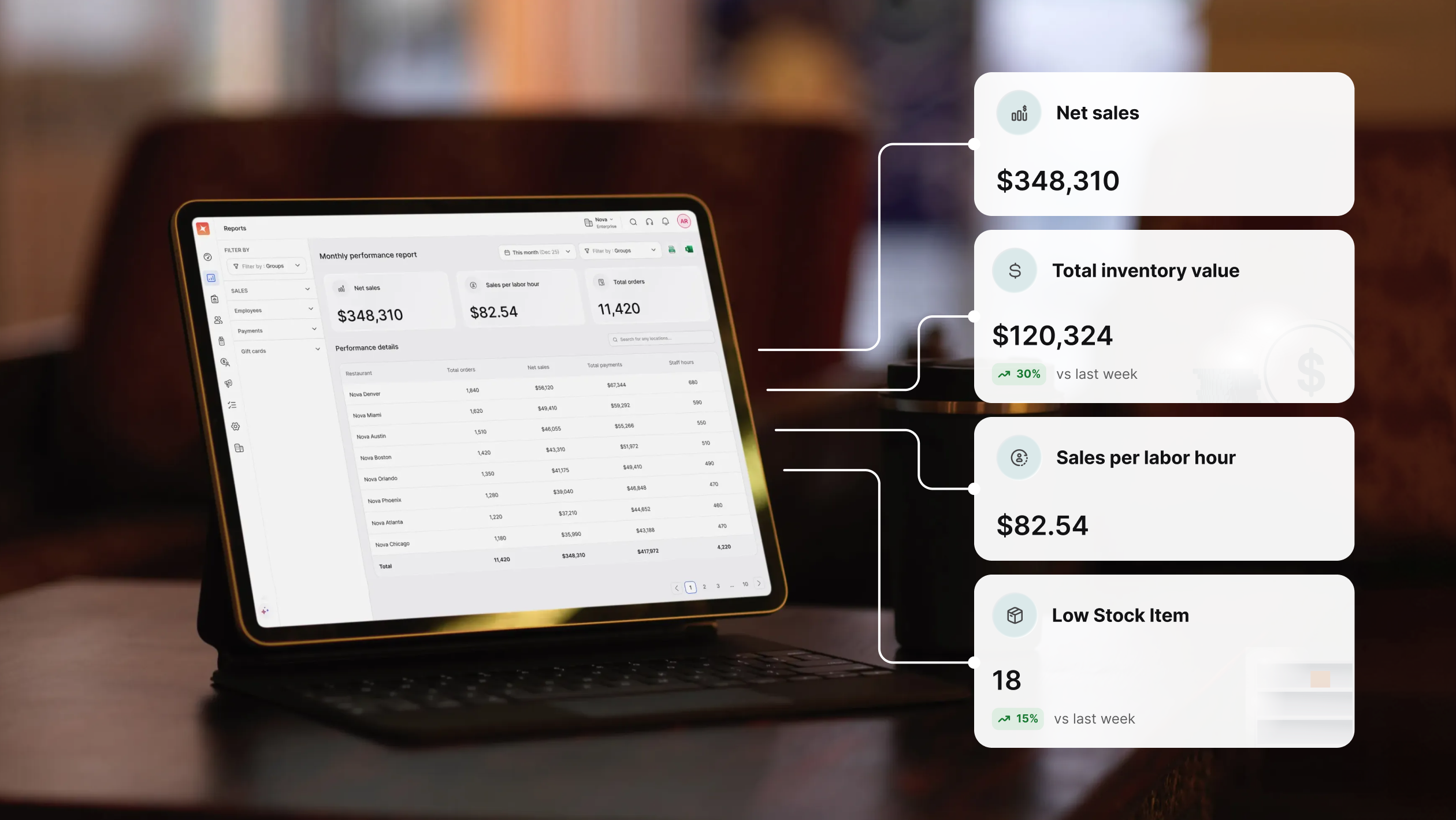
When restaurant POS, labor, inventory, and guest data live in one platform, the 30 minutes of nightly reconciliation disappears, because there's nothing left to reconcile. A price change in one place is the price everywhere. An item marked out of stock in the kitchen is out of stock on every ordering channel within seconds, not days. A regional manager comparing 15 locations is comparing the same fields, calculated the same way, because there's only one system generating them.
The subscription math changes too. Consolidating 12 tools into one platform rarely costs less line by line, but it eliminates the overlap: the second reporting tool, the third customer database, the scheduling system that duplicates what the labor-forecasting system already does. What's left is one bill instead of twelve, and one dataset instead of twelve versions of the truth.
Where Nova fits
Nova was built on the premise that a restaurant shouldn't need 10 to 18 disconnected systems to run one location, let alone fifty. POS, kitchen display, online ordering, labor scheduling, inventory, and guest data all run on one platform, so a price change, an 86'd item, or a labor forecast updates everywhere at once instead of waiting for someone to key it in five times.
That's also where the AI-native piece matters. Predictive labor scheduling only works if it can see real sales data as it happens, not last month's export. Menu and inventory intelligence only catches a cost creep early if inventory and POS data already share a system. Consolidation is what makes those faster decisions possible in the first place.
The real question to ask about a tech stack
The question worth asking isn't how much each system costs. It's how many hours a week your team spends making systems talk to each other that were never built to, and how many decisions get made a week later than they should because of it. Add up the licensing fees, the reconciliation hours, and the pricing errors, and disconnected software is rarely the cheap option it looked like when each piece was purchased separately.
Nova replaces that stack with one platform built specifically for restaurant operations, from a single counter-service location to a chain running hundreds of units. Schedule a walkthrough at novatab.com to see what your stack looks like collapsed into one system.