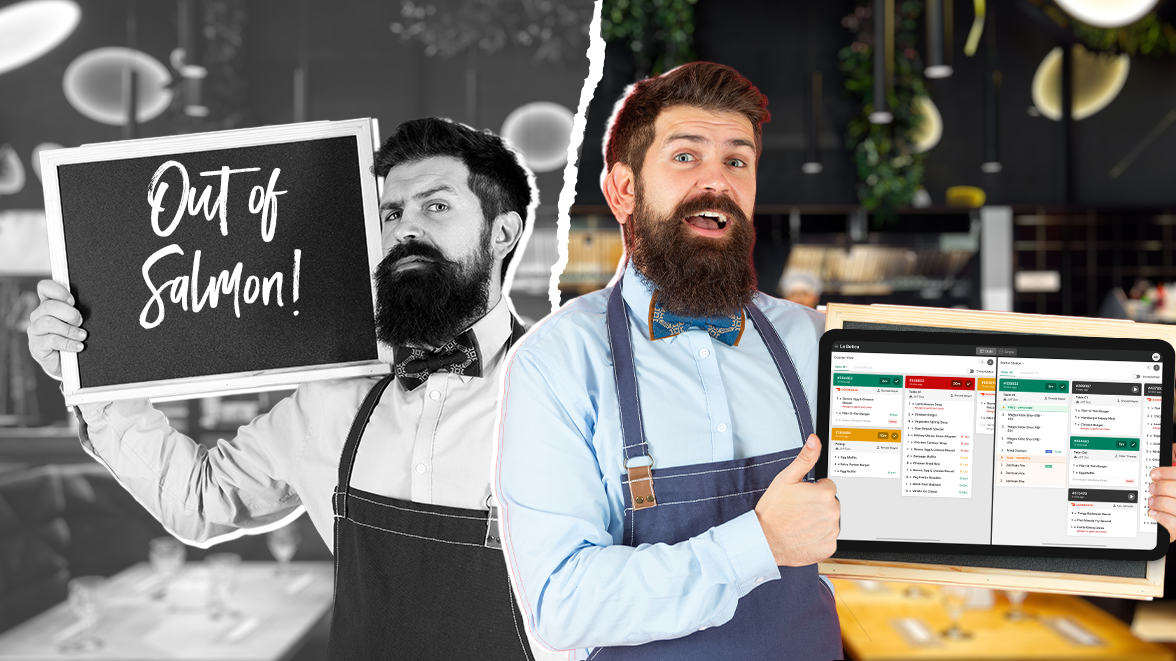

If you’ve spent more than a few days running a restaurant or managing the floor, you’ve probably heard someone shout “86 the salmon!” or “We’re 86’d on fries!” But what does 86’d mean in the restaurant world, really? And more importantly, how can you stop hearing it so often?
Getting “86’d” simply means an item is no longer available; either it ran out or it’s been taken off the menu for a reason. It’s kitchen shorthand, fast and familiar, but it often signals a breakdown behind the scenes. From frustrated servers to disappointed guests, 86’d items throw a wrench into the flow.
In this blog, we’ll unpack where the term came from, why it’s a bigger deal than it sounds, what causes it, and how the right Back of House (BOH) systems can make 86’d a thing of the past. Let’s get into it.
What Does 86’d Mean in Restaurants?
In restaurant slang, “86’d” is a fast way of saying an item is no longer available. It could mean you’ve run out of ingredients, the kitchen is behind, or the chef has pulled the dish for quality reasons. It’s a phrase thrown around kitchens, bar stations, and ticket lines with urgency.
So, what does 86’d mean to a restaurant owner or manager? It’s more than just a missing menu item. It’s a signal that something slipped. Whether it’s poor inventory control or a gap in communication, every 86’d item leaves a mark- on service, on morale, and on your bottom line.
While it’s a common issue in high-volume kitchens, it doesn’t have to be. With better systems in place, especially smart back-of-house restaurant tools, you can dramatically reduce how often you hear the word “86’d.”
Origins of the Term
No one knows for sure where “86’d” came from, but there are plenty of interesting theories.
One story ties it to 1930s speakeasies, where bartenders used “86” as code to kick out unruly guests or cut someone off. Another theory points to diners that used item numbers on their menus, so “86” might’ve been a code for “no longer available.” There’s also a military shorthand explanation, where “86” signified discarding or eliminating something.
Whatever the true origin, it stuck. Today, “86’d” is the standard language in restaurant kitchens around the world. The fact that a century-old phrase still dominates modern kitchens tells us something: it’s a problem that hasn’t gone away.
But now, with the right restaurant kitchen management tools, you can change that.
Why 86'd Items Hurt Your Restaurant
It is easy to treat an 86'd item as a minor inconvenience - the guest orders something else, and the meal continues. But the data tells a different story. The damage from an out-of-stock item rarely stays contained to that one table or that one moment.
The Guest Experience Damage
When a guest arrives specifically for a dish they saw online, heard about from a friend, or ordered before, being told it is not available is a genuine letdown. That disappointment is disproportionate to the size of the problem. Research shows that one negative review can deter as many as 22% of potential new customers from visiting a restaurant. Three negative reviews push that figure to 59%. Menu unavailability is a recurring trigger for negative reviews, and 65% of bad reviews are posted within 24 hours of the experience - meaning the frustration gets published before the guest has time to reconsider.
The broader retention picture is equally stark. 32% of consumers say they will stop visiting a restaurant they previously liked after just one bad experience. For a guest who planned their visit around a specific item, an 86'd menu means their experience peaked before they ordered.
The Revenue You Do Not See
The more immediate financial loss from an 86'd item is the revenue that never gets counted. A server cannot upsell a wine pairing on a dish that no longer exists. An add-on that was planned around a specific protein disappears from the conversation. High-margin items like premium cuts, fresh seafood, and seasonal specials are often the first to run out - and they are precisely the items that drive the strongest check averages.
When 86'd situations happen repeatedly during a service period, the cumulative effect on average check per cover is real and measurable. A table that settles for a second-choice dish at a lower price point, skips the add-ons they were excited about, and leaves slightly disappointed is not the table that comes back next week.
The Operational Friction
Beyond the guest-facing impact, frequent 86'd items create tension inside the operation itself. Servers who take orders without knowing what is unavailable have to return to the table with an apology. The kitchen deals with improvised substitutions under pressure. Managers field complaints that could have been prevented with better inventory visibility. These friction points add up across a service period and contribute to the kind of staff dissatisfaction that drives turnover - itself one of the most expensive operational costs a restaurant carries.
What Causes 86’d Situations
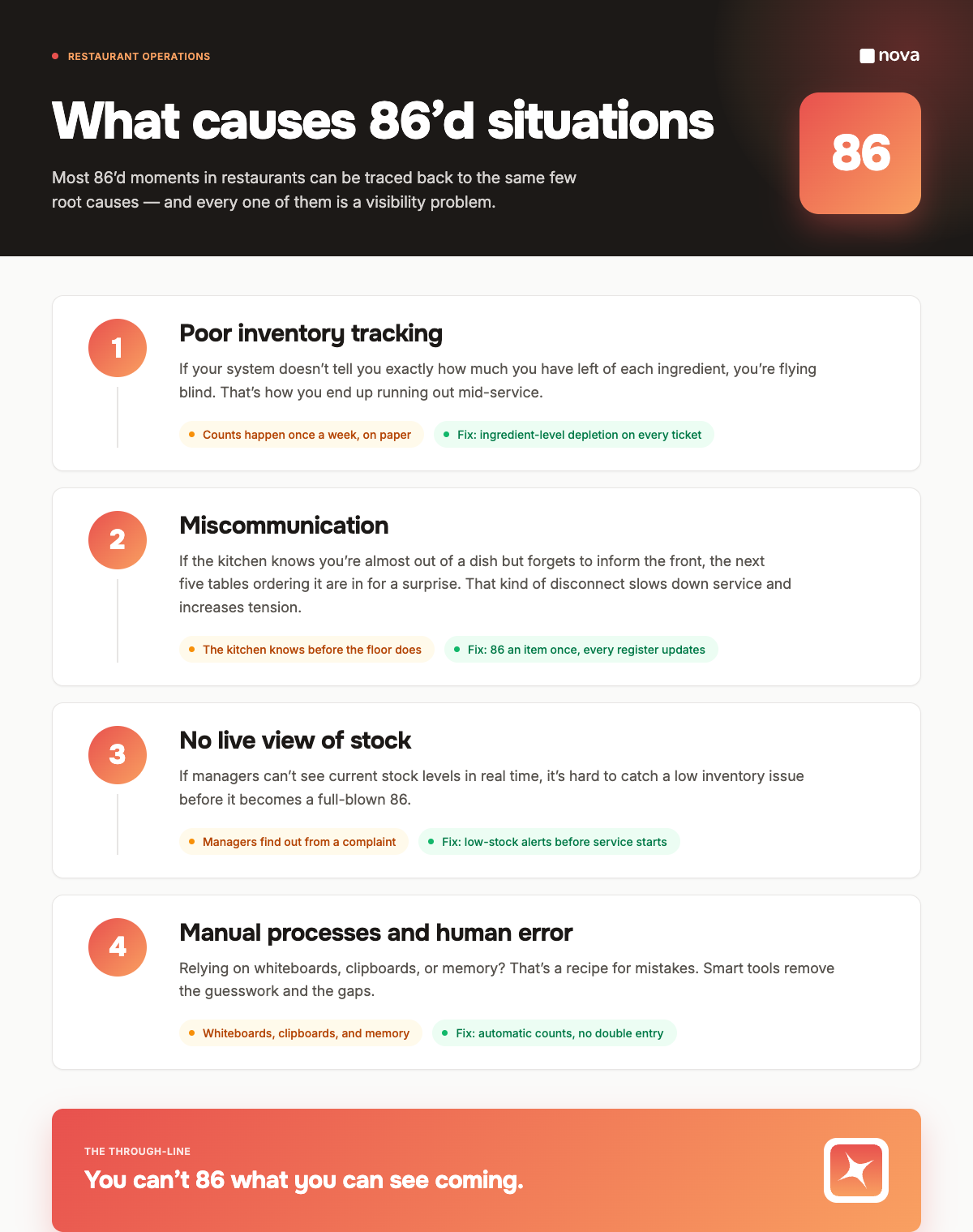
Most 86’d moments in restaurants can be traced back to the same few root causes:
1. Poor Inventory Tracking
If your system doesn’t tell you exactly how much you have left of each ingredient, you're flying blind. That’s how you end up running out mid-service.
2. Miscommunication
If the kitchen knows you’re almost out of a dish but forgets to inform the front, the next five tables ordering it are in for a surprise. That kind of disconnect slows down service and increases tension.
3. No Live View of Stock
If managers can’t see current stock levels in real time, it’s hard to catch a low inventory issue before it becomes a full-blown 86.
4. Manual Processes and Human Error
Relying on whiteboards, clipboards, or memory? That’s a recipe for mistakes. Smart tools remove guesswork and gaps.
How to Handle 86'd Items: What Your Servers Should Say
An 86'd item does not have to become a bad guest experience. The outcome depends almost entirely on how the server handles the moment. A clumsy delivery - "Oh sorry, we're out of that" after the guest has already decided - creates frustration. A well-handled one barely registers as a problem. Training your team on how to communicate 86'd items is one of the lowest-cost service improvements a restaurant can make.
Tell Guests Before They Order, Not After
The worst version of an 86'd item situation is when a guest studies the menu, decides on a dish, orders it, and then gets told it is unavailable. By that point they have already committed emotionally to the choice, and the news lands as a letdown rather than a simple update.
The better approach is to lead. As soon as a server is seated with a table, they should already know what is 86'd and mention it naturally before the guest has time to fall in love with an unavailable dish. "Just so you know before you look through the menu, we are out of the branzino tonight" takes three seconds and completely changes the guest's experience of the limitation.
Lead With the Alternative, Not the Problem
How a server frames the 86'd item determines how the guest receives it. "We're out of the short rib" is a dead end. "We're out of the short rib tonight, but the braised lamb shank is prepared the same way and has been really popular this week" is a recommendation. The guest's attention moves immediately from what they cannot have to what they can.
Servers who know the menu well enough to offer a genuine alternative in the same moment create a recovery rather than a disappointment. This is also an upselling opportunity. A confident substitution recommendation from a knowledgeable server often lands at the same or higher price point than the original order.
Stay Confident, Not Apologetic
There is a meaningful difference between acknowledging an 86'd item and over-apologizing for it. A server who says "I'm so sorry, I know that's really frustrating, we just ran out" amplifies the problem by mirroring frustration back to the guest. A server who delivers the same information matter-of-factly and pivots quickly to a recommendation keeps the energy of the table moving forward.
Guests take their cues from staff. A server who treats an 86'd item as a minor operational detail - rather than a crisis - communicates that the rest of the experience is still going to be excellent.
Keep the Whole Floor Updated in Real Time
None of the above works if individual servers find out an item is 86'd only when a guest orders it. FOH and BOH need a shared real-time update system so that the moment a dish hits its threshold, every server on the floor knows simultaneously. A server who walks a table through the menu and recommends the branzino - not knowing it was 86'd two tables ago - creates exactly the kind of situation that ends up in a negative review.
Pre-shift briefings cover planned 86'd items, but mid-service changes require faster communication. Whether through a KDS sync, a manager announcement, or a POS alert, the update needs to reach every server before the next order goes in.
How Smart Kitchen & BOH Management Tools (like NOVA) Solve Real Restaurant Pain
At NOVA, we’ve spent countless hours speaking with restaurant owners and managers who all echo the same frustrations: “Why did no one tell me we were out of this?” or “I’m tired of playing catch-up in the middle of dinner rush.”
Let’s be honest. Running a kitchen in real-time while juggling team communication, prep workflows, vendor delays, and unpredictable demand is chaos - especially when the systems in place were built for yesterday.
That’s where smart restaurant back of house software comes in. Not just to track stock. Not just to warn you when something’s low. But to give you foresight - to make your operations proactive, not reactive.
Here’s how NOVA steps in:
Real-Time 86’d Sync Between Kitchen & FOH
In most restaurants, the kitchen realizes something’s gone… after three more tables have ordered it. That creates friction, apologies, and sometimes refunds.
With NOVA: As soon as stock depletes or a dish hits its threshold, the system auto-flags it - syncing across your POS, KDS, and handheld ordering devices. No awkward moments. No blaming the kitchen. Everyone knows, instantly.
Predictive Inventory, Powered by Past Patterns
You shouldn’t be guessing how many chicken breasts to prep on a Wednesday - your system should already know.
With NOVA: We analyze historical sales, dayparts, weather trends, and even local events to forecast usage and prep needs. Our AI doesn’t just tell you what’s running low - it tells you what will run low before it actually does.
Automated Alerts That Actually Matter
Too many systems blast alerts you start ignoring. That’s not helpful.
With NOVA: You get smart alerts - context-aware nudges like:
“Tomatoes expected to 86 by 7:30 PM. Reorder now or sub menu items?”
“Low on mashed potatoes. Last reorder was 3 days ago.”
You don’t just get notified - you get options.
Mobile Kitchen Ops for Modern Managers
Let’s face it. You’re not always standing in front of a screen. You’re on the floor, meeting vendors, or off-site.
With NOVA: You get a mobile BOH dashboard in Nova Edge where you can track real-time inventory, respond to alerts, approve substitutions, or message the kitchen - all from your phone. Because managers don’t clock out when they step outside.
The NOVA Difference: Designed to Prevent “86” at Its Root
What does 86’d mean to us at NOVA? It means a missed opportunity. That’s why our platform is built to make it a rarity.
We didn’t build NOVA to fix one symptom. We built it to eliminate the root causes of 86’d items altogether.
- Unified Platform: One system for POS, kitchen display, inventory, and order intake.
- AI Forecasting: From prep to plate, our models help you plan smarter.
- Real-Time Sync: Everyone - from FOH to the prep station - is always on the same page.
- Multi-location Ready: Run 1 restaurant or 50 - your data lives in one, beautiful command center.
And because NOVA is built with AI-native architecture, every feature improves the more you use it. That’s the compounding advantage of a system that learns your operations.
Frequently Asked Questions: What Does 86'd Mean?
What does 86'd mean in a restaurant?
In a restaurant, 86'd means an item is no longer available. It is kitchen shorthand used when a menu item has run out of ingredients, has been pulled for quality reasons, or cannot be prepared during that service period. When a kitchen calls out "86 the salmon," it means every server on the floor needs to stop taking orders for that dish immediately. The term is one of the most universally recognized pieces of restaurant slang in the industry.
What is the 86'd meaning in bar slang?
In bar settings, 86'd carries a second meaning: refusing service to a guest or removing them from the premises. A bartender who 86s a patron has cut them off from further alcohol service, and in most cases has asked them to leave. This use of the term is closely linked to Article 86 of the New York State Liquor Authority code, which outlines the legal grounds for refusing service to a customer.
Where does the term 86'd come from?
The exact origin of 86'd is disputed, but the most widely cited theories trace it to 1930s New York. One theory connects it to Article 86 of the New York liquor code, which gave bartenders legal grounds to cut off or remove patrons. Another points to Chumley's, a Greenwich Village speakeasy where guests were told to exit via 86 Bedford Street during police raids. The first documented use of the term in print appears in a 1933 soda fountain glossary published in a New Jersey newspaper, though its restaurant kitchen use likely predates that.
What does it mean to 86 someone?
To 86 someone means to remove them from a bar or restaurant, refuse them further service, or ban them from returning. In most cases, it follows disruptive or threatening behavior, excessive intoxication, or repeated violations of house policy. In operational kitchen contexts, the phrase is also used informally to mean removing something entirely -"86 that idea" -though its core restaurant meaning remains tied to service refusal or item unavailability.
What does 86 mean in cooking?
In a cooking and kitchen context, 86 means a dish or ingredient is no longer available for that service period. It can refer to a specific menu item being out of stock, an ingredient that has run out during prep, or a dish the chef has decided to pull for quality reasons. When something is called 86 in the kitchen, it is communicated immediately to the front of house so servers stop taking orders for it.
How do restaurants prevent 86'd items?
The most effective way to prevent 86'd items is through real-time inventory tracking connected directly to the POS and kitchen management systems. When stock levels are visible in real time, and alerts trigger before an item runs out rather than after, kitchen teams can make proactive decisions about substitutions, prep quantities, or menu adjustments before service begins. AI-powered demand forecasting takes this further by predicting which items are likely to run low based on historical sales patterns, day of week, and expected cover counts - giving operators the visibility to prevent 86'd situations before they happen rather than reacting to them mid-service.
Is 86'd only used in the United States?
The term is most deeply embedded in American restaurant and bar culture, where it has been in use since at least the 1930s. It is widely understood across the US hospitality industry regardless of restaurant format or size. Outside the US, the term is recognized in international hospitality contexts, particularly in countries with strong American culinary influence, but it is not universal. Other countries use their own shorthand for the same operational concept.
Final Word: Make 86’d a Thing of the Past
Let’s go back to the beginning: what does 86’d mean? It means something is missing. But when you run a restaurant, you can’t afford to miss anything, especially not key menu items, team communication, customer delight, or revenue.
So, what does 86’d mean to you? At NOVA, it means an opportunity to innovate. 86’d may be part of kitchen slang, but it doesn’t have to be part of your daily routine. With the right back of house restaurant tools, you can turn a reactive kitchen into a proactive one.
Smart BOH systems like ours don’t just reduce out-of-stock issues. They redefine how your kitchen runs. You move from reactive firefighting to proactive decision-making. From manual guesswork to automated clarity.
Ready to stop hearing “We’re 86’d on that” for good? Book a demo today and see how NOVA transforms your BOH into a well-oiled, AI-driven machine - one that’s ready for every rush.