.svg)
Opening a restaurant kitchen from scratch costs between $150,000 and $750,000, depending on location, size, and equipment requirements, and that is before a single order has been placed. For operators at any stage of growth, that number creates a significant barrier, particularly when food costs have risen 37% over the past five years, and labor costs are running well above historical averages. Finding ways to reduce the capital and operational burden of food production without compromising on quality or compliance has become one of the more pressing questions in the industry.
Commissary kitchens have become one of the more practical answers to that question. Rather than building or leasing a full kitchen, operators rent access to a licensed, fully equipped facility on terms that fit their production schedule. The model is not new, but its adoption has accelerated sharply over the past several years, driven by the growth of food delivery platforms, the rise of ghost kitchen concepts, and a broader shift toward leaner, more flexible operating structures. In the United States, the shared kitchen market has grown to support tens of thousands of food businesses that range from single-operator food trucks to multi-location restaurant groups managing centralized production.
The economics make the case clearly. A shared commissary kitchen can reduce a food business's startup capital requirements by a significant margin, eliminate the cost of equipment ownership and maintenance, and allow operators to access licensed commercial space for as little as $15 to $40 per hour. For businesses in their early stages or those expanding into new markets, the ability to produce food legally and professionally without a long-term facility commitment changes what is financially possible.
This guide covers what a commissary kitchen is, how the model works, who it serves, and what to look for when choosing the right facility for your operation.
What Is a Commissary Kitchen?
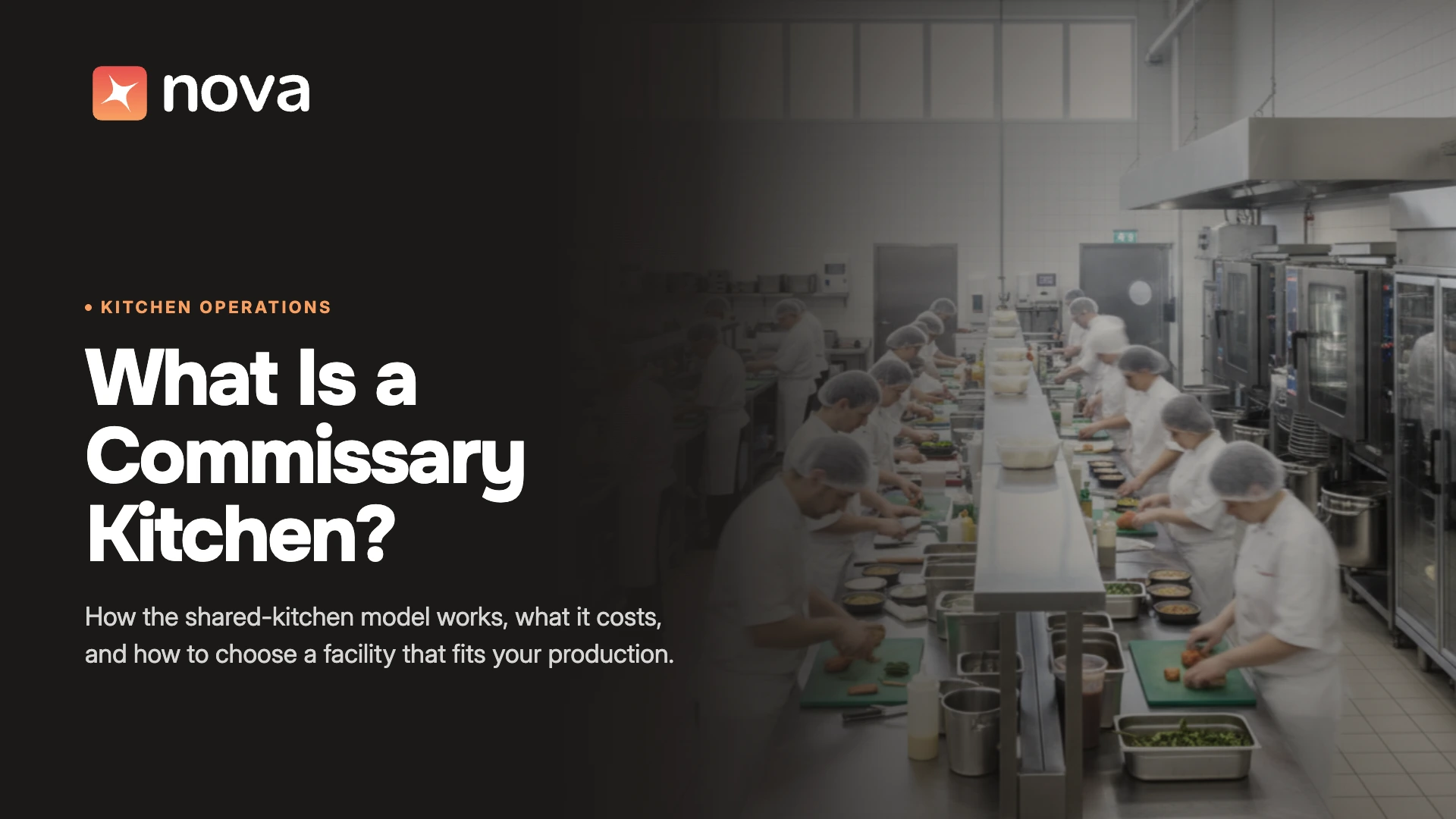
A commissary kitchen is a licensed, commercial-grade kitchen facility that food businesses rent by the hour, day, or month to prepare, cook, and store food products. Unlike a restaurant kitchen built and operated by a single business, a commissary is a professionally managed shared or dedicated space, fully equipped with commercial appliances and certified to meet local and state health department requirements.
The term has its roots in institutional food service, where large central kitchens produced food for schools, hospitals, and government facilities before distributing it to satellite locations. Today, the model serves a much wider range of operators, from food truck owners and caterers to ghost kitchen brands and multi-location chains centralizing production without the capital cost of building their own facility.
What a Commissary Kitchen Typically Includes
Equipment and infrastructure vary by facility, but most commercial-grade commissary kitchens provide:
- Industrial ranges, ovens, and fryers
- Commercial refrigeration, walk-in coolers, and freezers
- Stainless steel prep tables and work surfaces
- Dishwashing and sanitation stations
- Dry and cold storage allocated per operator
- Packaging and labeling areas for retail food producers
Touring the facility before signing any agreement matters more than relying on a provider's description, since equipment quality and available capacity can vary significantly between locations.
How the Rental Model Works
Commissary kitchens offer two main access structures:
- Hourly access: typically ranges from $15 to $40 per hour for shared kitchen time
- Monthly memberships: generally run from $200 to over $600 per month, depending on the market, hours included, and whether dedicated storage is part of the package
- Dedicated leases: single-business arrangements structured as longer-term commercial contracts, negotiated separately from shared pricing
Operators who use a commissary consistently through the week usually find that a monthly membership works out better financially than booking hourly.
Licensing and Legal Requirements
Commissary kitchens are licensed as food service establishments by local health authorities and inspected under the same food safety standards that govern commercial restaurants. This licensing is what legally distinguishes a commissary from any other prep space. Key compliance points include:
- Facilities must hold a valid food service establishment license issued by the local health department
- Regular health inspections apply, covering sanitation, equipment standards, and food handling protocols
- In many US states, food truck operators are legally required to provide proof of a commissary kitchen agreement as part of the truck licensing process
- Operating a food business from an unlicensed kitchen is illegal in most jurisdictions regardless of production volume
Market Context
Demand for commissary kitchen space has grown considerably over the past several years, driven by the rise of food delivery platforms, ghost kitchen concepts, and direct-to-consumer food brands. In major US markets including New York, Los Angeles, Chicago, and Austin, waitlists for well-equipped shared facilities are common. Operators entering the market for the first time should start their search early and have a clear picture of their weekly hour requirements before approaching providers.
Who Uses Commissary Kitchens
Different types of food businesses use commissary kitchens. These are some major ones -
- Multi-location restaurant chains
- Cloud kitchens and virtual brands
- Food trucks and pop-up restaurants
- Catering companies
- Bakeries and dessert brands
- Concession stands
Whether you want to scale, reduce costs, or improve efficiency, commissary kitchens are the right choice.
Types of Commissary Kitchens to Consider
There are primarily two types of commissary kitchens that restaurants can opt for based on their restaurant type, scale, and budget.
Shared Kitchen
This type of commissary kitchen is shared by multiple food businesses. As these kitchens are typically rented on an hourly, daily, or monthly basis, they are especially popular among startups and growing food brands. Businesses with budget constraints that want to minimize in-house capital expenses can opt for the shared model. However, shared kitchens offer less freedom and control as the amenities are shared.
Dedicated Kitchens
These are kitchens that rent or lease only to a single restaurant business. Restaurants get a dedicated space to operate with complete control over inventory and equipment. Dedicated kitchens are well-suited for restaurant chains that want a central location for food preparation and distribution. However, the cost of a dedicated kitchen is significantly higher than that of a shared one.
How Much Does It Cost to Rent a Commissary Kitchen?
The commissary and shared-kitchen market is growing fast, projected to reach $88.7 billion in 2026 and climb to $203.7 billion by 2033 at a 12.6% CAGR, with shared-kitchen space cited as the fastest-growing segment of that market. That growth is pushing more operators to compare commissary kitchen rent before committing to a lease, so pricing varies widely by model, market, and what's included.
What else factors into commissary kitchen rent
Beyond the base rate, budget for a deposit ($250-$1,000), general liability insurance ($200-$600/month), and separate charges for cold, frozen, dry, or locked storage. Trucks should also confirm what's included for parking, water/wastewater service, and delivery-platform address eligibility, since these are often billed separately from kitchen time.
How location changes the price
Metro markets (New York, San Francisco, Los Angeles) run 60-80% above the national average. A few real-world data points: Houston starts around $30/hour with a $250 deposit; Queens, NY runs $28-$48/hour with a 20-hour monthly minimum; Sacramento charges $20/hour for prep space, $35/hour for the hot line, or $3,500/month for an all-inclusive private kitchen. Dense markets tend to pair hourly rates with minimum-hour commitments rather than pure pay-as-you-go pricing.
Commissary Kitchen Equipment: What's Included
Commissary kitchens are marketed as "fully equipped," but the equipment mix varies by facility, so it's worth checking what's actually on-site before signing. Here's what a well-equipped commissary kitchen typically includes, organized by category:
What to check before signing
Specialized equipment (waffle irons, smokers, woks, combi ovens) isn't standard everywhere, so match the facility's equipment list to your menu before committing. For food safety and insurance purposes, look for NSF/ANSI-certified equipment, since it's built to be easily cleanable and typically what health inspectors expect to see during a walkthrough. Also confirm refrigeration and storage allocation in writing, especially in shared kitchens, where cold storage is split among multiple tenants and often the first thing operators run out of.
Benefits of Using a Commissary Kitchen
Let’s discuss some advantages a commissary kitchen offers to restaurants.
Reduces Expenses
A commissary kitchen reduces a restaurant’s:
Capital Costs
A commissary kitchen reduces a restaurant’s capital expenditure. Firstly, as a commissary kitchen provides kitchen infrastructure and equipment, you do not need to invest in in-house equipment. Consequently, you can optimize the kitchen space and save on real estate costs. Less equipment also means low maintenance costs.
Labor Costs
Labor costs consume a significant part of the restaurant’s profit, with the numbers going well above historical averages in 2025. In addition to capital expenses, the commissary kitchen saves labor costs significantly. With a commissary kitchen, you can centralize the preparation team to one location, thus minimizing the kitchen workforce in every outlet. It reduces hiring, onboarding, and training costs.
Food Costs
According to the National Restaurant Association, food costs have increased by 1.3% in the last year and 37% in the last five years. Hence, restaurants need to keep food costs in check.
Commissary kitchens reduce overall food costs by supporting centralized purchasing and preparation. Buying ingredients in bulk allows restaurants to negotiate better pricing with suppliers, reducing the per-unit cost. Moreover, when restaurants prepare food in one place, it reduces inventory wastage due to over-ordering and spoilage.
Ensures Food Consistency
If you run a restaurant chain, maintaining food consistency across locations is imperative. By opting for a commissary kitchen, you can centralize preparation and ensure consistent food quality by standardizing recipes and deploying proper quality controls. Moreover, it is your brand image as guests have the same experience across outlets.
Makes Scaling Operations Convenient
As your business grows, you need to scale your operations to meet the increasing demands. Consequently, you require additional equipment and kitchen space, which means more expenses and maintenance hassles. Moreover, there are peak periods, such as festivals and events, when your infrastructure cannot handle the increased footfall.
Commissary kitchens help you overcome both these challenges. Firstly, you can easily scale your business without having to invest in in-house equipment. Secondly, if you have a high influx of people during a specific period, a commissary can easily meet the demand.
Ensure Regulatory Compliance
Health violations can hamper a restaurant’s reputation and inflict heavy penalties. However, complying with regulations across locations can be challenging. Commissary kitchens ensure compliance with advanced infrastructure, hygiene procedures, and sanitary protocols. Outsourcing preparation to a commissary kitchen relieves the time and effort of compliance management and monitoring.
Boosts Kitchen Efficiency
A commissary kitchen provides a common preparation space for restaurants, optimizing kitchen workflows. It means that orders are executed faster and peak-hour bottlenecks are reduced, which increases table turns. Moreover, since operations are centralized, you get better visibility into the operations. You can easily measure KPIs and make data-powered decisions.
Signs Your Restaurant Needs a Commissary Kitchen?
Your restaurant may benefit from a commissary kitchen if:
- You are planning to open new outlets
- Your kitchen space is not able to meet current demands
- Your customers have experienced inconsistent food quality in different outlets
- There is high food waste and inventory inefficiencies
- There have been compliance issues in the past
How to Choose the Right Commissary Kitchen
Let’s discuss the steps and parameters for choosing the best commissary kitchen for your business.
Define Your Goals
You can select the right commissary kitchen only if you are clear about the restaurant’s objectives. You must identify the amount of storage you need, for how long you plan to use the service, and whether you are looking to reduce costs or scale. Defining your goals and objectives clearly also helps negotiate better with the provider.
Do Thorough Research
Before onboarding a commissary kitchen, it is essential to know everything about them. You must read online reviews and enquire with their current customers about the pros and cons. Moreover, you can also seek assistance from local food businesses near you.
Choose the Location Wisely
You must ensure that the commissary kitchen is close to your restaurant. If you run a restaurant chain, select a centralized location that is closer to each outlet. Proximity to the commissary kitchen ensures timely delivery and reduces transportation costs. It also mitigates the risk of food spoilage.
Check for Licensing and Compliance Standards
Shortlist a commissary kitchen that is fully licensed and compliant with state and local health department regulations. The provider must implement proper sanitation protocols, waste disposal methods, and have fire and building code approvals. A fully compliant commissary reduces the regulatory burden on individual outlets because critical prep processes already meet required standards.
Analyze the Equipment and Infrastructure
It is essential to check the commissary kitchen’s equipment and infrastructure before selecting it. You can ask the provider about the necessary details and even tour the facility to experience their functioning. Inspect the quality of kitchen equipment, including the oven, chiller, and mixer. You must also check whether the provider has optimized the layout for navigation and ventilation.
Ask for Storage Capabilities
A competent commissary kitchen must have an advanced storage system. As a commissary kitchen is a shared space, you must ask the provider how much storage space you will be allotted. Moreover, check whether the kitchen has separate storage zones for perishable and non-perishable items. The kitchen must also implement batch tracking and FIFO protocols to prevent wastage.
Check the Cost Structure
You must analyze the provider’s pricing and contract carefully before selecting a commissary kitchen. Check whether pricing includes all essential components, such as storage, maintenance fees, equipment usage, and service fees. Don’t prefer the cheapest option; rather, go for the provider that offers the highest ROI.
Optimize In-house Operations with NOVA
Combining the convenience of a commissary kitchen with the advanced features of an intelligent restaurant management system like NOVA makes your restaurant cost-efficient, scalable, and automated. While a commissary kitchen offers infrastructural benefits, NOVA enhances in-house guest experience, workforce management, and decision-making.
Choose NOVA and get:
AI-native Analytics
NOVA is an AI-native platform that analyzes customer preferences, shift patterns, and ordering history and provides automated prompts for order recommendations, shift management, cost control, inventory management, and more.
Workforce Management
With NOVA’s advanced scheduling tools, managers can track employee hours, manage shifts, and reduce payroll errors. Employees get real-time notifications of breaks and upcoming shifts.
Handhelds
NOVA’s handheld POS systems ensure a delightful tableside ordering experience. Guests can order, pay, and tip right at the table. Servers get automated combos and add-on suggestions based on the guest’s order history.
Personalized Loyalty Programs
NOVA’s loyalty programs are integrated with the POS, handheld devices, and delivery platforms, providing customers with real-time visibility into their rewards. The AI-powered loyalty programs give guests personalized discounts and deals on their preferred items.
Waitlist Management
NOVA reduces the pain of waiting for a table by offering guests regular updates on the wait time and items on their phones. Send custom text messages with great offers and pre-booking options to enhance the experience.
Voice AI
Enhance the guest’s ordering experience with NOVA’s Voice AI feature. Whether through in-store, drive-thru, or call, Voice AI facilitates quick and error-free orders. Gives customers a personalized experience with purpose-built LLMs.
Personal Webstore
NOVA enables you to create your own mobile-optimized restaurant webstore, aligned with your brand design and logo. Customize menus, integrate loyalty programs, and integrate multiple payment methods.
Marketing
NOVA’s in-built marketing feature enables you to launch campaigns in minutes. The AI-powered engine analyzes customer information to create targeted campaigns based on customer behavior, dietary preferences, and visit history.
Want to see NOVA in action? Get a free demo now.
.png)
Conclusion
A commissary kitchen can be a powerful lever for restaurant owners looking to reduce costs, scale efficiently, and maintain consistent food quality across locations. By centralizing prep, production, and compliance, operators gain tighter control over labor, inventory, and food safety while freeing up in-store teams to focus on execution and guest experience.
That said, success depends on choosing the right commissary partner. Location, capacity, compliance standards, pricing structure, and contract flexibility all matter. Take time to evaluate your operational needs, understand how the commissary integrates with your workflows, and review agreements carefully before committing.
When paired with the right technology to manage production, inventory, and performance, a commissary kitchen is not just a cost-saving solution; it becomes a strategic foundation for sustainable growth.
Frequently Asked Questions About Commissary Kitchens
What is the difference between a commissary kitchen and a commercial kitchen?
A commercial kitchen is a broad term for any professional, licensed kitchen used to prepare food for sale. A commissary kitchen is a specific type of commercial kitchen designed to be rented out to multiple food businesses, either by the hour or through a membership arrangement. The key distinction is ownership and access. A commercial kitchen is typically owned and operated exclusively by one business, while a commissary kitchen is a shared or rentable facility that serves several operators, often at the same time or in scheduled blocks.
Is a commissary kitchen the same as a ghost kitchen?
They are related but not the same thing. A ghost kitchen, also called a cloud kitchen or dark kitchen, is a food production facility that operates delivery-only restaurant brands with no dine-in service. A commissary kitchen is the physical infrastructure where that food gets prepared. Ghost kitchens often operate out of commissary kitchen spaces, but a commissary kitchen can also serve food trucks, caterers, bakeries, and any other food business that needs licensed production space. Think of the commissary kitchen as the facility and the ghost kitchen as the business model running inside it.
Do food trucks need a commissary kitchen?
In most US states, yes. Food truck operators are typically required by local health departments to operate out of a licensed commissary kitchen for food storage, prep, and cleaning. The commissary serves as the legal base of operations for the truck, and proof of a commissary agreement is often required as part of the food truck permitting process. Requirements vary by city and state, so operators should check with their local health department before assuming they can operate independently.
How much does it cost to rent a commissary kitchen?
Commissary kitchen pricing varies by market, facility quality, and access model. Hourly rates for shared commissary space typically range from $15 to $40 per hour. Operators who need regular access tend to opt for monthly memberships, which generally run from $200 to over $600 per month depending on the number of hours included and whether dedicated storage is part of the package. In high-demand urban markets like New York, Los Angeles, and Chicago, pricing trends toward the higher end of these ranges, and some facilities have waitlists for new members.
What equipment is typically included in a commissary kitchen?
Most commissary kitchens include commercial-grade ranges, ovens, refrigeration, prep stations, and a three-compartment sink or dish machine for sanitation. Specialized equipment like smokers or combi ovens varies by facility, so confirm what's on-site against your menu before signing a contract.
What licenses do you need to use a commissary kitchen?
The commissary kitchen facility itself holds the food service establishment license issued by the local health department, which covers the physical space and its equipment. As a renting operator, you will typically need your own food handler or food manager certification, a business license, and, depending on what you produce, a separate food business or cottage food permit. Some states also require operators renting commissary space to register the commissary address with the health department as their official food production location. Requirements vary by state and business type, so confirming with your local authority before starting production is the right first step.
Can I run a full food business from a commissary kitchen?
Yes, and many successful food businesses do exactly that. Catering companies, meal prep services, food truck operators, specialty food producers, and early-stage restaurant concepts all use commissary kitchens as their primary production facility. The model works particularly well for businesses that do not need a front-of-house dining space, that are still testing demand before committing to a permanent location, or that want to expand into a new market without the capital investment of a full buildout. The main limitations are scheduling constraints in shared facilities and the fact that you are working within someone else's space, which limits certain customizations.