
Fourteen to seventeen percent of new restaurants close within their first year, and roughly half don't make it past year five, according to Restaurant Velocity research on restaurant survival rates. Rising food costs, thin labor markets, and constant competition for the same guests make every empty table a real financial loss, not just an inconvenience.
The usual fix, hiring outside marketing help, has its own problem: a marketing agency retainer typically runs $1,000 to $12,000 or more per month, on top of hourly rates as high as $500, according to WebFX's 2026 marketing agency pricing research. For an independent restaurant or a small multi-location group already working on thin margins, that retainer can easily cost more than the extra covers it's supposed to fill.
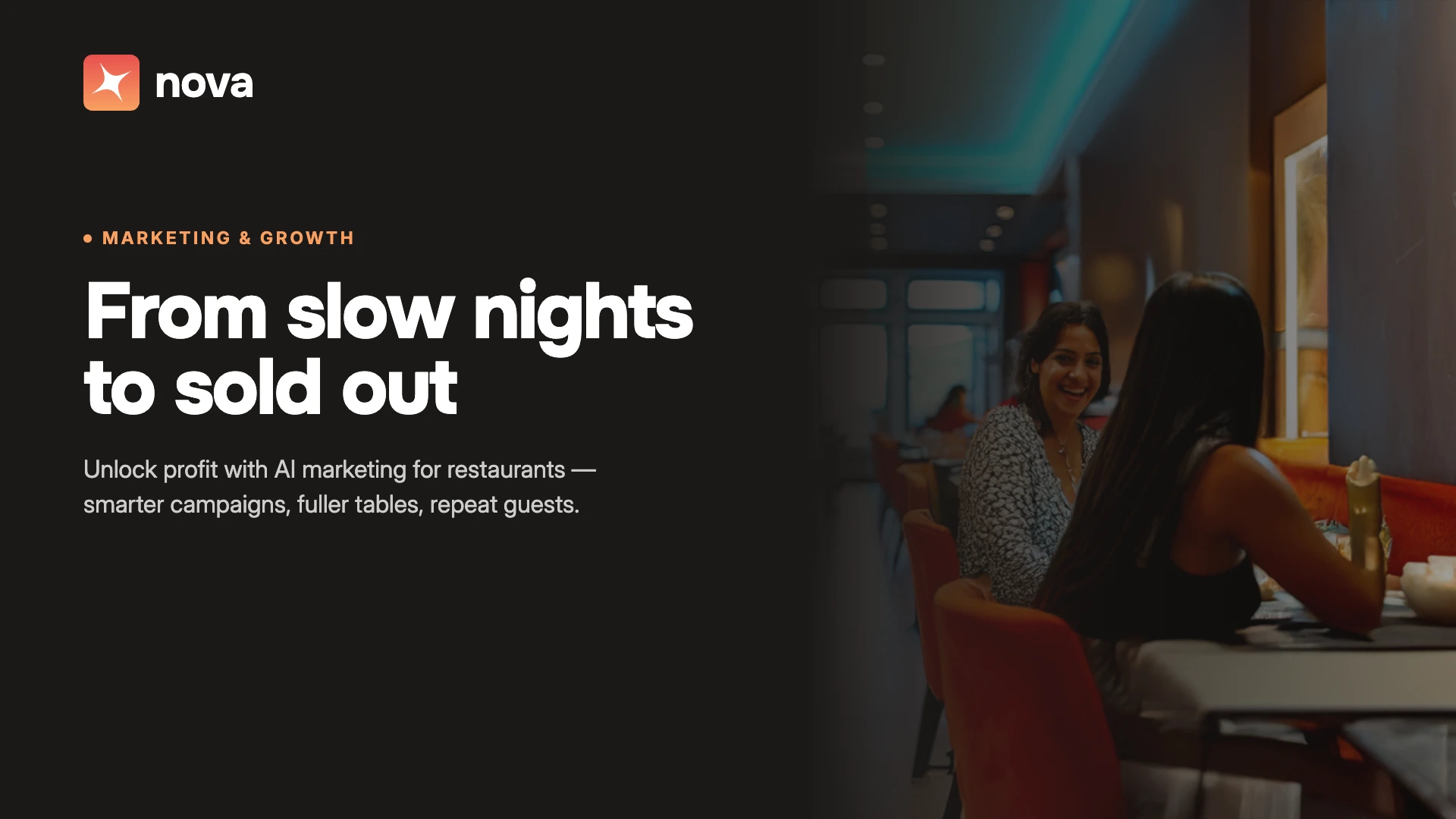
AI marketing for restaurants exists to solve both problems at once: it helps operators fill more seats, on more nights, without needing a bigger marketing team or a bigger marketing budget.
This guide breaks down what AI marketing for restaurants actually means, why it matters heading into 2026, the specific benefits and tools operators are using, the mistakes to avoid, and how a platform like NOVA turns AI marketing for restaurants from a buzzword into a repeatable system for turning slow nights into sold-out ones.
What Is AI Marketing for Restaurants
AI marketing for restaurants means using artificial intelligence and machine learning inside a restaurant's marketing process, rather than running every campaign manually. Instead of a marketing manager guessing which guests to email or when to post on Instagram, AI marketing for restaurants uses real guest data, purchase history, and behavioral patterns to make those decisions automatically.
In practice, AI marketing for restaurants covers three core functions:
- Automation: sending the right message to the right guest at the right time, without a person clicking "send" for every campaign.
- Recommendation: surfacing which offer, channel, or menu item is statistically most likely to bring a specific guest back.
- Real-time adaptation: adjusting campaigns mid-flight based on what is actually working, not what was working last quarter.
This is different from traditional restaurant marketing, which typically relies on broad, one-size-fits-all promotions (a Tuesday discount blasted to every subscriber) rather than offers shaped around what each guest actually orders and when they actually visit.
Why AI Marketing for Restaurants Matters in 2026
AI marketing for restaurants has moved from an experiment to a mainstream operating practice in a very short window. According to the National Restaurant Association's 2026 State of the Restaurant Industry report, 26% of restaurant operators say they are already using AI-related tools, and marketing is the single leading use case: 19% of full-service operators and 15% of limited-service operators specifically use AI for marketing assistance, ahead of AI in administrative work (about 10%) and AI for customer ordering (about 6%).
Separately, Toast's 2025 AI in Restaurants survey found that 28% of restaurants are already automating marketing with AI, more than any other reported use case, and Toast's 2026 Voice of the Restaurant Industry survey (April 2026, 676 U.S. operators) found that 87% of operators now feel comfortable using AI in their operations.
That shift matters because guest expectations have shifted alongside it. Klaviyo's 2025 Restaurant Marketing Report, based on a survey of more than 8,000 restaurant consumers, found that loyalty program members are 100% more likely than non-members to say they plan to increase restaurant spending, and that high-spending guests are 29% more likely to respond to personalized dining recommendations than the general population. Guests increasingly expect the kind of personalization AI marketing for restaurants delivers by default, and restaurants that still rely on blanket promotions are competing at a structural disadvantage against operators using AI marketing for restaurants to target the right guest with the right offer.
Benefits of AI Marketing for Restaurants
Let’s check out how AI-powered restaurant marketing overcomes them.
Personalization at Scale
The clearest benefit of AI marketing for restaurants is personalization that would be impossible to do manually. AI analyzes each guest's order history, visit frequency, and spending habits to build offers that feel individually written, a birthday discount on a guest's actual favorite entree, or a win-back email timed to when a specific guest historically goes quiet. Klaviyo's 2025 data shows guests loyal to five or more restaurant brands are nearly 3x more likely to increase spending than guests with no loyalty ties, which is the outcome AI-driven personalization is built to produce.
Smarter, Data-Backed Campaigns
AI marketing for restaurants doesn't guess at timing or channel. It tests when a given audience segment actually opens email, engages with SMS, or responds to social content, then shifts spend and scheduling toward what is measurably working, rather than what "usually" works across the industry.
Sentiment and Reputation Management
AI tools continuously scan reviews, comments, and ratings across social platforms and review sites, flagging negative sentiment before it snowballs and surfacing praise that can be repurposed as social proof. This turns reputation management from a once-a-week manual check into a standing, real-time function of AI marketing for restaurants.
Meaningful Cost Savings
Hiring a marketing agency typically costs between $50 and $500 per hour, or $1,000 to $12,000-plus per month in retainer fees, according to WebFX's 2026 marketing agency pricing research, with enterprise-level engagements running well above that. AI marketing for restaurants replaces much of that spend with a single platform subscription that handles campaign creation, targeting, and reporting, which is a significant advantage for independent restaurants and small multi-location groups operating on tight margins.
Reduced Manual Workload
Self-learning campaigns adjust themselves as results come in, which means restaurant marketers spend less time manually A/B testing subject lines or rebuilding segments, and more time on strategy, brand, and the creative decisions AI still can't make well on its own.
Types of AI Marketing Tools Restaurants Use Today
Not all AI marketing for restaurants looks the same. Most platforms fall into a few practical categories, and understanding the difference matters when evaluating tools:
Most restaurants adopting AI marketing for restaurants don't need all five categories on day one. The highest-leverage starting point is almost always a CRM and guest data platform, since email, SMS, loyalty, and predictive tools all perform better once they're working from a single, accurate guest profile instead of fragmented data across a POS, a reservation system, and a spreadsheet.
How to Implement AI Marketing for Restaurants: A Step-by-Step Framework
- Audit your existing guest data. Before adopting AI marketing for restaurants, confirm your POS, loyalty program, and reservation system data can actually be connected. Fragmented data is the single most common reason AI marketing for restaurants underperforms.
- Start with one channel. Pick email or SMS win-back campaigns first. They're the easiest to measure and typically show results within weeks.
- Set a small number of clear KPIs. Track return visit rate, average order value from targeted campaigns, and cost per incremental visit, not vanity metrics like open rate alone.
- Layer in personalization gradually. Move from broad segments ("guests who haven't visited in 30 days") to individual-level offers only once the broad segment is working.
- Keep a human review layer. Have a real person review AI-generated copy and offers before they go out, especially early on, to protect brand voice and catch errors.
- Review performance monthly and expand. Once one channel is working, add the next highest-leverage tool from the table above, rather than adopting everything simultaneously.
Common Mistakes to Avoid With AI Marketing for Restaurants
Restaurants that get poor results from AI marketing for restaurants tend to make one of the same handful of mistakes, several of which Modern Restaurant Management's analysis of AI adoption in the industry calls out directly:
- Automating everything at once. Trying to launch AI-driven email, SMS, social, and review management simultaneously makes it impossible to tell what's actually working, and increases the odds something breaks unnoticed.
- Over-personalizing to the point of feeling invasive. A message like "we know you order the lasagna every Friday" can read as helpful or as creepy, depending on tone and context. AI marketing for restaurants should feel attentive, not surveilled.
- Letting AI write without a human check. AI can misclassify guest data or reference a dish or promotion that doesn't exist. Unreviewed errors in guest-facing messages damage trust faster than no message at all.
- Treating AI as a pure cost-cutting tool. Restaurants that adopt AI marketing for restaurants purely to eliminate an agency retainer, without a clear strategy behind it, tend to see weaker results than restaurants that treat it as a strategic capability.
- Losing brand voice. Generic, AI-generated copy that could belong to any restaurant undermines the personality that made guests loyal in the first place. AI marketing for restaurants works best when it's trained on and constrained by a restaurant's actual voice and menu.
- Tracking vanity metrics. Open rates and impressions look good in a report but don't tell you whether a campaign drove an actual visit. Tie every AI marketing for restaurants campaign back to return visits or revenue.
From Marketing to Margin: The NOVA Advantage in Action
The NOVA restaurant management platform provides a comprehensive one-stop marketing solution for your restaurant. It includes everything from POS, kitchen display systems, handhelds, loyalty programs, workforce management, gift cards, and an built-in CRM, ensuring seamless data interaction for deep data insights. It enables the AI-native marketing engine to create and launch effective campaigns automatically by analyzing relevant data, such as order history, guest preferences, visit frequency, and more.
Searching for a marketing tool to promote your products? No need. NOVA’s AI-native marketing helps you launch lucrative campaigns within minutes. NOVA is transforming restaurant marketing by:
Enabling Personalized Campaigns
NOVA tracks each guest's order history and visit frequency automatically through the POS, then uses that data to build personalized campaigns without requiring a marketer to manually segment lists.
Supporting a True Multi-Channel Approach
NOVA runs AI marketing for restaurants across email, SMS, and social with channel-specific templates, so a single campaign concept can reach guests wherever they actually respond, instead of being limited to one channel.
Deploying Campaigns in Minutes, Not Days
NOVA's platform surfaces marketing opportunities, such as a dip in weekday traffic, and generates a launch-ready campaign template within minutes, cutting the lag between spotting an opportunity and acting on it.
Ensuring a Targeted, Not Blanket, Approach
NOVA can automatically identify regular guests who haven't visited recently and trigger a win-back offer without manual list-building, which is one of the highest-ROI use cases in AI marketing for restaurants.
Personalized Loyalty Programs
NOVA's built-in CRM tracks points, rewards repeat visits, and issues tailored discounts based on individual guest behavior, reinforcing the loyalty effects documented in Klaviyo's 2025 research.
Advanced Analytics and Reporting
NOVA reports on which channels and campaigns are actually performing, so operators can shift budget toward what is working instead of guessing, closing the loop on AI marketing for restaurants from execution back to strategy.

What Results Actually Look Like
These figures point to the same conclusion from different directions: AI marketing for restaurants is no longer a differentiator reserved for large chains, guest expectations for personalization are rising, and the cost of not adopting AI marketing for restaurants is increasingly measured in lost loyalty spend, not just lost efficiency.
The Future of AI Marketing for Restaurants: What to Watch
AI marketing for restaurants is still early in its adoption curve, which means the gap between operators who use it well and operators who ignore it is likely to widen, not narrow, over the next few years. Three shifts are worth watching heading into 2026 and beyond.
First, predictive demand forecasting is moving from a nice-to-have into a marketing input, not just an operations one. Restaurants are starting to use the same demand signals that drive staffing and inventory decisions to decide which nights need a promotional push and which don't, so AI marketing for restaurants increasingly reacts to what's about to happen, not just what already happened.
Second, guest-facing AI is expanding beyond email and SMS into channels like automated review responses and conversational ordering assistants, which means the definition of AI marketing for restaurants is broadening to cover more of the guest journey, not just the outbound campaign.
Third, the operators pulling ahead are the ones treating AI marketing for restaurants as a data problem first and a tools problem second. Adopting a new platform without unifying guest data behind it consistently produces weaker results than starting with clean, connected data and a simpler tool.
None of this requires waiting. The operators already ahead started with the same fragmented POS-and-spreadsheet setup most independent restaurants have today; the difference was starting the consolidation now rather than later.
Frequently Asked Questions
Is AI marketing for restaurants only for large chains or franchises?
No. Because AI marketing for restaurants replaces agency spend rather than adding to it, it's typically most cost-effective for independent restaurants and small multi-location groups that can't justify a full in-house marketing team.
Will AI marketing for restaurants replace my marketing team?
It replaces manual, repetitive tasks like list segmentation and campaign scheduling, not strategy or brand judgment. Most restaurants that succeed with AI marketing for restaurants still keep a human reviewing outputs before they go to guests.
How quickly do restaurants see results from AI marketing for restaurants?
Win-back email and SMS campaigns, the typical starting point, often show measurable results (more returning guests, higher average order value) within a few weeks, since they act on data the restaurant already has.
What's the biggest risk with AI marketing for restaurants?
Over-automation without a human review layer. Restaurants that let AI marketing for restaurants run fully unsupervised are the ones most likely to see brand-voice or accuracy issues reach guests.
Do I need new software to start with AI marketing for restaurants, or can I use my existing POS data?
It depends on whether your current systems can connect. An all-in-one platform like NOVA, where POS, loyalty, and CRM data already live together, removes the integration step that otherwise slows down AI marketing for restaurants adoption.
Which channel should a restaurant start with when adopting AI marketing for restaurants?
Email and SMS win-back campaigns are the most common starting point for AI marketing for restaurants, since they act on data most restaurants already have (visit history) and typically show measurable results within a few weeks, before expanding into social content or review management.
Ensure Perennial Growth With AI Marketing for Restaurants
The restaurants winning slow nights back aren't the ones spending more on marketing; they're the ones spending it more precisely. AI marketing for restaurants turns scattered guest data into a system that fills seats automatically, without requiring a bigger team or a bigger budget. NOVA brings the POS, loyalty, CRM, and analytics pieces together so that transition doesn't require stitching together five separate tools. If you're ready to see what AI marketing for restaurants looks like on your own guest data, book a demo with NOVA.