
Restaurant owners used to grow their business almost entirely through word of mouth. A satisfied guest told a neighbor, a neighbor told a coworker, and tables filled up over time. That conversation has not disappeared, but it has moved online, and it now happens before a guest ever calls the restaurant or walks through the door.
Modern diners search Google, browse Instagram and TikTok, scan photos, and read reviews before they pick where to eat. According to BrightLocal's 2025 Local Consumer Review Survey, only 4 percent of consumers say they never read online reviews before choosing a local business, and 74 percent check two or more review sources before deciding. Toast's 2026 restaurant industry research adds that half of diners say social media played a role in discovering a restaurant, rising to 73 percent among Gen Z and millennials who say a social post led them to visit within the past three months.
This is the reality restaurant digital marketing exists to address. Great food and service are still the foundation of a restaurant business, but digital visibility and discovery now decide who gets a chance to serve that food in the first place. Restaurant digital marketing is the set of online channels, content, and data-driven tactics that helps an operator attract new guests, convert online attention into booked tables and orders, and turn first-time visitors into regulars who come back on their own.
This guide breaks down what restaurant digital marketing actually involves, why it matters more in 2026 than it did even two or three years ago, the strategies that consistently work, the mistakes that quietly waste marketing budgets, and how AI-native platforms are changing what a lean restaurant marketing operation can accomplish.
What Is Restaurant Digital Marketing?
Restaurant digital marketing is the practice of using online channels, platforms, and data to promote a restaurant, attract guests, and grow revenue. Unlike traditional advertising through flyers, direct mail, or billboards, restaurant digital marketing meets guests where they already spend their time: on search engines, social apps, review sites, and their phones.
The core channels that make up restaurant digital marketing include:
- Local SEO and Google Search, including Google Business Profile optimization
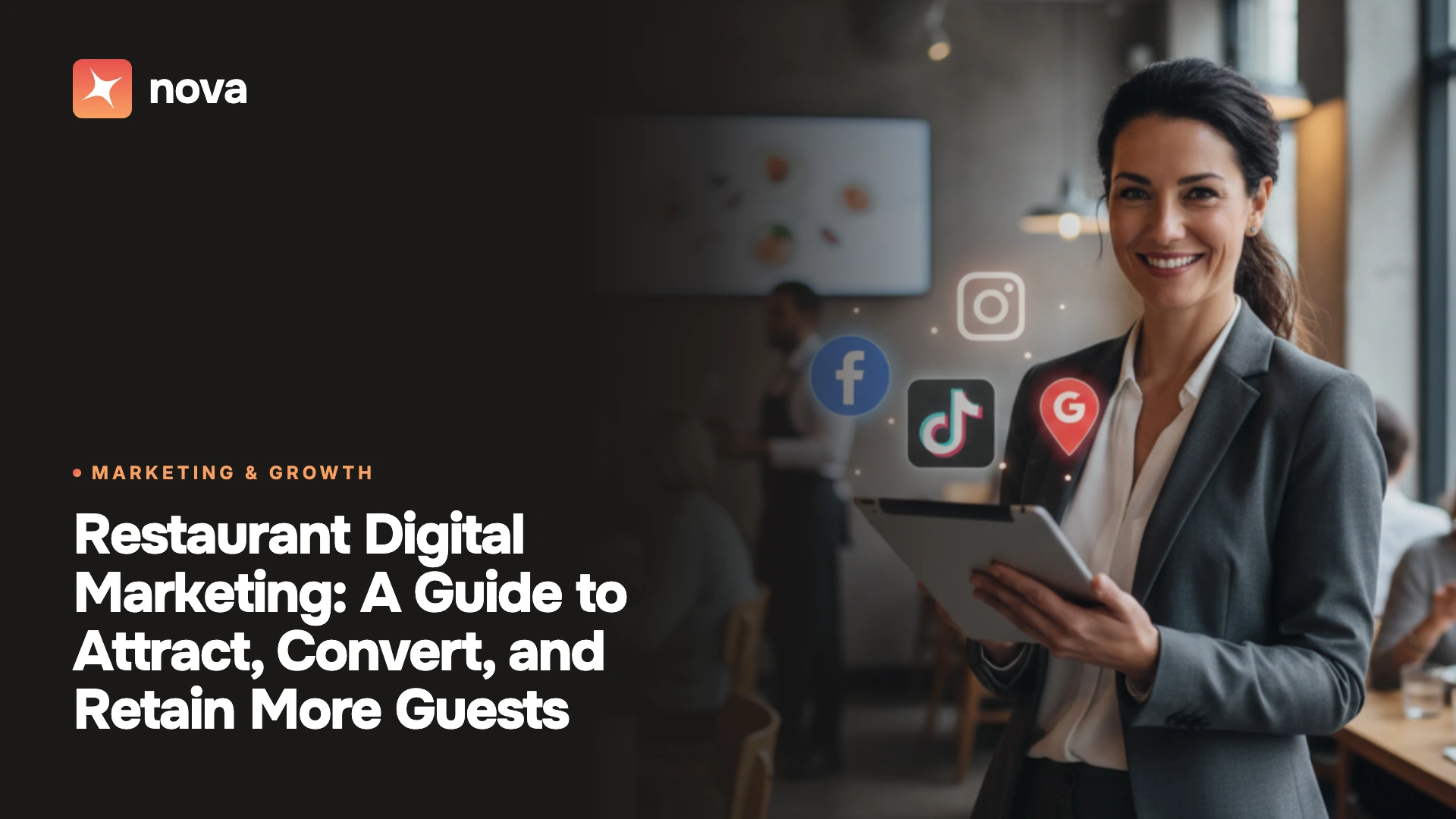
- Social media marketing across Instagram, TikTok, and Facebook
- Online reputation management and review generation
- Email and SMS marketing to a restaurant's own guest list
- Paid digital advertising (search, social, and display)
- Loyalty and guest engagement programs
- Website and online ordering experience
Visibility alone is not the goal. The point of restaurant digital marketing is to convert online attention into an actual reservation, order, or walk-in visit, and then to keep that guest coming back.
Why Restaurant Digital Marketing Matters More Than Ever in 2026
The restaurant industry entered 2026 more competitive and more cost-pressured than at almost any point in the past decade. According to the National Restaurant Association's 2026 State of the Restaurant Industry report, published in February 2026, industry sales are projected to reach $1.55 trillion, yet 42 percent of operators say their restaurant was not profitable in the prior year, and rising food, labor, insurance, and payment processing costs were cited by more than 90 percent of operators as top pressures. In an environment like this, every guest a restaurant can attract, convert, and retain through owned digital channels matters far more than it did when margins were looser.
Consumer research backs this up with specifics:
- 85 percent of consumers say they are more likely to use a business after reading positive reviews, according to BrightLocal's 2026 Local Consumer Review Survey data cited by Toast, while 77 percent say negative reviews actively deter them.
- 74 percent of consumers look specifically for reviews written in the last three months, and 32 percent want reviews from within the past two weeks, meaning stale review profiles quietly cost restaurants bookings.
- Toast and Resy's 2026 Regulars Report found that just 7 percent of guests can drive up to 50 percent of a restaurant's total order volume, which is why retention-focused restaurant digital marketing has become as important as new-guest acquisition.
- 81 percent of restaurant operators say they are increasing their digital marketing investment in 2026, per Popmenu's early-2026 survey of 328 U.S. restaurant leaders, a clear signal that digital channels are no longer optional line items.
A typical guest journey now looks like this: someone searches "restaurants near me" or a cuisine plus neighborhood, compares star ratings and review recency, scans a few food photos, checks the menu and price point, glances at recent social posts, and only then decides where to go. Restaurants that show up consistently and credibly at every one of those steps capture guests that competitors with a thinner digital presence lose by default. This is precisely the discovery-to-decision path that restaurant digital marketing is built to influence.
Restaurant Digital Marketing Statistics Every Operator Should Know in 2026
These figures matter because they describe where the return on restaurant digital marketing effort is concentrated right now: reputation and review freshness, social discovery among younger diners, and retention of a small core of regular guests who disproportionately drive revenue.
The Core Goals of Restaurant Digital Marketing
Every effective restaurant digital marketing program is built around three objectives, in this order.
Attract New Guests
Visibility across Google, social platforms, and food discovery apps helps a restaurant reach first-time guests through local search results, map listings, social discovery, and targeted advertising. This is the top-of-funnel work of restaurant digital marketing, and it is where most operators start, though it should never be the only place they invest.
Convert Online Interest Into Visits and Orders
Getting found is only half the job. Once a prospective guest discovers a restaurant online, converting that interest into an actual visit or order depends on strong reviews, appealing and current food photography, an accurate and easy-to-read menu, a fast and frictionless ordering or reservation flow, and a compelling reason to choose now rather than later. This conversion stage is where many restaurant digital marketing programs quietly lose guests, and restaurants that tighten this middle stage of the funnel see meaningfully higher conversion from the same amount of top-of-funnel traffic.
Drive Repeat Visits and Guest Loyalty
Repeat guests are the most valuable segment in the entire restaurant digital marketing funnel. Toast and Resy's 2026 Regulars Report found that a small core of regulars, roughly 7 percent of guests, can generate up to half of total order volume, and that loyalty program members return at rates up to four times higher than the baseline. Retention-focused restaurant digital marketing, including loyalty programs, email, and SMS, consistently delivers a stronger return on investment than acquisition spend alone because it is far cheaper to keep an existing guest engaged than to win a new one from scratch.
10 Restaurant Digital Marketing Strategies That Work in 2026
No restaurant needs to run every tactic below at once. These are the foundational strategies that consistently move the needle for restaurant digital marketing programs of any size.
1. Optimize Your Google Business Profile
Google is frequently the first place a potential guest encounters a restaurant, whether through Maps, local search results, or a "restaurants near me" query. A complete, accurate, and actively managed Google Business Profile, with an updated menu, current hours, high-quality photos, and prompt responses to reviews, directly affects local search rankings and Maps visibility. Restaurants that treat their Google Business Profile as a living asset rather than a one-time setup task tend to outrank those that set it up once and forget it.
2. Invest in Local SEO Beyond Google
Local SEO extends past a single listing. Consistent name, address, and phone (NAP) information across directories, location-specific landing pages for multi-unit brands, schema markup that helps search engines and AI answer engines understand menu and hours data, and locally relevant content all reinforce the same signal Google and other discovery engines reward: this restaurant is real, current, and relevant to this neighborhood.
3. Build a Strategic Social Media and Short-Form Video Presence
Social platforms have become genuine restaurant discovery engines, not just brand-awareness channels. Instagram, TikTok, and Facebook let a restaurant show off food, atmosphere, and personality in a format food is naturally suited to. Toast's 2026 data shows 44 percent of Gen Z and millennial diners use social media as their primary restaurant discovery tool, and short-form video of signature dishes, behind-the-scenes kitchen moments, and staff personality consistently outperforms static posts for reach. Consistency matters more than production value.
4. Turn Online Reviews Into a Growth Channel
Reviews are no longer passive feedback; they are active restaurant digital marketing content that search engines, AI answer engines, and prospective guests all read. With 85 percent of consumers more likely to choose a business after positive reviews and 74 percent specifically looking for recent ones, a structured system for requesting reviews after a great visit, responding to every review (positive and negative) within a day or two, and resolving service issues publicly and professionally is no longer optional hygiene; it is a growth lever.
5. Optimize Your Website and Online Ordering Experience
A restaurant's website and online ordering flow are where discovery either converts or dies. Slow load times, outdated menus, missing prices, and clunky checkout flows quietly cost bookings that social media and SEO worked hard to earn. Toast's research found that 78 percent of customers who use online ordering say it saves them meaningful time, and roughly three-quarters of consumers now prefer contactless or digital payment options, so a modern, mobile-first ordering experience is functionally part of a restaurant's marketing, not just its operations.
6. Run Targeted Local Digital Advertising
Paid search, social, and display advertising let a restaurant reach nearby guests with precision based on location, dining behavior, timing, and interests. Common, high-performing campaigns include grand openings, happy hour promotions, slow-shift offers, seasonal menu launches, and event marketing. Because digital advertising is measurable, operators can track cost per acquisition and return on ad spend in a way that print or radio advertising never allowed.
7. Build a First-Party Guest Database
A restaurant's own guest database, built from loyalty sign-ups, WiFi capture, online ordering accounts, reservation platforms, and POS transactions, is one of its most valuable long-term assets. Restaurants that rely too heavily on third-party delivery and reservation marketplaces hand control of the guest relationship to platforms that also work with every competitor down the street. A first-party database is what makes personalized, cost-effective restaurant digital marketing possible at all.
8. Use Email and SMS Marketing to Re-Engage Guests
Email and SMS remain some of the highest-return channels in restaurant digital marketing precisely because they reach people who have already chosen to hear from a restaurant. Toast and Resy's Regulars Report found that 86 percent of email-driven orders and 83 percent of SMS-driven orders come from guests who have dined at that restaurant before, underscoring how powerful these channels are for retention rather than cold acquisition. Seasonal menu announcements, birthday and anniversary offers, and limited-time promotions all perform well here.
9. Launch a Loyalty Program Guests Actually Use
Loyalty programs convert occasional diners into regulars. Toast and Resy's 2026 data found that loyalty members return at up to four times the baseline rate and retain at roughly twice the rate of new customers, and that regulars in general spend 34 percent more per check and are 80 percent more likely to try new menu items. Points-based rewards, visit-based tiers, and exclusive member perks all work, but the programs that succeed are the ones that are simple enough for a guest to understand in one visit.
10. Use AI to Personalize and Automate Campaigns
AI has moved from a future trend to a current baseline in restaurant digital marketing. The National Restaurant Association reports that 19 percent of full-service and 15 percent of limited-service operators are already using AI for marketing tasks, while a separate Popmenu survey of restaurant leaders found 55 percent using AI to help create marketing content and 87 percent using technology to automatically customize guest messaging based on order history and preferences. AI-driven segmentation, win-back campaigns for lapsed guests, and send-time optimization let small marketing teams operate at a scale that used to require a much larger staff.
Track Restaurant Digital Marketing Performance With Data
None of the strategies above matter without measurement. A surprising number of restaurant digital marketing efforts fail simply because no one is tracking whether they work. The metrics that matter most for any restaurant digital marketing program are customer acquisition cost, marketing return on investment, repeat visit rate, customer lifetime value, average check size, and promotion redemption rate. Reviewing these numbers monthly, not just at the end of a slow quarter, is what separates restaurants that improve their restaurant digital marketing results over time from those that keep repeating what feels familiar.
Common Restaurant Digital Marketing Mistakes to Avoid
Even well-intentioned restaurant digital marketing efforts commonly go wrong in a handful of predictable ways.
Treating restaurant digital marketing as a series of one-off promotions instead of a system. A single Instagram post or a one-time discount code rarely moves the needle. Restaurants that see consistent growth treat restaurant digital marketing as an always-on system: content, reviews, email, and loyalty all running continuously, not sporadically.
Letting the Google Business Profile go stale. Outdated hours, an old menu, or unanswered reviews actively push potential guests toward a competitor with a more current listing, even when the food and service are better.
Ignoring negative reviews instead of resolving them publicly. Silence reads as indifference. A calm, specific, public response to a negative review often does more for trust with future guests than the review itself does damage.
Spending on acquisition while ignoring retention. Chasing new guests through paid ads while a restaurant's existing guest list sits untouched in a POS system is one of the most common and most expensive restaurant digital marketing mistakes, especially given how concentrated revenue is among regulars.
Running marketing across disconnected tools. Separate systems for POS, loyalty, email, and reviews mean no one has a complete picture of the guest, and campaigns end up duplicated, contradictory, or simply never sent.
Not tracking return on investment. Without cost-per-acquisition and repeat-visit data, it is impossible to know whether a campaign actually paid for itself or just felt productive.
How Much Should Restaurants Budget for Digital Marketing?
There is no single right number, but a useful starting benchmark is to treat overall marketing, and restaurant digital marketing specifically, as a percentage of gross revenue rather than a fixed dollar amount, so spend scales with the business rather than becoming a fixed cost during a slow month. Independent restaurants commonly allocate somewhere in the low single digits of revenue to marketing overall, with a growing share of that shifting from print and traditional advertising toward digital channels each year, consistent with the 81 percent of operators reported to be increasing digital marketing investment in 2026. Within that budget, the highest-leverage allocation for most independent and small multi-unit restaurants is typically weighted toward owned channels, a restaurant's own website, email list, SMS list, and loyalty program, before paid acquisition, because owned channels keep working long after a single ad campaign ends. Multi-location and franchise operators should also budget for location-specific Google Business Profile management and local SEO, since a single corporate listing cannot represent every neighborhood a brand serves.
The Biggest Challenges Restaurant Owners Face
Despite the clear upside, many restaurant owners struggle to execute on restaurant digital marketing consistently. The most common obstacles are fragmented systems that do not talk to each other, not enough time to plan and run campaigns on top of daily operations, difficulty proving what is actually working, incomplete guest data, and restaurant digital marketing activity spread thin across too many disconnected platforms. A restaurant might run separate systems for POS, loyalty, email, and analytics, none of which share data automatically, which turns marketing into manual, error-prone work rather than a repeatable system.
Why Restaurants Need an Integrated Restaurant Digital Marketing Platform
An integrated restaurant management platform solves this fragmentation by centralizing guest data, campaigns, loyalty, and analytics in one place. Instead of juggling separate logins and exporting spreadsheets between systems, a unified platform gives an operator a single, current view of every guest and every campaign's performance. That consolidated view is what makes personalized, data-driven restaurant digital marketing realistic for a team without a dedicated marketing department, and it is quickly becoming the baseline expectation for any serious restaurant digital marketing operation.
The Future of Restaurant Digital Marketing Is AI-Native
AI-native automation is the clearest emerging shift in restaurant digital marketing. Rather than a marketing team manually building every campaign, AI can analyze guest transaction and visit data to surface patterns on its own: which guests have gone quiet, which ones are high-value regulars, which dishes a given guest orders most, and when a slow shift is coming up that needs a targeted push. The National Restaurant Association and independent operator surveys both point in the same direction for 2026: AI use in restaurant marketing is still early, concentrated in the high-teens percentage of operators, but adoption is accelerating quickly as more platforms build it in natively rather than as an add-on. Restaurants that adopt AI-native restaurant digital marketing now are effectively automating work that used to require a dedicated analyst or agency retainer.
Restaurant Digital Marketing Checklist
Use this as a working checklist for any restaurant digital marketing program, whether it is being built from scratch or audited against an existing restaurant digital marketing plan.
- Google Business Profile is complete, accurate, and updated monthly
- Menu, hours, and photos are current across Google, the website, and delivery apps
- A system exists for requesting reviews after positive visits
- Every review, positive or negative, gets a timely response
- Website and online ordering load quickly and work well on mobile
- Social content posts consistently, with a mix of short-form video and static posts
- A first-party guest database is being built through loyalty, WiFi, or online ordering
- Email and SMS campaigns run on a regular cadence, not just occasionally
- A loyalty program is live and simple enough to explain in one sentence
- Marketing performance (CAC, ROI, repeat visit rate, LTV) is reviewed monthly
- Marketing spend is tied to a percentage of revenue, not an arbitrary flat budget
How NOVA Helps Restaurants Win With AI-Native Digital Marketing
Effective restaurant digital marketing requires more than a collection of tools; it requires intelligence and automation working from the same guest data. NOVA is an AI-native restaurant platform with digital marketing built directly into its core rather than bolted on as a separate add-on. Because NOVA combines POS, guest data, and marketing operations in one system, restaurants can unlock marketing capabilities that disconnected tools cannot easily replicate.
Unified Customer Data
Every transaction, visit, and touchpoint automatically builds a complete guest profile. Operators gain visibility into visit frequency, favorite menu items, spending patterns, and loyalty participation, all in one place, which is the foundation every other restaurant digital marketing capability below depends on.
AI-Native Campaign Automation
Instead of manually building every promotion, NOVA automates campaigns based on real guest behavior: win-back offers for guests who have gone quiet, targeted incentives for high-value regulars, menu-preference-based offers, and occasion-based campaigns like birthdays and anniversaries, all running with minimal manual setup.
Smart Loyalty Programs
NOVA makes it straightforward to launch and manage a loyalty program that drives repeat visits, including points-based structures, visit-based rewards, and exclusive perks. Because loyalty data lives directly alongside POS data, tracking redemption and measuring impact does not require reconciling two separate systems.
Data-Driven Marketing Insights
NOVA surfaces real-time restaurant digital marketing analytics so operators can see what is actually working: promotion performance, repeat customer rate, customer lifetime value, and campaign profitability, all without exporting data to a spreadsheet first.
Frequently Asked Questions
What is restaurant digital marketing?
Restaurant digital marketing is the use of online channels, including local SEO, social media, email, SMS, paid advertising, and loyalty programs, to attract new guests, convert online interest into visits and orders, and build repeat business.
What is the most important restaurant digital marketing strategy for a new restaurant?
For most new restaurants, an accurate and actively managed Google Business Profile combined with a consistent review-generation process delivers the fastest return, since it directly affects whether the restaurant even appears in local search and Maps results.
How much should a restaurant spend on digital marketing?
Most independent restaurants allocate a percentage of gross revenue to marketing overall rather than a fixed amount, and shift a growing share of that budget toward digital channels each year. Within that budget, owned channels like email, SMS, and loyalty typically deliver stronger long-term returns than paid acquisition alone.
How is AI changing restaurant digital marketing?
AI is moving restaurant digital marketing from manually built campaigns to automated, behavior-triggered marketing, such as win-back offers for lapsed guests and personalized promotions based on order history. Adoption is still in its early stages industry-wide but is accelerating quickly heading into 2026 and beyond.
Do online reviews really affect restaurant sales?
Yes. Recent survey data shows a large majority of consumers are more likely to choose a restaurant after reading positive reviews and are actively deterred by negative ones, and a meaningful share of consumers specifically look for reviews written within the past few months, which makes ongoing review management an active restaurant digital marketing responsibility rather than a one-time setup task.
Final Thoughts
Restaurant success today depends on more than food quality and service, though both remain the foundation everything else is built on. Guests now discover, evaluate, and choose restaurants through digital marketing channels first, which means restaurant digital marketing is no longer a side project; it is core to how a restaurant grows. The operators who treat restaurant digital marketing as an ongoing system, built on strong reviews, active social presence, a first-party guest database, and increasingly AI-native automation, are the ones consistently outperforming competitors who still treat marketing as an occasional afterthought. Platforms like NOVA exist to make that system achievable without needing a dedicated marketing department to run it.