Your POS logs a $360 catering order as one ticket. That order fed 20 to 50 people at an office lunch, most of them strangers to your food, and nobody on your team will know what to do next.
Those guests make restaurant catering the cheapest way to win new customers, because the client pays for the tasting. Run catering like a marketing channel and measure it like one. The numbers that matter are how many guests come back on their own and what each one costs to win.
How much is a catering order worth to a restaurant?
Catering checks average about $360, roughly nine to ten times a typical takeout order, according to ChowNow’s catering playbook. Larger brands see more. Across 8,000 locations, Monkey’s transaction data put the average catering order near $416 in 2025, and on ezCater the average workplace order is $430 for a headcount of 26.
That headcount is where the growth sits. Getting 26 strangers to taste your food any other way means giving away 26 lunches. With catering, the office pays you $430 to serve them.
Plenty of them come back. In ezCater’s 2026 workplace research, which surveyed more than 2,300 orderers, operators, and employees, 62% of employees who first tried a restaurant at work later ordered from it in their personal lives, and 67% recommended it to friends and family. The same study found that 96% of workplaces tried a new restaurant in 2025, so offices are willing to try you.
Apply those rates to one average office lunch. If they held, about 16 of the 26 guests would later order from you on their own, and around 17 would recommend you to someone else.
Why is workplace catering growing in 2026?
Offices are filling back up, and employers are buying lunch. Only 26% of work locations with remote-capable jobs were fully remote in early 2026, down from 70% in May 2020, according to Gallup data cited by Food On Demand. ezCater reports that 38% of employees now get employer-provided meals daily or weekly, a 26% jump in a year, and 81% of workplace meals are free to employees. Lunch is the main occasion: 90% of orderers book it.
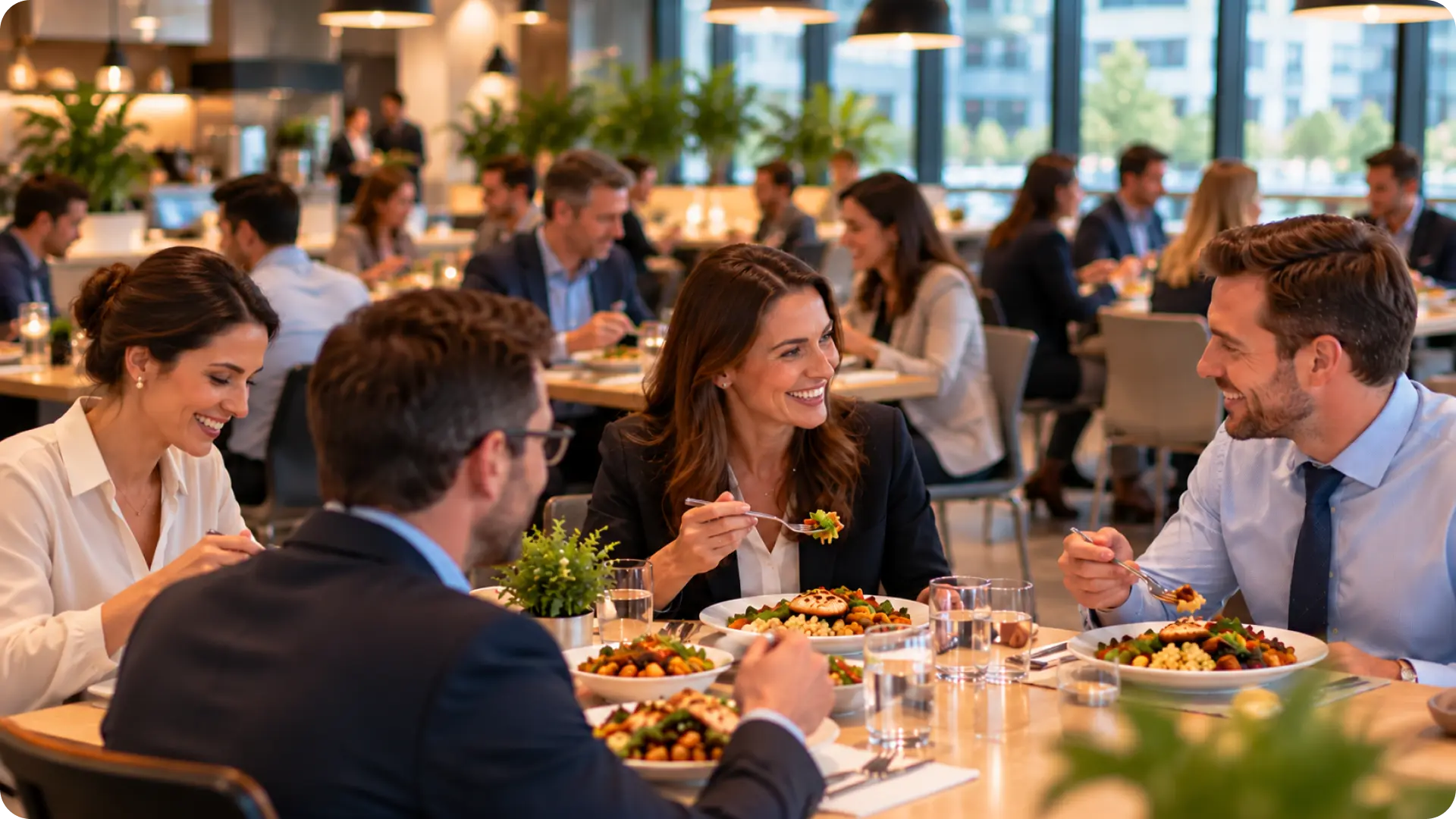
Food has become part of how companies get people back to their desks. Among hybrid employees in ezCater’s survey, 79% say employer-provided food would make them more likely to stay at a company with an in-office mandate. Budgets are following, too: 91% of workplaces plan to spend the same or more on food in 2026, up from 82% in 2024. For one workplace in five, the planned increase tops 25%.
Catering is outgrowing the rest of the restaurant industry. Monkey’s 2026 State of Catering report, built on more than $1 billion in catering sales across 100+ brands, projects 5.3% annual growth for U.S. catering through 2032. The broader restaurant industry grew about 3% in 2025, and the National Restaurant Association expects only 1.3% real sales growth in 2026. Expert Market Research, cited by Food On Demand, sizes the U.S. catering market at more than $81 billion this year.
That growth now depends on order count. Average catering checks rose only 3% in 2025 after several years of inflation-driven gains, while the top brands in Monkey’s data grew catering sales 10% to 20% year over year in Q1 2026. The report names first-party ordering and repeat customers as the biggest growth opportunities.
Operators see the opening. In Toast’s 2026 survey of 676 operators, 27% put adding more ways to generate revenue among their top three goals, up 6 points and the biggest jump on the list. Their top revenue focus was bringing in more guests, at 47%, and another 26% named new revenue streams such as catering. A catering program can serve both goals.
Are catering marketplaces good for restaurants?
Marketplaces are good at introductions, and their share keeps climbing. Monkey’s report puts the marketplace share of orders at a projected 36% in 2026, up from 12.8% in 2021.

The trade-offs are smaller checks and a weaker hold on the customer. Marketplace orders average 6% to 8% less than first-party orders and leave restaurants thinner margins, per the same report. And when reorders come back through the marketplace, as Buyers Edge Platform notes, you end up paying again to win a customer you already have. It’s the same commission math that makes third-party delivery eat into restaurant margins.
Catering demand is also concentrated. In Monkey’s data, 60% of orders come from just 5% of customers. Those few accounts carry the program, so they belong in a channel where you can see them and keep more of the margin.
Use marketplaces for what they do well, which is getting you in front of new offices. Then build the direct relationship yourself, starting with the first delivery. More restaurants are already taking that step on the logistics side: in-house delivery handled 53% of catering orders in 2026, up from 31% in 2021.
How to turn catering guests into repeat customers
Every office order can start a loop. Guests who like the food come back on their own, and the office books again when the job runs smoothly.
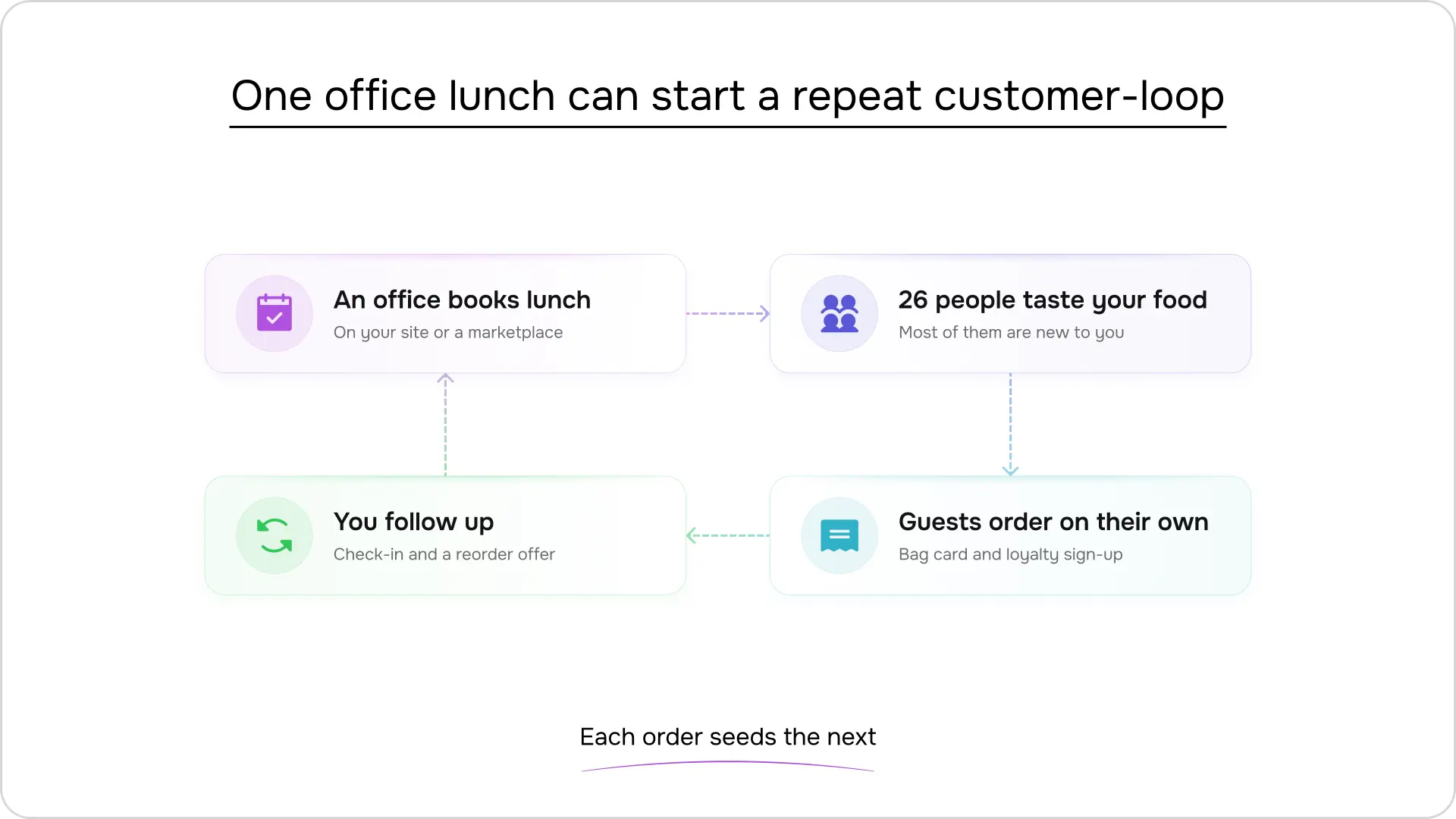
The loop only turns when guests have a direct way back to you, so start there.
Put a way back in every bag. Add a card or sticker with a QR code that opens your online ordering and offers a reward on the guest’s first personal order. The copy can be short: “Liked lunch? Your first order is on us, up to $10. Scan to order.” A loyalty sign-up on the same screen makes the guest yours from the first scan. When each account gets its own code, you can see which lunches turn into customers.
Say yes to short notice. Thirty percent of workplace orders arrive with less than 24 hours’ notice, according to ezCater data reported by Food On Demand. Set a rush cutoff your kitchen can hit, and cover the extra work with a clear service charge. The restaurant that can feed 26 people by tomorrow gets the offices that plan late.
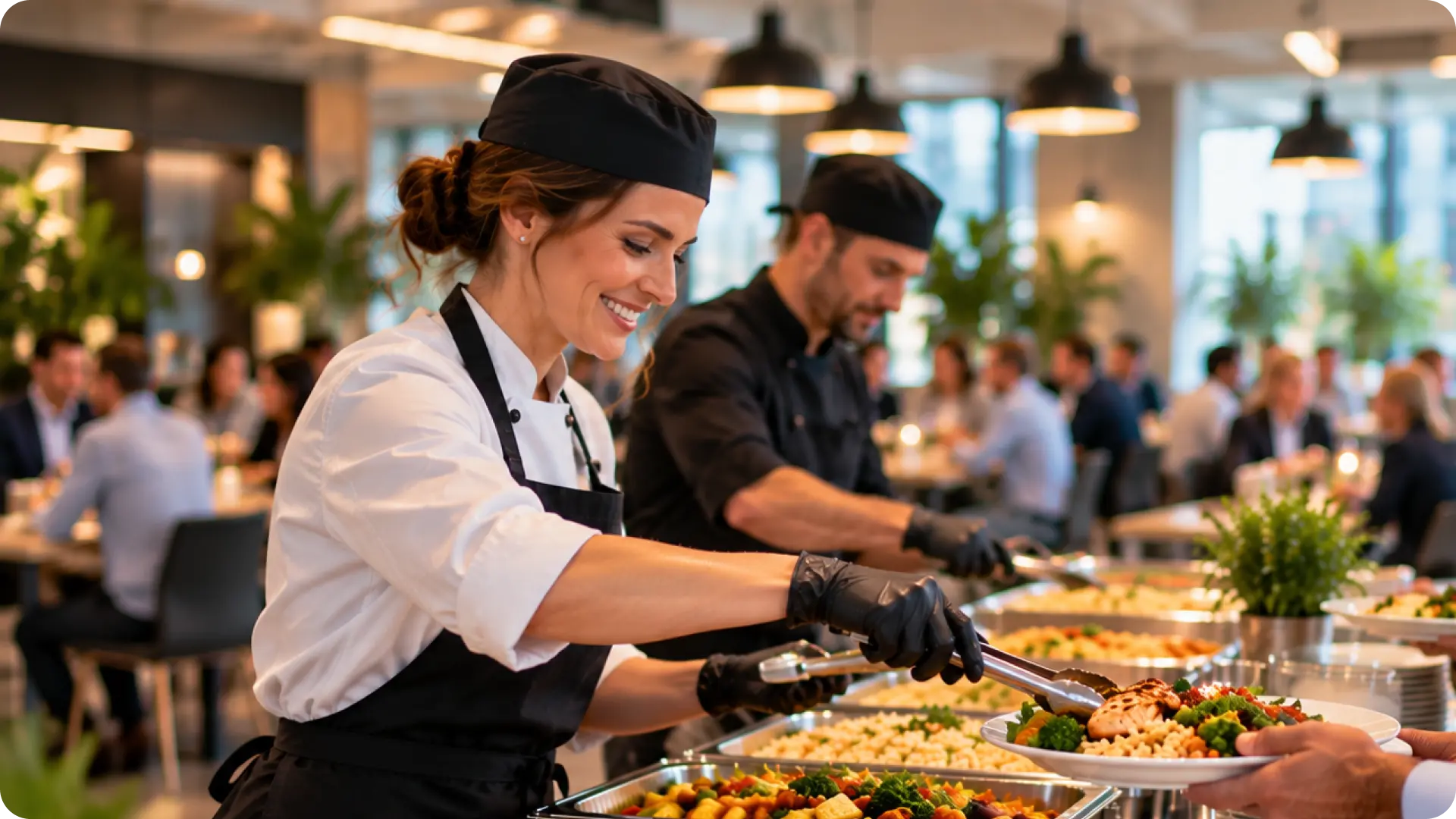
Build a menu an office can book fast. ezCater found that detailed, descriptive menus get twice as many bookings. Its menu guidelines ask for serving sizes, ingredients, packaging (individual or group), and clear labels for gluten-free, vegan, and vegetarian dishes. Those labels matter to buyers, since 24% of orderers rank dietary labeling among their top factors when choosing a menu.
Tell the client where the food is. In ezCater’s data, 94% of catering customers expect delivery tracking notifications, yet only half of operators always send them. Two texts cover it: one when the driver leaves and one at the door.
Follow up with the person who ordered. Ask about their next meeting at drop-off. The next morning, send a two-line text: “Thanks for having us yesterday. Want me to hold the same order for your next team meeting?” Accounts that go quiet past their usual rhythm should get a win-back offer, and Nova’s AI marketing can send those campaigns automatically.
How to measure catering ROI
Catering ROI runs on a longer clock than a takeout ticket. Judge each job by what happens in the 90 days after delivery, using four numbers you can track in a spreadsheet or your POS.
1. Count the guests you fed
Headcount is your reach. Clients give it to you when they book, so store it with the account and total it each month. Twenty office orders of 26 people each add up to 520 people who tasted your food.
2. Track who comes back on their own
The account codes on your bag cards do the work here. Count the guests who place a first personal order within 90 days, then divide by the number of guests you fed. That’s your guest conversion rate. Your measured rate will sit below ezCater’s 62%, since you only see the guests who use a code.
3. Add up what it cost to win them
List what you spent beyond food and labor: marketplace commissions, discounts or free add-ons, redeemed first-order offers, and any delivery cost you absorbed. Divide the total by the number of new customers from step 2, and set the result against what a new guest costs you through ads or coupons.
Take a month with 20 office orders and 520 guests. If 39 of those guests place a first personal order, your conversion rate is 7.5%. Say their $10 first-order offers cost $390, and free add-ons plus delivery you absorbed cost another $195. Each new customer costs you $15.
4. Watch the accounts that reorder
Your heaviest accounts carry most of the volume, so keep a watch list. Note how often each one orders, and flag any account that goes quiet past its normal gap. Your account reorder rate is the share of last quarter’s accounts that ordered again this quarter.
What to look for in restaurant catering software
Good software turns all of this into a weekly habit. Look for a system that does four things:
- One queue for every order. Website, phone, email, and marketplace orders should land in one list and one kitchen production schedule. In Nova, ezCater orders flow into the same queue as your direct orders.
- Accounts that remember. Each office keeps its contacts, addresses, usual order, and payment terms on file, so the fifth order takes a fraction of the time the first one did.
- One guest profile across the restaurant. A guest who scans your card at an office lunch should land in the same profile and rewards program as your dine-in and online guests.
- Follow-up that runs on its own. Campaigns should reach quiet accounts and new guests without anyone writing each email by hand.

When catering runs in a separate tool, those four break first, which is the hidden cost of disconnected restaurant software. Nova’s catering platform runs inside the same system as your POS and kitchen display, so all four work from one set of data.
Want to see what your next $360 order could turn into? Schedule a walkthrough and we’ll load your catering packages and lead times into a demo account, then show you the guest side and the staff side.