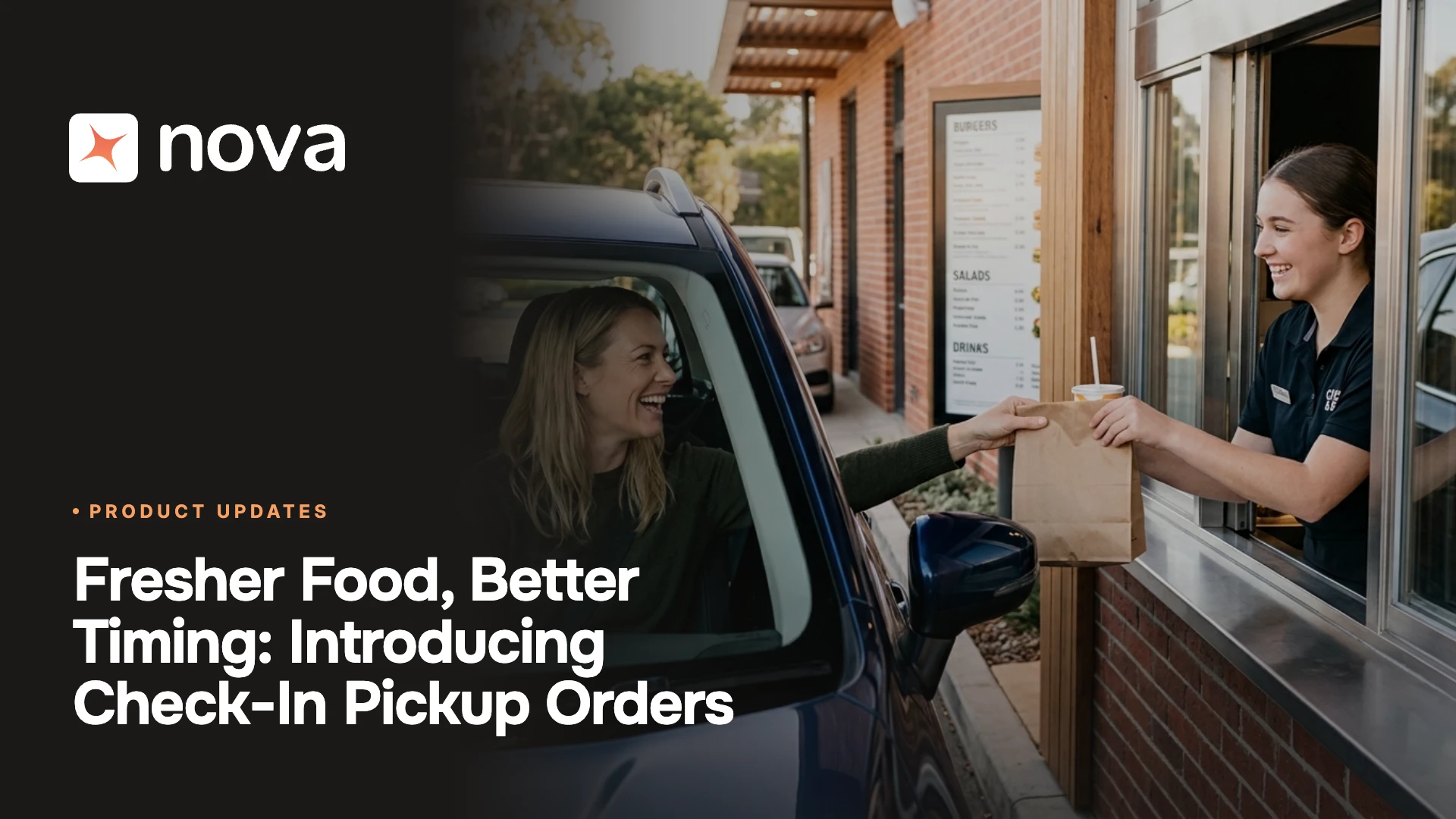

Picture this at one of your locations: a guest who ordered ahead specifically to avoid waiting arrives to find fries that have gone cold under the heat lamp and a drink that's more melted ice than soda. It looks like a small moment. The data says otherwise.
A 2026 mystery-shopper study of nine major QSR brands found that pickup satisfaction swings from 97.2% when the experience runs smoothly to just 31.3% when it doesn't. And this isn't a niche channel: nearly 75% of all restaurant traffic now happens off-premise, through takeout, delivery, and drive-thru, according to National Restaurant Association data. Pickup timing isn't a side issue for your restaurant. It's the main event, playing out hundreds or thousands of times a day.
Here's why the timing gap exists, what the biggest names in restaurant tech are spending to close it, and how Nova's new Check-In Pickup feature gives your restaurant the same benefit without the infrastructure bill.
The Real Cost of "Ready Before the Guest Is"
Here's the quiet flaw in most mobile ordering systems. The kitchen starts cooking the moment an order is placed, not when the customer actually shows up. That timestamp becomes the production trigger, regardless of traffic, parking, a last-minute meeting, or a detour to grab the kids. The food finishes, then it waits. Waiting food is the enemy of quality, and once it's happening across all your locations, it stops being an isolated complaint and starts showing up as a repeatable operational cost.
The data backs up what shows up in your feedback channels every week:
- Late orders wreck the experience. In the same 2026 study, roughly 1 in 5 mobile orders arrived late, and when orders were delayed, in-store dwell time jumped from 2 minutes 51 seconds to 7 minutes 10 seconds - more than double.
- On-time delivery is the single biggest satisfaction lever. Satisfaction hit 97% when orders were ready as promised, and dropped to 76% the moment they weren't.
- Order accuracy and consistency matter just as much as speed. 70% of quick-service customers say order accuracy is a key factor in their experience, and 64% say consistency across locations shapes where they choose to go back to, which matters even more once you're running that experience at more than one location.
- Guests chose digital ordering specifically to save time, so a bad pickup breaks the exact promise your ordering channel made in the first place. 78% of customers using online ordering say it has genuinely helped them save time, per Toast's restaurant industry data.
None of this is a "some customers are picky" problem. It's a structural one, built into how most ordering systems trigger production, and it shows up on the P&L as remakes, comps, and lost repeat visits across every location running the same timing logic.
The Industry Is Racing to Solve This
This gap is well-known enough that the largest chains in the country are spending real engineering budget to close it, each with a different approach:
- Chick-fil-A uses geofencing to detect when a customer is approaching the restaurant and signals the kitchen to start. The result: wait times dropped by 1 to 2 minutes, with estimated wait times accurate more than 90% of the time.
- McDonald's "Ready on Arrival" program shaved 62 seconds off mobile pickup wait times by sequencing food to actual arrival instead of order time.
- Starbucks just rolled out scheduled ordering nationwide, letting customers reserve a five-minute pickup window up to an hour in advance, powered by a "Smart Queue" algorithm that sequences drinks across cafe, drive-thru, and mobile channels.
Three of the biggest names in the industry, three different technical approaches, one shared conclusion. When the kitchen starts matters as much as what it makes, and each of these solutions required meaningful investment in location data, infrastructure, or queuing systems to get there.
Introducing Check-In Pickup: How It Works
Nova's answer has already shipped during our last release, and it gets your locations the same result without geofencing, GPS, or new hardware.
Guests select Check-In as their pickup method at checkout. Once the restaurant confirms the order, it holds; nothing starts yet. When the guest is actually on their way, they tap Check-In from the order tracking page, and that single tap is what tells the kitchen to begin preparation. Your team sets an arrival buffer, typically 30 to 60 minutes, to account for prep time and store hours, and the system handles the rest, automatically stepping back whenever a location is too close to closing or too backed up to fulfill an order in time. It never makes a promise the kitchen can't keep.
No location tracking. No new devices. No engineering lift. Just a single tap that shifts the production trigger from order placed to guests actually coming - the same principle behind every solution the largest chains have built, minus the infrastructure spend. It's live now on Web Ordering, with support for additional ordering channels planned.
The ROI: What Fresher Pickup Means for Your Bottom Line
This isn't just a nicer experience for a single transaction. It's a retention and margin lever for your restaurant, and the underlying economics make the case on their own.
The economics is worth a look:
- Existing customers spend 67% more per order than first-time diners, and 65 to 80% of restaurant revenue comes from repeat customers.
- Acquiring a new customer costs 5 to 7 times more than retaining one you already have.
- According to Bain and Company, increasing customer retention by just 5% can lift profits by 25% to 95%.
- Loyalty members who keep coming back visit 20% more often and spend 20 to 38% more per visit.
- Roughly 70% of first-time diners never return, and a cold, soggy pickup order is exactly the kind of experience that keeps them from giving a location a second chance.
There's also a waste angle worth naming for anyone building the business case. The restaurant industry loses an estimated 162 billion dollars a year to food waste industry-wide. Most of that is plate waste, not remade orders, but comps and remakes triggered by "my order sat too long and got cold" complaints are a smaller, entirely avoidable slice of that same waste problem, and one that's straightforward to isolate and track once you know to look for it, precisely because it's fixable with a settings change rather than a capital project.
Put simply, the moment a guest decides whether they're coming back is often the moment they open the bag. A fresher, better-timed handoff protects the repeat visits that already drive most of your revenue, reduces the remakes and comps tied to timing complaints, and gives your brand a genuine, provable point of difference against competitors still making customers wait on food that's been ready for ten minutes.
The Bottom Line
Starbucks, Chick-fil-A, and McDonald's have all concluded the same thing: food that's ready before the guest is isn't a convenience; it's a liability. If you're evaluating where the ordering experience is quietly costing you repeat visits, this is one of the more addressable levers available. Turning it on is a settings change, not a project, and it's already live, requires no new infrastructure, and protects the repeat business that keeps every location profitable.
Ready to turn on Check-In Pickup across your locations? Talk to your Nova account team to enable it, or reach out to learn how it fits into your broader ordering experience.