Restaurant Holiday Promotions: How to Plan Thanksgiving to Cyber Monday With POS Data

Thanksgiving week can put pressure on every part of a restaurant operation. Customer traffic changes by the day, popular menu items sell out, and staffing decisions become harder to get right.
Your POS system holds the information you need to prepare. Last year’s sales, order patterns, average check size, and labor costs give you a practical starting point for planning restaurant holiday promotions that fit your customers and your business.
In 2026, Cyber 5 runs from November 26 through November 30. Reviewing last year’s holiday sales now gives you time to plan offers, prepare your team, and manage inventory before the rush begins.
What Is Cyber 5, and Why Does It Matter for Restaurants?
Cyber 5 refers to the five days from Thanksgiving through Cyber Monday. Retailers see heavy shopping activity during this period, which creates openings for restaurants near shopping centers, retail districts, hotels, and busy commercial areas.
The National Retail Federation reported that a record 202.9 million consumers shopped during the 2025 Thanksgiving holiday weekend, including 129.5 million who shopped in physical stores. Shoppers spent an average of $337.86 each, the highest level since 2019.
For restaurants, that activity can mean more lunch traffic, takeout orders, delivery demand, and gift card purchases. How much of it reaches you depends on your location, service model, and customer base.
Start by reviewing last year’s holiday sales. Look for traffic spikes, popular menu items, and the hours when your team needed extra support. These patterns will guide your decisions about promotions, purchasing, and staffing.
How to Plan Restaurant Promotions for Each Day of Cyber 5
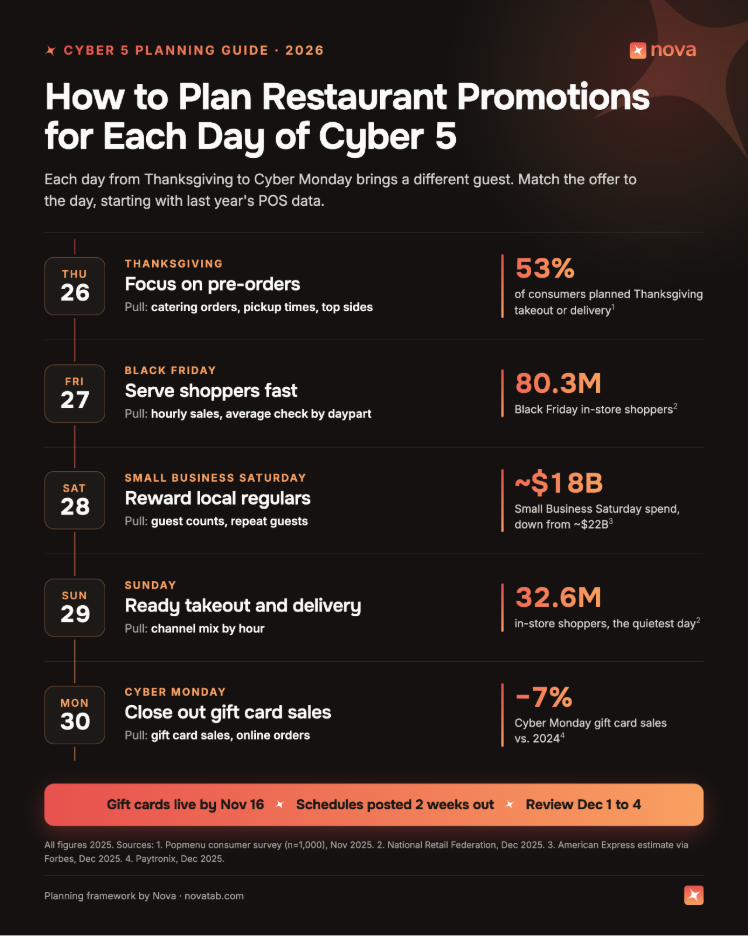
Each day brings different customer needs. Use your POS reports to see what happened last year and build a plan around those patterns.
Thanksgiving, November 26: Focus on Pre-Orders
Many customers cook at home, while others look for catering, prepared sides, desserts, or complete holiday meals. That second group is growing fast. In a Popmenu survey of 1,000 US consumers fielded in November 2025, 53% planned to order takeout or delivery for Thanksgiving dinner, up from 37% in 2024. Only 5% planned to dine in.
Review last year’s catering orders, pickup times, and best-selling items. Use those numbers to estimate demand and organize kitchen preparation. Clear pickup windows also help prevent congestion at the counter.
Restaurants that close on Thanksgiving can use the days before the holiday to promote catering packages, gift cards, or weekend specials.
Black Friday, November 27: Serve Shoppers Quickly
Black Friday can bring strong lunch traffic to restaurants near retail locations. The NRF counted 80.3 million in-store shoppers on Black Friday in 2025, the busiest in-store day of the weekend. Your own sales history will show whether that activity turned into more guests, larger checks, or higher takeout volume.
Review hourly sales and average check size before choosing an offer. A quick lunch bundle or a limited-time special can appeal to shoppers who want a convenient meal between stores. Technomic data reported by Restaurant Business shows checks that include a limited-time offer run 26% higher than checks without one.
Make sure the promotion fits your kitchen’s capacity. An offer that creates long wait times frustrates customers and puts unnecessary pressure on employees.
Small Business Saturday, November 28: Reward Local Customers
Small Business Saturday gives independent restaurants a chance to connect with local customers. The NRF counted 62.7 million in-store shoppers that Saturday in 2025. Spending was tighter, though: American Express estimates cited by Forbes put Small Business Saturday spending at independent retailers and restaurants near $18 billion, down from about $22 billion in 2024.
With guests watching their budgets, a clear reason to visit matters. Check last year’s guest counts and compare them with a typical Saturday. Look at returning guests, new customers, and the offers that drew the most interest.
A seasonal special or a reward for repeat customers can bring people in. You can also partner with nearby independent retailers on a joint promotion. Track redemptions and average check size to see whether the campaign generated additional business.
Sunday, November 29: Prepare for Takeout and Delivery
Sunday is the quietest in-store day of the weekend, with 32.6 million in-store shoppers in 2025 against 38.7 million online, according to the NRF. Some customers are traveling home, while others want an easy meal after a long weekend.
Review last year’s dine-in, takeout, and delivery sales by hour. Use those patterns to adjust staffing and promote meals that travel well, such as family bundles or dinner packages. Your sales history will tell you when to increase delivery coverage and when a smaller team will be enough.
Cyber Monday, November 30: Promote Gift Cards
Cyber Monday belongs to online shoppers. The NRF counted 75.9 million of them in 2025, which makes it a good day to reach customers with restaurant gift cards.
Timing matters more than the day itself. Paytronix reported an 8% lift in restaurant gift card purchases over Thanksgiving weekend 2025, with buying shifting earlier. Black Friday gift card sales rose while Cyber Monday sales fell about 7%. Full-service restaurants gained ground while quick-service gift card sales declined.
Launch your gift card campaign before Thanksgiving. This gives customers time to discover the offer, and Cyber Monday becomes your last reminder for anyone who hasn’t bought yet.
How to Choose Promotions That Protect Restaurant Margins
Discounts attract customers, and every one of them still has to make financial sense. Value matters to guests: in the National Restaurant Association’s 2026 State of the Industry findings, 85% of consumers said specials, discounts, or value promotions influenced where they ate.
Start with your best-selling menu items. Review their food costs, contribution margins, and preparation requirements. Build offers around products your kitchen can prepare efficiently and customers already enjoy.
A lunch bundle might work well for a quick-service restaurant near a shopping mall. For a restaurant with strong takeout demand, a family meal package is the better fit, and regulars may respond best to a seasonal special on Small Business Saturday.
Before setting a price, calculate the expected margin and set a performance target. Ask whether the promotion will bring in additional sales or discount purchases customers would have made anyway.
Your customer data also helps you reach the right audience. Where marketing permissions allow, send relevant offers to repeat guests based on their visit frequency and purchase history. Track redemptions, average check size, and repeat visits to see which campaigns deserve another run.
How to Staff Cyber 5 Using POS Data
Staffing decisions shape the customer experience, employee workload, and profitability. They matter more in an industry where people leave often: accommodation and food services had an annual quit rate of 4.2% in 2025, nearly double the 2.2% across all private industry, according to the Bureau of Labor Statistics. A short-staffed rush slows service, and paying for coverage nobody needs during a quiet stretch raises labor costs.
Review last year’s hourly sales and guest counts to find your busiest shifts. Compare demand with the staffing levels you had in place, then adjust the upcoming schedule.
If Friday lunch consistently brings higher traffic, schedule extra support for that window. Quieter Sunday afternoons may call for shorter shifts where that works operationally.
Share the schedule with employees at least two weeks in advance when possible. Make sure everyone understands the promotions, pricing, and redemption rules before the holiday weekend begins.
Nova’s staff scheduling optimization helps restaurants align shifts with expected demand, and our scheduling software buyer’s guide covers what to look for in any tool.
Review the schedule again as the weekend approaches. Reservations, weather, and local activity can all change expected demand.
How to Measure Your Holiday Promotion Results
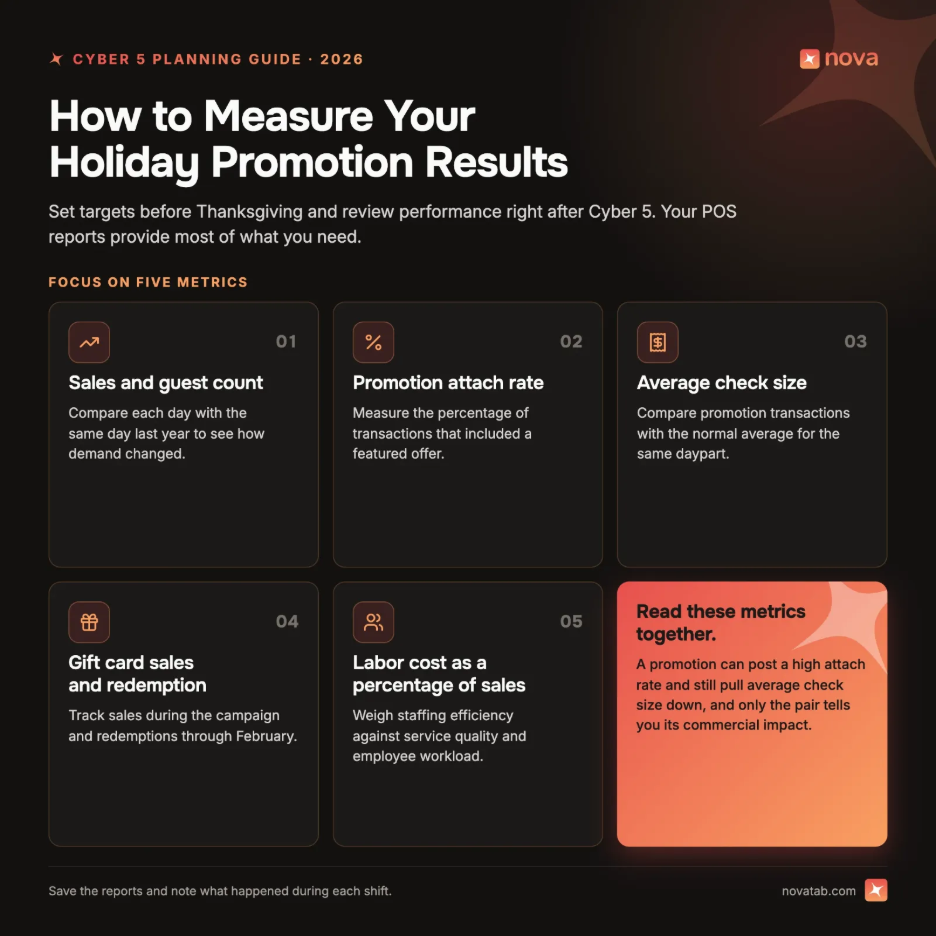
Set targets before Thanksgiving and review performance right after Cyber 5. Your POS reports provide most of what you need.
Focus on five metrics:
- Sales and guest count: Compare each day with the same day last year to see how demand changed.
- Promotion attach rate: Measure the percentage of transactions that included a featured offer.
- Average check size: Compare promotion transactions with the normal average for the same daypart.
- Gift card sales and redemption: Track sales during the campaign and redemptions through February.
- Labor cost as a percentage of sales: Weigh staffing efficiency against service quality and employee workload.
Read these metrics together. A promotion can post a high attach rate and still pull average check size down, and only the pair tells you its commercial impact. Our guide to restaurant key performance indicators explains each one in more depth.
[Insert infographics]
Save the reports and note what happened during each shift. That record gives your team a stronger starting point for the next holiday season.
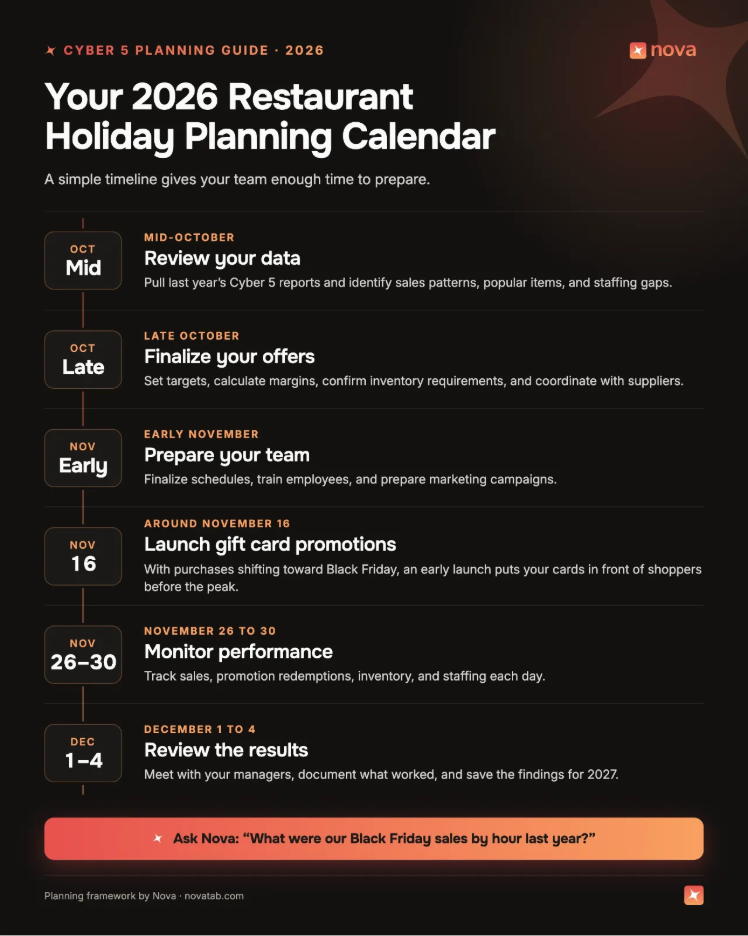
Your 2026 Restaurant Holiday Planning Calendar
A simple timeline gives your team enough time to prepare.
- Mid-October: Review your data. Pull last year’s Cyber 5 reports and identify sales patterns, popular items, and staffing gaps.
- Late October: Finalize your offers. Set targets, calculate margins, confirm inventory requirements, and coordinate with suppliers.
- Early November: Prepare your team. Finalize schedules, train employees, and prepare marketing campaigns.
- Around November 16: Launch gift card promotions. With purchases shifting toward Black Friday, an early launch puts your cards in front of shoppers before the peak.
- November 26 to 30: Monitor performance. Track sales, promotion redemptions, inventory, and staffing each day.
- December 1 to 4: Review the results. Meet with your managers, document what worked, and save the findings for 2027.
Turn Your POS Data Into a Better Holiday Plan
Restaurant holiday promotions work best when they start from a clear picture of customer behavior, sales trends, and what your kitchen and team can handle.
Your POS data helps you choose relevant offers, schedule employees more effectively, and measure results. Reviewing last year’s reports now gives your team a practical foundation for Cyber 5.
Nova helps restaurant teams access sales insights and manage daily operations. Its smart reporting lets users ask about performance in plain English, so investigating trends before a busy period takes minutes. A manager can ask, “What were our Black Friday sales by hour last year?” and use the answer to plan staffing and promotions.
Want to see how Nova helps restaurants manage operations and understand sales performance? Schedule a walkthrough with our team.