
Running a restaurant has never been more complex or more data-rich.
Every order placed, every item comped, every shift scheduled, and every guest served generates data. Yet despite having access to more information than ever before, many restaurant owners still rely heavily on instinct, gut feel, and retrospective reports to make decisions.
That gap between data available and data actually used is where profitability is often won or lost.
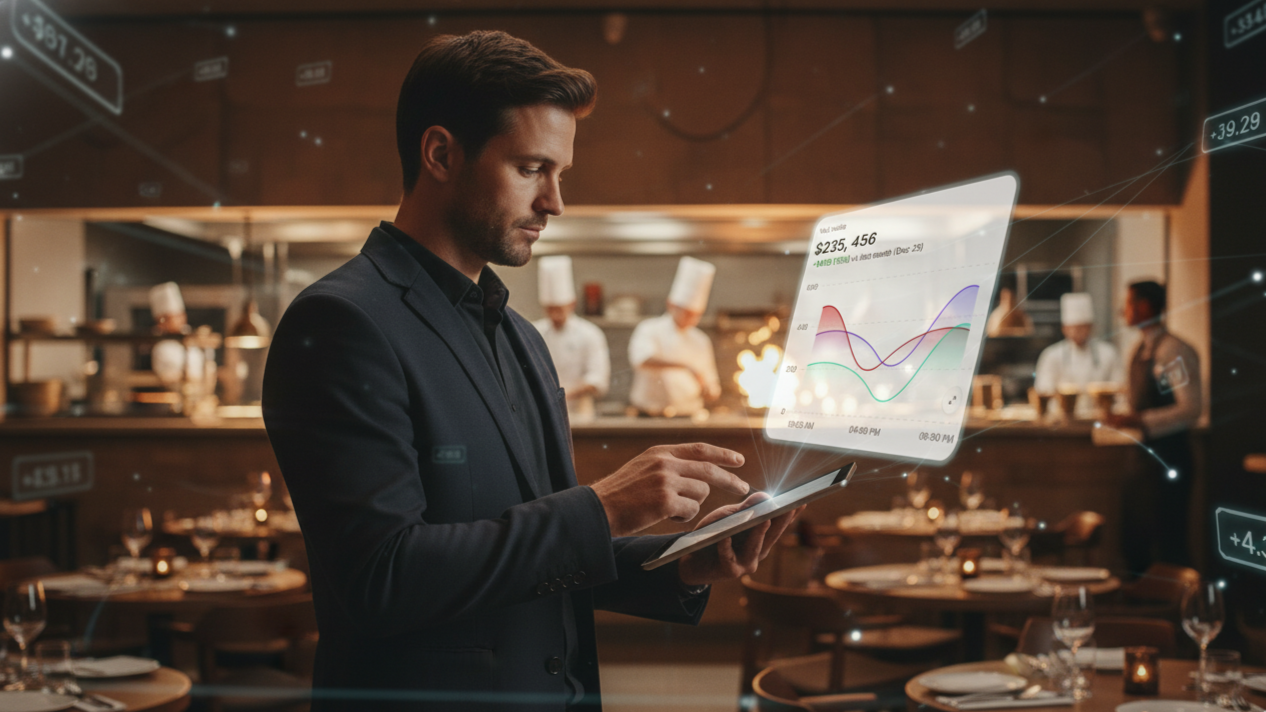
Restaurant data analytics is no longer about spreadsheets or back-office reporting. It is about operational intelligence, using real-time, connected data to make smarter decisions across menu design, staffing, inventory, pricing, and guest experience.
The most successful restaurant operators today are not necessarily the ones with the most locations or the biggest marketing budgets. They are the ones who understand their numbers deeply and act on them faster than everyone else.
Why Restaurant Data Analytics Has Become Mission-Critical
The restaurant industry has always operated on thin margins. But the margin for error has narrowed dramatically over the last few years.
Consider these realities:
- Average restaurant profit margins typically range between 3 percent and 5 percent
- Labor costs now consume 25 to 35 percent of total revenue for many full-service restaurants
- Food costs frequently account for 28 to 35 percent of sales
- Guest expectations for speed, accuracy, and personalization continue to rise, even as staffing remains unpredictable
In this environment, decisions made on assumptions or delayed reporting can quietly erode profitability.
Restaurant data analytics changes this dynamic. It allows owners to move from reactive management to proactive control, spotting problems early and identifying opportunities hidden in plain sight.
What Is Restaurant Data Analytics (Without the Jargon)
At its core, restaurant data analytics is the practice of collecting, analyzing, and acting on data generated by daily restaurant operations.
This data typically comes from multiple sources:
- Point-of-sale transactions
- Menu and modifier selections
- Labor scheduling and clock-in data
- Inventory usage and food cost records
- Guest ordering patterns across dine-in, takeout, and delivery
Analytics transforms this raw data into insights that inform decisions, such as:
- Which menu items truly drive profit
- When labor is over- or under-allocated
- Where food waste is occurring
- How guest behavior is changing over time
Crucially, restaurant data analytics is not about replacing experience or intuition. It is about augmenting judgment with evidence.
The Four Core Pillars of Restaurant Data Analytics
1. Sales and Menu Performance Analytics
Most restaurants track sales. Far fewer analyze them correctly.
True menu analytics goes beyond knowing what sells most frequently. It answers deeper questions:
- Which items generate the highest contribution margin
- Which items sell well but underperform on profitability
- How menu performance varies by time of day and day of week
It is observed that 20 to 30 percent of menu items often generate 70 to 80 percent of revenue, yet many low-margin items remain on menus out of habit rather than performance.
Analytics enables menu engineering, where items are categorized by popularity and profitability. This allows owners to optimize pricing, placement, and promotion.
Even small changes, such as repositioning a high-margin item or adjusting modifier defaults, can lift average order value by 5 to 10 percent without increasing traffic.
2. Labor Analytics: The Largest Controllable Cost
Labor is the single biggest expense most restaurant owners face, and also the area where analytics delivers the fastest returns.
Key labor metrics include:
- Labor cost percentage
- Sales per labor hour
- Overtime frequency
- Productivity by role and shift
Many operators are surprised to discover that labor inefficiencies are not evenly distributed. Analytics often reveals that:
- Certain shifts are consistently overstaffed relative to sales
- Others are understaffed, leading to slower service and lower guest satisfaction
- Restaurant labor costs spike during specific hours with minimal revenue upside
Industry benchmarks show that improving labor efficiency by just 1 to 2 percentage points can significantly impact net profit, often more than increasing sales by the same amount.
3. Inventory and Food Cost Analytics
Food cost volatility has made inventory control more complex than ever.
Restaurant data analytics helps owners answer questions such as:
- Which ingredients contribute most to food cost variance
- Where waste occurs, whether from over-portioning, spoilage, or prep inefficiency
- How menu changes impact overall food cost percentage
Industry studies suggest that 4 to 10 percent of food purchased is wasted in many restaurant operations. For a business operating on single-digit margins, this represents a significant hidden leak.
4. Guest and Ordering Behavior Analytics
Guest behavior has changed dramatically in recent years and continues to evolve.
Data reveals insights such as:
- Growth of off-premise and digital ordering
- Differences in order size between dine-in and online channels
- Popular add-ons and modifiers that increase ticket size
- Repeat visit frequency and ordering patterns
Research consistently shows that returning guests spend almost 67% more than first-time guests, and increasing retention by even 5 percent can materially increase profitability.
How Restaurant Data Analytics Directly Improves Profitability
The power of analytics lies in compounding gains across the business.
- Average order value can increase 8 to 15 percent through data-driven menu design
- Labor waste can be reduced without sacrificing service quality
- Food waste decreases as purchasing aligns more closely with demand
- Performance consistency improves across shifts and locations
Common Mistakes Restaurant Owners Make with Analytics
- Focusing on revenue instead of margins
- Reviewing reports weekly or monthly instead of in real time
- Using disconnected systems that prevent a single source of truth
- Tracking too many metrics instead of a focused set of KPIs
Effective analytics prioritizes clarity and actionability.
Must read: Restaurant Key Performance Indicators
From Reporting to Intelligence
Traditional reporting tells you what happened. Restaurant data analytics goes further by explaining why it happened, what is likely to happen next, and what actions operators should take in response.
Instead of simply reviewing past sales or daily summaries, analytics connects patterns across menu performance, guest demand, labor costs, and operational trends. This deeper layer of insight helps restaurant owners anticipate problems, optimize decisions, and capture opportunities earlier.
The shift from simple reporting to actionable intelligence is what separates exceptional restaurant operators from average ones.
The Future of Restaurant Data Analytics
Emerging trends include:
- AI-driven demand forecasting
- Automated labor and inventory recommendations
- Dynamic pricing based on demand patterns
- Personalized guest experiences
As these capabilities mature, analytics becomes a strategic differentiator rather than a back-office function.
Final Thought
Restaurant data analytics does not replace hospitality. It protects it by removing guesswork, reducing stress, and enabling better decisions.
When restaurant owners understand their numbers, including menu performance, peak demand hours, labor efficiency, and guest behavior, they can run smoother operations, reduce waste, and deliver more consistent guest experiences.
The restaurants that thrive in the coming years will be the ones that use data deliberately, intelligently, and consistently.
Modern all-in-one restaurant management platforms like NOVA make this easier by bringing sales data, operational insights, and performance analytics into a single view, helping owners move from reacting to problems to proactively improving their business.
Because in today’s restaurant industry, the real competitive advantage is not just great food. It is the ability to run a smarter, data-driven operation.