What are Sustainable Kitchens? Reduce Waste, Cut Costs & Build a Future-Ready Restaurant

The process of running a restaurant in 2026 does not look like it did several years ago. Prices are higher, profit margins are leaner, and even the smallest decisions appear to come back to haunt you in your P&L.
One of the largest points of pressure is labor. In 2026, the rise in minimum wage occurred in 19 states, and the hourly wages are now between 10 and 18 dollars. Over 30 states and Washington, D.C. have surpassed the federal minimum wage that remained at 7.25 since 2009. Meanwhile, food costs continue to rise, utilities are on the high, and nobody is able to pay rent at a slower pace.
The National Restaurant Association reports that food and labor expenses have increased by 35% in the last 5 years. The menu prices increased by 31% in 2020-25 just to allow restaurants to maintain a stable 5% margin. That is a lot of work just to stay in the same place.
This is where sustainable kitchens come into the picture. Not as a trend. Not as a moral lecture. But as a practical business response to increased costs.
What if sustainable restaurant operations were not about spending more, but about wasting less? In this guide, we will break down what a sustainable kitchen actually means in 2026, why it matters for your margins, and how to build one without turning your operation upside down.
What Is a Sustainable Kitchen & Why It Matters in 2026?
Whenever the majority of the population mentions sustainable kitchens, they imagine the compost bins, bamboo straws, or turning off lights. It is not a big part of the picture.
A sustainable kitchen is one that consumes resources at will. Ingredients, labor, energy, equipment, and time are designed, estimated, and optimized rather than estimated.
To put it simply, sustainability within a restaurant implies:
- Purchasing more in accordance with actual demand.
- Consistent Food preparation.
- Minimizing waste prior to its occurrence.
- Operating equipment when it is not adding value.
- Data-driven decision-making as opposed to intuition.
This is where the definition goes wider than being eco-friendly.
Sustainability within the context of profitability, efficiency, and responsibility is placed at the center in 2026. There is increased customer concern. There is an increase in stricter local regulations regarding waste, water, and energy. Operational discipline is more and more considered by investors and landlords, rather than revenue.
As a matter of fact, the majority of sustainable kitchen practices are cost-reducing. They eliminate inefficiencies that silently rob money on a daily basis. Wasting inventory, excessive cleanup, not putting equipment to use, bad ordering, and uneven portions are not only operational problems. They are profit leaks.
A sustainable kitchen does not transform your food or your brand. It brings efficiency and structure to how your kitchen operates.
The Real Business Benefits of a Sustainable Kitchen
A sustainable kitchen focuses on building systems that protect margins and make operations more predictable. Here are some key benefits:
Reduce food expenses by cutting down on waste.
One of the least considered costs in restaurants is food waste. Remains are discarded, out-of-date products are left in storage, prepared in advance, and discarded at the end of service. Such losses are small in individual terms, but within a month, they accumulate rapidly.
Sustainable kitchens target waste management at the source. They can eliminate over-ordering, enhance portion accuracy, and match prep with actual demand. Reducing food waste in restaurants would translate into fewer emergency orders and a reduced food cost percentage.
Lower utility and operating costs.
Energy costs rise quietly. For instance, ovens are pre-heated too early, or machines that are not used during rushes.
Energy consumption also reduces systematically when kitchens prepare windows, batch cook, and use equipment with proper planning, without affecting service quality. This is not about asking staff to do more. It is about removing unnecessary running time.
Better inventory precision and prediction.
Lack of inventory prep is a recipe for stress and chaos. Slow-moving stock at the close of the week. Last-minute vendor calls.
Kitchens that are sustainable are based on proper inventory management and demand forecasting. This brings about smoother operations. Managers do not have to spend a lot of time fire-fighting, and they can focus more on enhancing performance.
Better brand perception and brand loyalty.
Guests notice consistency. They will observe when their favorite dishes are out of stock, or when the quality is not the same. They are also aware when a brand is discussing sustainability and supporting it.
An efficiently operated kitchen helps to build a more credible, strong brand image without the need to scream about it.
Easier compliance with regulations
There is an increasing trend in the number of areas with waste segregation regulations, water use standards, and energy efficiency standards. Kitchens with structured systems adapt faster and avoid last-minute compliance stress.
Key Pillars of a Sustainable Kitchen
Sustainability works best when broken into systems. Not ideas. Not posters on the wall.
a) Smarter Inventory and Waste Management
Overstocking is the most common waste. It is safe to order excessively, but it poses an expiry risk.
Kitchens that are sustainable place orders nearer to demand. This means:
- Monitoring the real-time flow of ingredients.
- Knowing peak days, slow days, and changes of seasons.
- Minimizing large orders that sit unused.
Expiry tracking plays a significant part. Ingredients should be used in the right order. Batch usage planning ensures older stock is consumed first.
Portion control is another hidden lever. When recipes are standardized and portions are clear, costs stabilize. This allows customers to get consistent dishes every time, and the kitchen avoids silent overuse of premium ingredients.
b) Energy-Efficient Kitchen Operations
Waste of energy is not usually deliberate. It usually comes from habit. Preparation earlier than necessary. Service-to-service equipment. Several stations went online without any apparent demand.
Sustainable kitchens match the sales with preparation schedules. When lunch is slow on Tuesdays, prep is the reflection of that fact. When weekends are high, the energy consumption is concentrated where it counts.
Data-driven processes assist teams in knowing when equipment is required to be on and when it is not. It saves on wear and tear, and it minimises monthly bills without putting a strain on personnel.
c) Sustainable Sourcing and Menu Design
Sustainability efforts also show up on the menu. Local and seasonal ingredients are not just fresher; they are often cheaper and easier to source consistently. This also prevents supply chain disruptions.
Menu engineering plays a powerful role. Some dishes sell well but generate waste. Others have strong margins and low complexity. Tracking ingredient performance helps operators refine menus without hurting guest satisfaction.
d) AI-Powered Forecasting and Automation
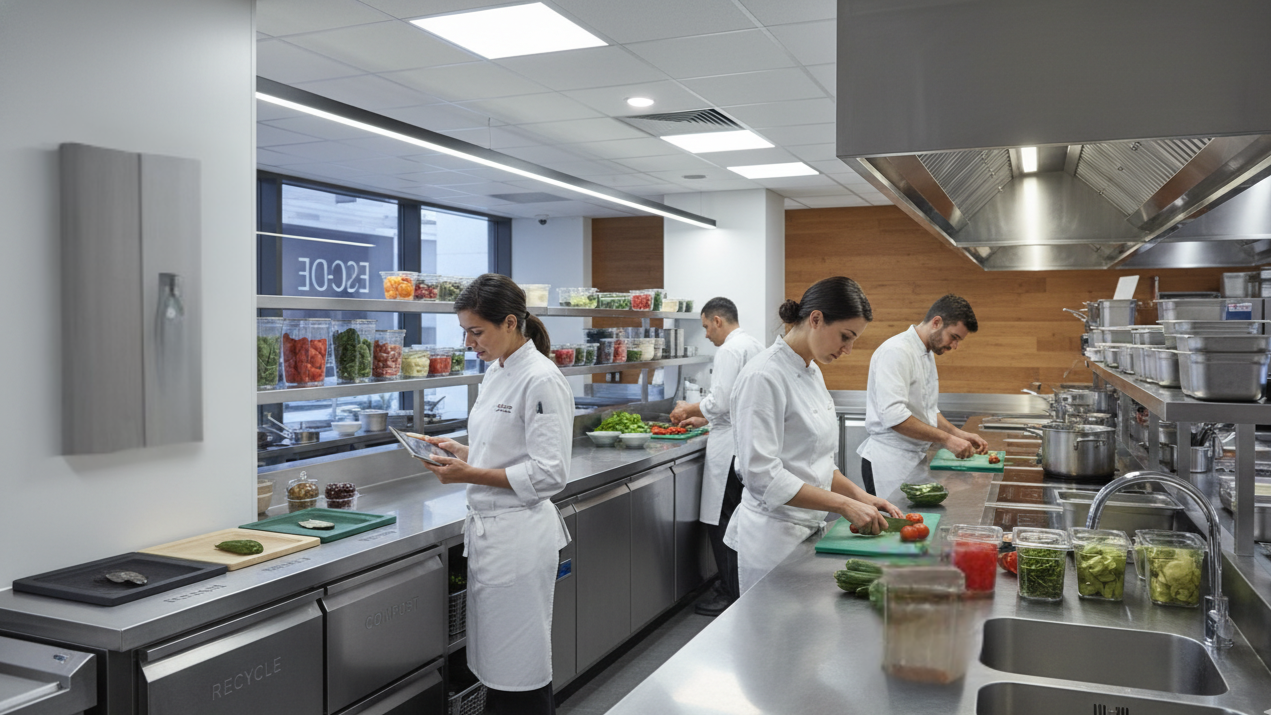
This is the pillar that's changed the most since this article first went up. Industry-wide, restaurants still waste an estimated 22 to 33 billion pounds of food a year, with individual operators losing 4% to 10% of total inventory to spoilage and overstock. AI-driven forecasting is now the primary tool operators use to close that gap.
Instead of ordering off instinct or last week's numbers, AI systems analyze historical sales, demand patterns, and external factors - weather, local events, seasonality - to predict what a kitchen actually needs, day by day. Paired with automated "digital kitchen boards" that replace manual prep sheets, this turns forecasting from a once-a-week guess into a continuous, self-correcting process.
The shift is already mainstream: in a recent Deloitte survey, 82% of restaurant executives said they plan to increase AI investment, most of it aimed squarely at operational efficiency rather than novelty. For sustainable kitchens, AI isn't replacing the judgment of a chef or GM - it's acting as an operational copilot for forecasting, ordering, and labor allocation, so fewer decisions are made blind.
New Regulations Reshaping Sustainable Kitchens in 2026
Sustainability in the kitchen is no longer just a cost play - it's increasingly a compliance requirement. A growing list of states now mandate organic waste diversion for commercial food generators, and the thresholds keep getting lower:
A federal Zero Food Waste Act has also been reintroduced in 2026 (not yet law), which would fund EPA grants for waste-reduction and measurement projects at the operator level.
The practical takeaway: if your kitchen doesn't already have a system for tracking and documenting waste, that gap is quickly becoming a legal exposure, not just a cost one. This is exactly where the checklist and 30-day plan later in this article earn their keep.
How Technology Enables Sustainable Kitchens Without Extra Effort
This is where many restaurant owners hesitate. Restaurant sustainability technology sounds like more screens, more training, more complexity. The truth is that modern restaurant technology reduces effort when used correctly.
Restaurant technology platforms like NOVA support sustainable kitchens by connecting the dots between sales, inventory, and kitchen operations.
Here is how NOVA helps.
- Real-time inventory tracking
Instead of manual counts that happen once a week, inventory updates automatically as items sell. This improves accuracy and confidence in ordering decisions.
- Sales-driven demand forecasting
When inventory planning is tied directly to sales data, kitchens prep closer to actual demand. This reduces over-prepping and last-minute shortages.
- Ingredient-level reporting
Understanding which ingredients contribute most to revenue and waste changes how purchasing and menu decisions are made.
- Waste insights from POS and kitchen data
Waste becomes visible. Not emotional. Not anecdotal. Managers can see patterns and address root causes instead of blaming teams.
- Centralized operations across locations
For multi-location brands, sustainability breaks down when systems differ by outlet. Centralized data keeps standards consistent without micromanagement.
NOVA is an operational clarity tool. Sustainability becomes a byproduct of better decisions.
Circular Sourcing: Packaging, Materials, and the End of "Away"
Waste inside the kitchen is only half the sustainability picture. What leaves the kitchen - packaging, to-go ware, disposables - is under just as much pressure, from both regulation and guest expectations.
A few shifts worth planning around:
- Certified compostable is becoming the default, not the exception. BPI alone now certifies over 51,000 products as commercially compostable. Operators are increasingly favoring products with verified certifications (BPI, TÜV Austria) over vague "eco-friendly" labels that don't hold up to scrutiny.
- Plant-based materials are replacing petroleum-based plastics. Sugarcane bagasse and upcycled agave fiber are turning agricultural byproducts into durable, hot- and grease-safe foodware - without the performance tradeoffs earlier compostables had.
- Plastic bans are expanding, state by state and city by city, which makes proactively switching to compliant packaging a lot cheaper than reacting to a ban after the fact.
- Infrastructure-matched purchasing matters. Not every market has industrial composting access. Forward-thinking operators check what's actually available locally - industrial compostable, home compostable, or standard recyclable - before standardizing on a packaging line, rather than assuming compostable automatically means "handled."
Packaging decisions used to be a back-of-house afterthought. In 2026, they're a line item regulators, suppliers, and guests are all watching.
Sustainable Kitchen Checklist for Restaurant Owners
Getting Started: First 30 Days to Build a Sustainable Kitchen
There's no need to get this perfect out of the gate. The goal is replacing assumptions with facts.
Week 1: Establish a waste and inventory baseline. Track discarded items across every shift. Stay observational and judgment-free — this is data collection, not a performance review.
Week 2: Identify your top five loss areas. Look for the ingredients, patterns, and timing driving the biggest waste. Focus effort where it will actually move the needle.
Week 3: Streamline purchasing and prep. Bring orders closer to real demand and get inventory moving faster.
Week 4: Track improvements and savings. Compare your new numbers against the baseline. Visible progress is what builds team buy-in for the long haul.
NOVA Is Built for the Way Restaurants Actually Run
Restaurant owners don't need more tools. They need clarity, control, and fewer surprises. That means:
- Purchasing guided by actual sales trends
- Prep planning that reduces overproduction
- Lower food waste without adding staff burden
- Faster visibility into cost and margin
- Consistent systems across every location
Sustainable kitchens aren't built through perfection - they're built through smarter decisions made consistently over time. NOVA helps make those decisions easier, faster, and more reliable.
.png)
Frequently Asked Questions About Sustainable Kitchens (NEW)
What is a sustainable kitchen?
A sustainable kitchen is a restaurant operation where ingredients, labor, energy, and equipment use are planned and optimized around actual demand, rather than run on guesswork - reducing waste, cost, and environmental impact at the same time.
Do sustainable kitchen practices cost more to implement?
No - most sustainable kitchen practices reduce costs. They target the everyday inefficiencies (over-ordering, over-portioning, idle equipment) that already quietly drain margin, rather than requiring new spending.
What food waste laws affect restaurants in 2026?
As of 2026, states including California, Massachusetts, Maryland, Connecticut, New York, Washington, and New Jersey have active organic waste diversion laws for commercial food generators, with thresholds as low as 96 gallons or 1 ton of waste per week. Check your state's specific threshold and reporting requirements.
How does AI help with sustainable kitchen operations?
AI-driven forecasting analyzes sales history, demand patterns, and external factors to predict ingredient needs more accurately than manual ordering — reducing overstock and spoilage while freeing up manager time for higher-value decisions.
How long does it take to build a more sustainable kitchen?
Most operators can establish a working baseline and identify their biggest waste sources within 30 days, using consistent daily tracking rather than a one-time audit.
If you're ready to reduce waste, control costs, and build a future-ready restaurant, book a demo with NOVA today.