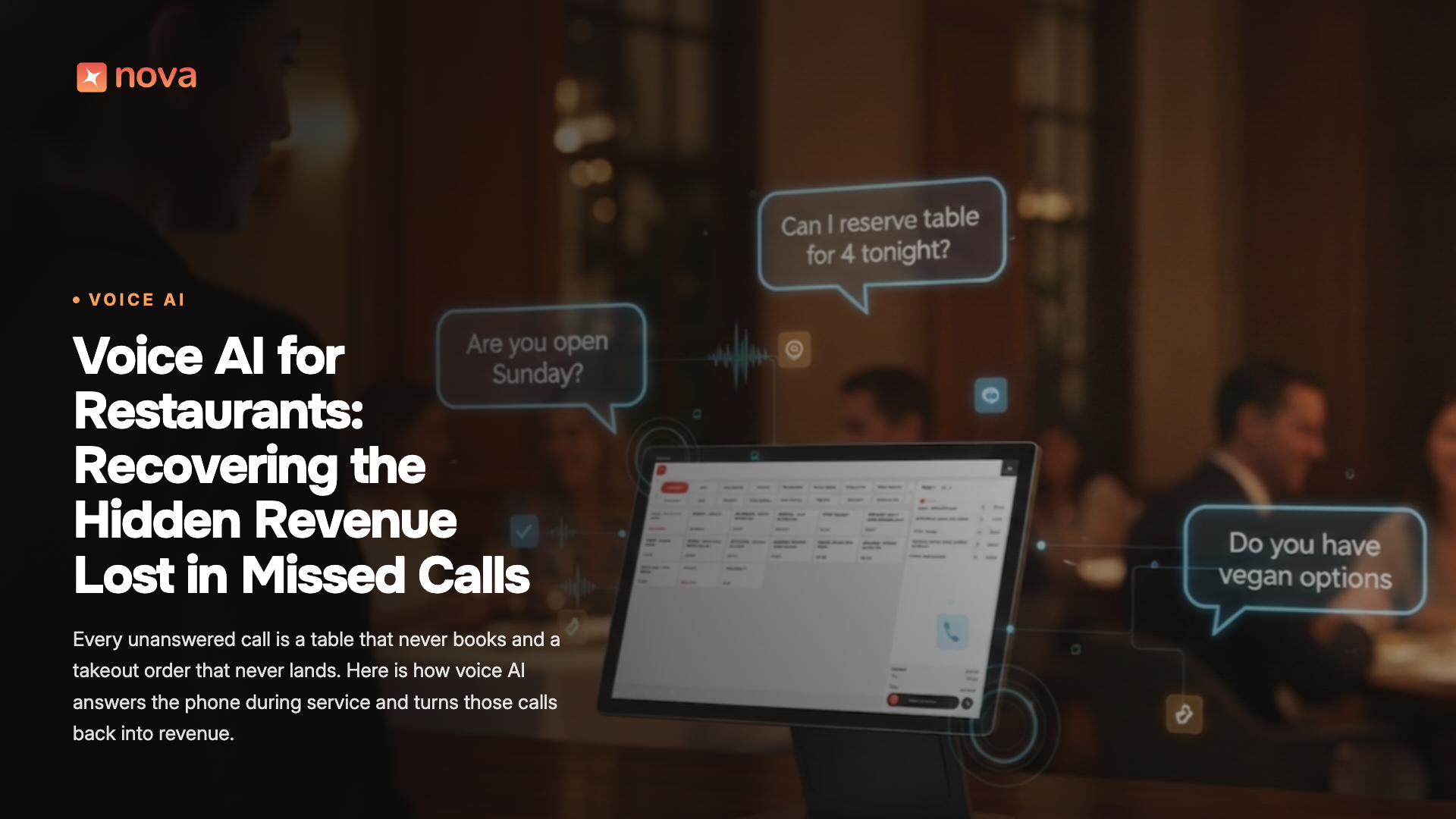

The restaurant industry has spent the last few years optimizing delivery, digital payments, online ordering, loyalty programs, and table management. Yet one major revenue leak continues to remain largely invisible: Missed phone calls.
For most restaurants, the phone is still a high-intent ordering and customer engagement channel. Customers calling a restaurant are usually ready to place an order, make a reservation, clarify a menu item, or inquire about availability.
But during peak hours, many of those calls go unanswered. According to industry estimates, restaurants miss between 20% to 30% of incoming calls during busy periods. For independent restaurants operating on thin margins, this translates into thousands of dollars in lost revenue every month.
This is why voice AI for restaurants is rapidly moving from an experimental technology category into a critical operational layer for modern restaurant businesses.
The Revenue Leak Most Restaurants Never Measure
Most restaurant operators already know the operational reality. During lunch and dinner rushes, teams are simultaneously handling:
- Dine-in guests
- Delivery coordination
- Kitchen operations
- POS management
- Online orders
- Payment processing
Answering incoming calls becomes difficult, especially when staffing is limited. The numbers behind this operational gap are larger than most owners realize.
A restaurant missing just 5 calls per day loses:
- 150+ calls every month
- 1,800+ calls annually
If the average ticket size is between $25 to $40, even a modest conversion rate creates a significant revenue opportunity.
At a conservative estimate:
- 1,800 missed calls × 40% order intent × $30 average order value
- Potential annual lost revenue: $21,600+
For high-volume restaurants, the number can be substantially higher.
More importantly, missed calls create a second-order effect: Customers often do not call back.
Research consistently shows that modern consumers expect immediate responsiveness. If a restaurant fails to answer quickly, customers frequently move to the next available option on delivery platforms or local search results.
In an increasingly competitive dining landscape, responsiveness itself has become part of the customer experience.
Labor Costs Continue to Rise Across the Industry
At the same time, restaurants are facing growing labor pressure. Labor costs now account for roughly 25% to 35% of total restaurant expenses, making it one of the largest operational cost centers for restaurant businesses. Staff turnover also remains one of the industry's biggest challenges.
Many restaurant operators face:
- Frequent hiring cycles
- Constant training requirements
- Staffing shortages during peak periods
- Increased wage pressure
- Reduced operational bandwidth
The result is operational overload. Frontline teams are expected to deliver hospitality while simultaneously managing incoming calls, online orders, guest interactions, and operational coordination.
Something eventually breaks. In many cases, that "something" is phone responsiveness. This is one of the core reasons voice ordering for restaurants is gaining momentum globally. Restaurant owners are realizing that solving communication bottlenecks directly impacts revenue capture, customer satisfaction, and operational efficiency.
Why Traditional Voice AI Solutions Failed Independent Restaurants
Voice AI technology itself is not new. Large restaurant chains and enterprise contact centers have used automated voice systems for years. However, most of these solutions were designed for enterprise environments with:
- Dedicated IT teams
- Complex implementation cycles
- Multi-location operations
- Large software budgets
- Long onboarding processes
That model excluded the majority of restaurants. Independent restaurants and small chains often found traditional voice AI solutions:
- Too expensive
- Too difficult to deploy
- Too rigid operationally
- Poorly integrated with restaurant workflows
Ironically, smaller restaurants are often the businesses that suffer the most from missed calls because they operate with leaner staffing structures. This is where the market is beginning to shift.
The next generation of voice AI for restaurants is focused on accessibility, operational simplicity, and direct revenue impact rather than enterprise complexity.
Must Read: Enhancing Guest Experience and Operational Excellence with Voice AI
NOVA’s Vision: Democratizing Voice AI for Restaurants
The future of restaurant technology will belong to platforms that simplify operations while increasing revenue efficiency.
At NOVA, the vision behind voice AI is straightforward: Every restaurant should be able to access enterprise-grade operational automation without requiring enterprise-level budgets or technical resources. The goal is not simply answering calls. The goal is to build an intelligent voice ordering layer that becomes deeply integrated into restaurant operations.
Modern voice AI systems can now:
- Answer every incoming call instantly
- Take orders accurately
- Handle menu questions
- Process modifications
- Suggest upsells intelligently
- Capture reservations
- Route complex interactions to staff when needed
When integrated directly with the restaurant POS systems, the operational value increases significantly. Voice AI can understand:
- Menu availability
- Pricing
- Add-ons
- Combo opportunities
- Operational workflows
This transforms voice ordering from a basic automation tool into a real-time revenue optimization engine. For restaurant owners, the operational implications are significant:
- Fewer missed orders
- Faster response times
- Reduced staff overload
- Better customer experience
- Higher order capture rates
Most importantly, it enables restaurants to scale operational efficiency without proportionally increasing labor costs.
Voice AI Is Becoming an Operational Advantage
The restaurant industry is entering a phase where AI will increasingly function as operational infrastructure rather than experimental technology.
The businesses that adopt AI intelligently will gain advantages in:
- Responsiveness
- Labor efficiency
- Revenue capture
- Customer retention
- Operational consistency
This does not mean replacing hospitality with automation. In fact, the opposite is true.
The best restaurant experiences will always remain deeply human. But repetitive operational tasks like answering high volumes of incoming calls can now be handled far more efficiently through AI systems. This allows restaurant staff to focus on what matters most: guest experience and service quality.
For independent restaurants operating on tight margins, even small efficiency improvements compound meaningfully over time. Capturing a few additional orders every day can translate into tens of thousands of dollars annually.
The Future of Restaurant Operations
Over the next few years, voice AI for restaurants will likely become as common as online ordering systems or digital payments. Not because it is trendy. Because it solves a real operational problem. The most important shift is that these technologies are finally becoming accessible to standalone restaurants and growing regional brands, not just large chains.
That democratization matters.
Independent restaurants form the backbone of the hospitality industry, yet they have historically lacked access to advanced operational tools. Voice AI changes that equation. The future is not about replacing restaurant teams. It is about giving them a reliable operational layer that:
- Never misses a call
- Never gets overwhelmed during rush hours
- Operates 24/7
- And helps restaurants recover revenue that would otherwise remain invisible
In a business where margins are tight and competition is increasing, that operational advantage can become transformative.