
Ask any restaurant operator what keeps them up at night, and food costs, labor, and thin margins usually top the list. But there is a quieter drain on profitability that shows up on every single credit card transaction: processing fees.
Credit cards now account for most restaurant sales, and that convenience carries a real cost. Card processing typically takes 3% to 4% out of a restaurant's revenue on every transaction, a cost that never goes away as long as guests pay with plastic. For an industry where net profit margins often run 3% to 7%, losing 3% or more per swipe can be the difference between a good year and a break-even one.
Understanding how a payment actually moves- from the guest's card to the restaurant's bank account- is the first step toward controlling that cost. Paired with the right point of sale platform and pricing strategy, operators can claw back much of that margin.
How a payment moves through the system
A card payment looks instant from the counter or the table, but it passes through several financial institutions before it lands in a restaurant's bank account. Here is what happens between the tap and the deposit.
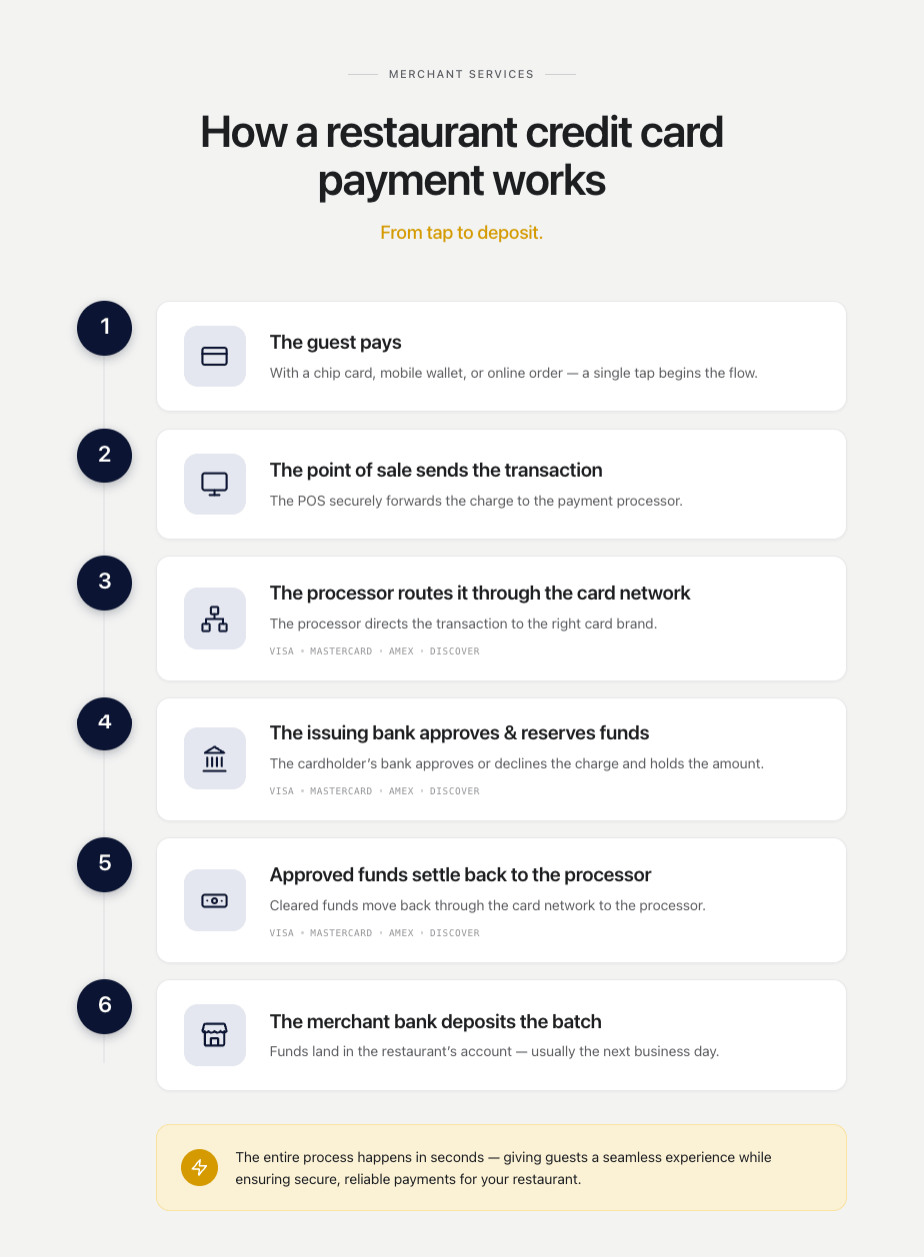
The four parties behind every transaction
Four institutions make that flow possible, and each one takes a cut or plays a defined role.
- The payment processor. This is the operational link between a restaurant's point of sale and the broader card networks. The processor routes transaction data, handles settlement, and manages functions like fraud screening, encryption, and tip adjustments.
- The card brands. Visa, Mastercard, American Express, and Discover do not issue cards directly to guests. Instead, they set network rules and establish interchange, the base fee that processors pay on every transaction.
- The issuing bank. This is the guest's own bank or credit union: Chase, Capital One, Bank of America, and similar institutions. It verifies available funds or credit, approves or declines the charge, and releases payment.
- The merchant bank. This is the restaurant's business bank account, sometimes called the acquiring bank. It receives settled batches from the processor and deposits them into the restaurant's account.
Why interchange rates vary so much
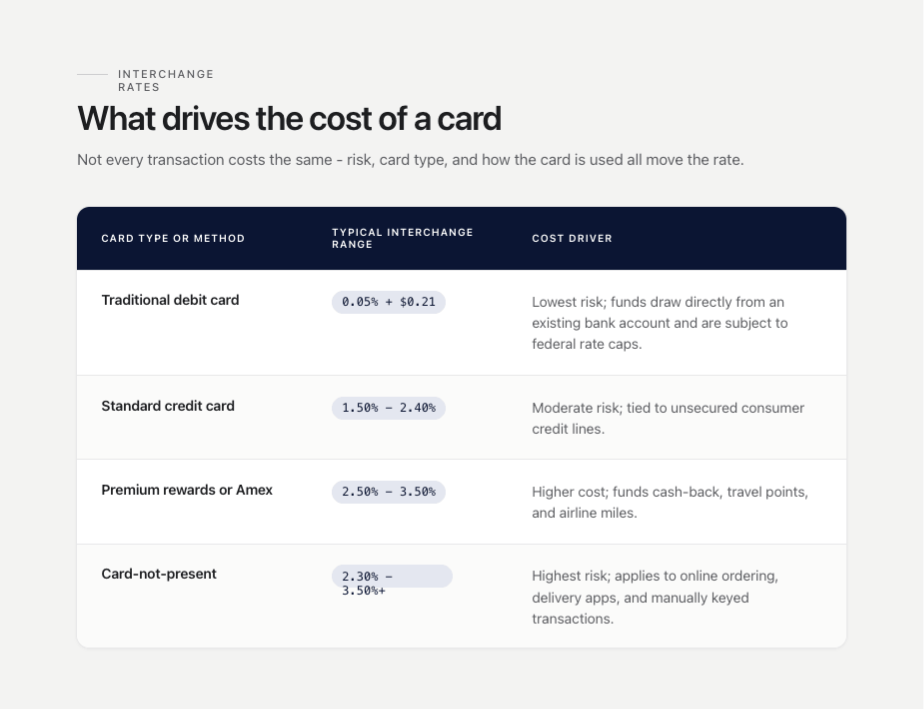
The least understood line on a merchant statement is interchange: the wholesale fee that card brands set and that flows to the issuing bank to cover fraud risk and system upkeep. Processors do not set this rate and cannot negotiate it. What operators can plan for is how much it varies by card type and transaction method.
The premium card dilemma
Restaurants that draw a higher-income or corporate crowd tend to see more premium rewards cards at the register — travel and cash-back cards from major issuers, for example. Card networks charge more interchange on these cards to fund the rewards attached to them, and there is no way for a restaurant to opt out of accepting them without turning away guests.
The same is true for online ordering. Because a digital menu or app cannot verify the physical card, networks classify these as card-not-present transactions and charge more to offset the added chargeback risk.
Traditional processors versus all-in-one platforms
How a restaurant absorbs interchange costs depends heavily on the processor it uses. Two broad models dominate the market.
Legacy processors: Fiserv and Worldpay
Traditional processors function as dedicated payment pipelines focused almost entirely on transaction routing and settlement.
- Pricing structure. Most offer interchange-plus pricing, which separates the true wholesale interchange cost from the processor's markup; for example, interchange plus 0.40% plus $0.15. This is transparent for high-volume restaurants, since every line on the statement is traceable.
- The tradeoff. These processors typically require a separate merchant agreement, separate statement, and standalone terminal hardware. They were not built to understand table layouts, ticket sizes, inventory, or kitchen workflows.
All-in-one payment platforms
A newer category of payment service providers, Stripe among them, bundles processing into a broader software platform and typically charges a flat rate; for example, 2.9% plus $0.30 per transaction, regardless of the underlying interchange rate.
- The benefit. Data moves between the point of sale, the guest, and the back office without manual reconciliation at the end of the night.
- The tradeoff. Bundling processing with software can limit an operator's ability to shop transaction volume around for a better rate, since the two are contractually tied together.
Where Nova fits in
Nova Platform (novatab.com) takes a different approach: a single point of sale and restaurant management platform where payment data is visible in the same dashboard as sales, labor, and inventory, rather than sitting in a separate processor portal that gets checked once a month.
That visibility matters for the margin conversation above. An operator can see debit-to-credit mix, premium card concentration, and online ordering volume in real time, rather than waiting for a monthly statement to understand where interchange costs are coming from. Nova processes payments through Worldpay, pairing established payment infrastructure with a platform built specifically for restaurant operations.
Three strategies to reduce processing costs
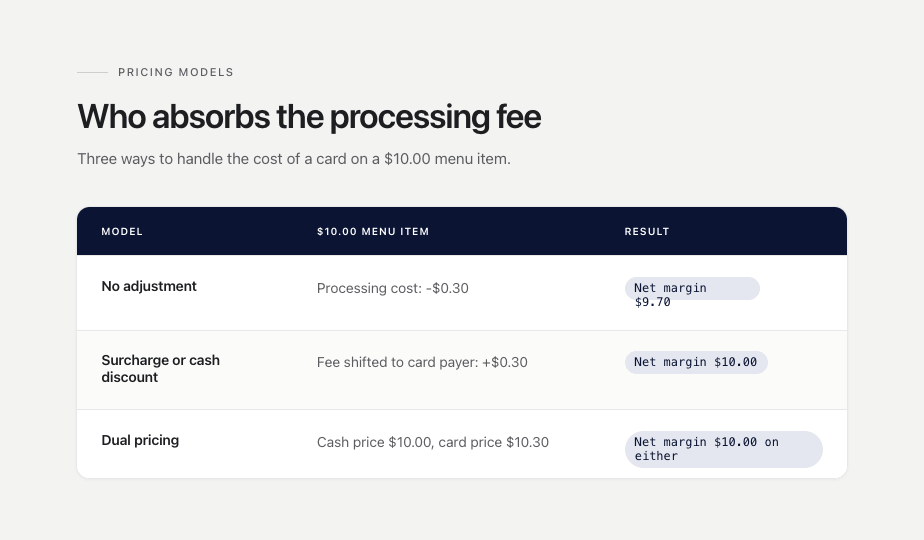
Once an operator understands where the 3% to 4% goes, there are three established pricing models: each compliant, each in wide use, for offsetting or eliminating it.
Credit card surcharging
Surcharging adds a transparent fee, typically 2.5% to 4%, to transactions paid by credit card, shifting the processing cost to the guest who chooses that payment method.
- Surcharges cannot legally be applied to debit or prepaid cards under card brand rules and federal law.
- Several states restrict or regulate surcharging, and most require clear disclosure at the entrance and at the register.
Cash discounting
Cash discounting works from the other direction: posted menu prices reflect the card price, and guests who pay with cash receive an automatic discount at checkout.
Because the restaurant is lowering the price for cash rather than raising it for card, cash discounting is legally compliant in all fifty states and avoids most of the disclosure requirements tied to surcharging.
Dual pricing
Dual pricing shows both prices up front. The point of sale maintains a cash price and a card price simultaneously, and guests see both at the menu board or the register before they choose how to pay.
The extra amount collected on card transactions offsets the processing bill directly, and because both prices are visible before the guest decides, there is no friction or surprise at checkout.
Building a sustainable financial foundation
Every percentage point saved on processing goes straight back to a restaurant's bottom line. Reducing that overhead takes more than chasing a low introductory rate: it takes real-time visibility into how guests are paying and a pricing model that matches the restaurant's concept and guest base.
Nova pairs a unified point of sale with the pricing tools operators need: dual pricing, cash discounting, and surcharging support, to help restaurants keep more of every transaction. Visit novatab.com to schedule a platform walkthrough.