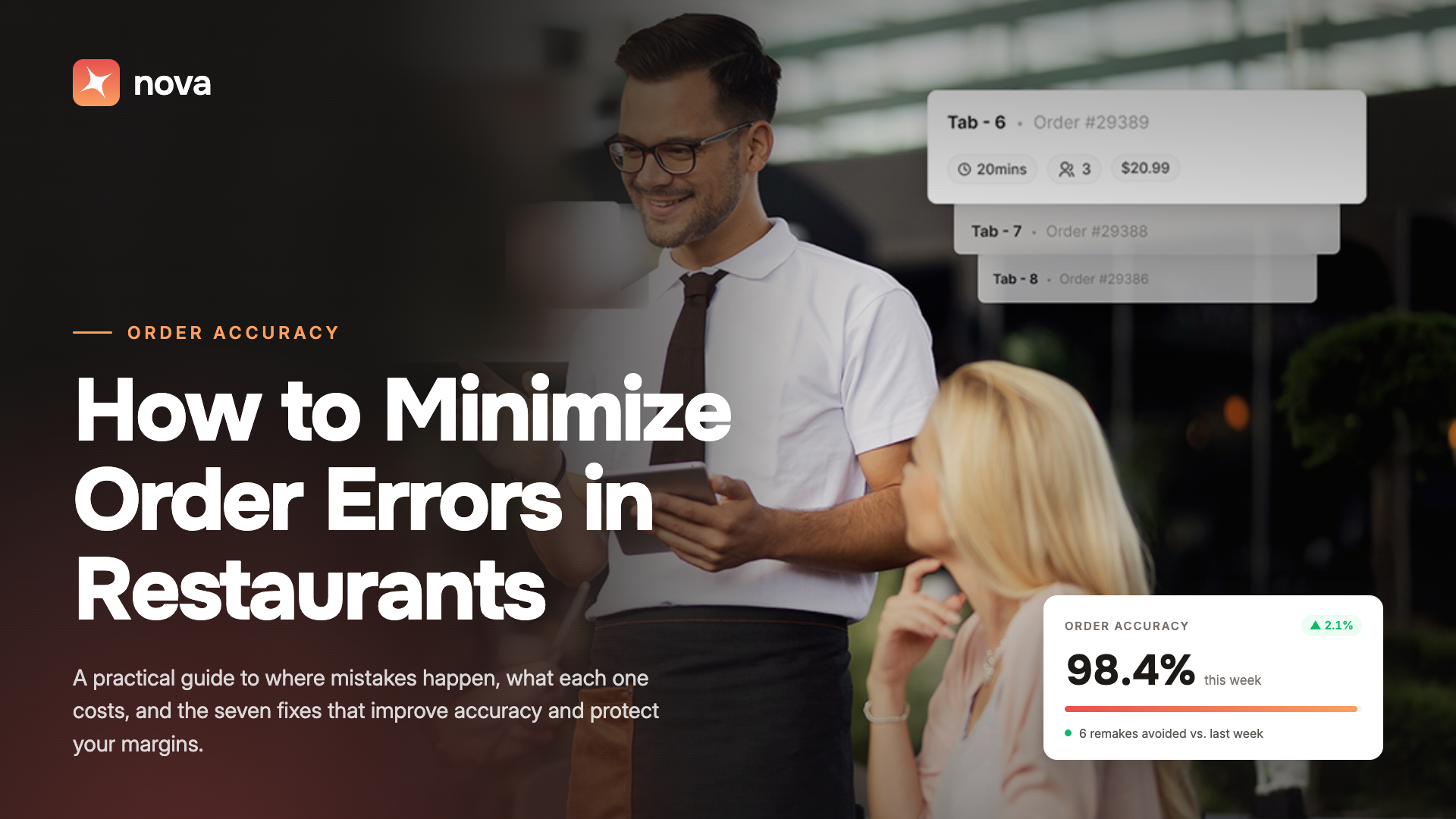
How to Minimize Order Errors in Restaurants: A Practical Guide to Improving Accuracy and Protecting Margins

Quick Answer: Restaurants cut order errors by standardizing how orders are captured (structured POS and modifiers), digitizing how tickets reach the kitchen (a Kitchen Display System), adding a confirmation step before every order is submitted, unifying dine-in, online, and delivery into one order stream, and tracking an order error rate every week instead of reacting shift by shift. Published benchmarks put average order accuracy at 86 to 89% across major chains (QSR Magazine Drive-Thru Reports, 2023 to 2025), meaning roughly 1 in 7 to 1 in 8 orders has a mistake even at the most heavily audited restaurants. Independent and full-service operations, which are rarely audited this closely, have little reason to assume they're doing better.
How much is an incorrect order really costing you?
On the surface, a wrong order doesn't look like much of a problem: a missing side, a skipped modification, the wrong main. In the long run, these small mistakes become major problems, both operationally and financially.
Order accuracy is one of the few restaurant operations metrics with a real, published industry benchmark. The 2025 QSR® Drive-Thru Report, an annual mystery-shopper audit of major chains, put industry-wide order accuracy at 87%, down from 89% in 2024 and in line with the 84 to 89% range recorded every year since 2019. In plain terms, even at the most heavily benchmarked drive-thrus in the country, roughly 1 in 8 orders leaves the window wrong. Independent, full-service, and delivery-heavy restaurants, which are almost never audited this rigorously, have little reason to assume they're doing better.
The current dining climate has restaurants juggling dine-in service alongside third-party delivery, online orders, and a growing volume of modification requests, all at once, often during the same rush. That combination is exactly where accuracy breaks down.
Order accuracy isn't just a service-quality metric. It's margin protection.
What Order Errors Are Actually Costing You
Most restaurants treat order mistakes as a cost of doing business. A few remakes here and there don't seem like a major issue during a busy shift. But zoom out to the monthly numbers, and the picture changes fast. Every incorrect order creates several layers of cost at the same time.
1. Food Waste
The most obvious cost is the dish itself.
If a $22 entrée needs to be remade, that food usually can't be resold. Depending on your food cost percentage - typically 28 to 35% of revenue across the industry, according to ReFED-sourced data cited by Toast - that's roughly $6 to $9 in direct ingredient loss per remade dish, gone immediately.
Now multiply that by several mistakes per day.
Even a restaurant averaging just four incorrect orders daily could lose thousands annually in wasted food alone.
That's not a hypothetical category, either. Food waste already costs the U.S. restaurant industry an estimated $162 billion a year, and a separate ChefHero study reported by Toast put lost profit from waste at roughly $2 billion industry-wide. Neither figure is specific to order errors, but remakes triggered by mistakes are a controllable, trackable slice of that number that most restaurants have never actually measured.
2. Labor Waste
Order mistakes also consume labor hours.
The kitchen has to stop and remake dishes. Servers spend extra time apologizing and resolving complaints. Managers step in for service recovery. Delivery staff may need to coordinate replacements or refunds.
These hidden labor costs add up quickly, especially during busy service periods when time is already stretched thin.
3. Slower Table Turnover
A delayed order affects the entire dining flow.
Guests wait longer, tables stay occupied longer, and new customers may face slower seating times. During high-volume hours, this can directly reduce how many covers your restaurant serves in a shift.
For quick-service and casual dining concepts, even small delays create operational bottlenecks.
4. Negative Reviews and Lost Loyalty
A customer may forgive one mistake.
But repeated errors turn into bad reviews, refund requests, or guests who simply stop coming back. One widely cited customer-experience study, run by Simplr and reported by QSR Magazine, found that 51% of customers won't return to a business after a single bad experience. A wrong order is one of the fastest ways to manufacture that experience, and it's entirely self-inflicted.
Today's diners have endless options. Consistency matters more than ever.
Many restaurants pour money into marketing to acquire new customers while unintentionally losing repeat business to operational issues that were preventable in the first place.
A Simple Monthly Example
Imagine an independent restaurant experiences:
- 5 order errors per day
- Average remake cost: $15
- 30 operating days per month
That equals:
- $2,250 monthly in direct remake costs
- Not including labor, discounts, delayed service, or reputation damage
Over a year, that becomes more than $27,000 lost from a relatively "small" operational issue.
That's a conservative estimate. It only counts direct remake cost, not the labor spent fixing it, the comps handed out to smooth things over, or the customers who quietly stop coming back. For many restaurants, the real number is significantly higher.
The reality is simple: even a small error percentage creates major revenue leakage over time.
Industry Benchmark: How Order Accuracy Has Trended
These figures come from the most rigorously and consistently audited segment of the industry: major drive-thru chains. Full-service and delivery-heavy restaurants are measured far less formally, but the same error drivers apply everywhere orders are taken, entered, and relayed by hand.
Where Most Order Errors Happen (And Why)
Restaurant owners often blame staff when mistakes happen. But in most cases, order errors aren't caused by careless employees. They're caused by weak systems, unclear processes, or disconnected technology.
When restaurants identify where mistakes actually occur, they can fix the root causes instead of constantly firefighting symptoms.
A. Front-of-House Errors
Miscommunication During Order Taking
Busy environments create communication gaps.
Servers may mishear guests during loud dinner rushes. Complex modifications get forgotten. Handwritten notes become unclear. Verbal communication between FOH and kitchen becomes inconsistent under pressure.
The more manual the process, the greater the chance for mistakes.
This isn't limited to human error, either. Among restaurants using AI voice ordering at the drive-thru, the 2025 QSR Drive-Thru Report found accuracy drops to 81% when the AI completes the order without human help, versus 95% when an employee steps in, and customization requests account for 62% of the AI's mistakes. If brand-new ordering technology still stumbles most on custom modifications, that's a strong signal about where the real risk sits, human or automated.
Manual POS Entry Mistakes
Typing errors are surprisingly common.
Selecting the wrong modifier, entering incorrect quantities, or accidentally skipping customizations can all lead to inaccurate tickets reaching the kitchen.
This becomes even more problematic when menus are large or heavily customizable.
B. Kitchen Errors
Misread Tickets
Traditional paper tickets create multiple problems:
- Poor handwriting
- Lost tickets
- Incorrect sequencing
- Missed modifiers
- Duplicate preparation
During peak hours, kitchens moving quickly may overlook small instructions that significantly affect the final order.
Modifier Confusion
"Extra crispy." "No dairy." "Sauce on the side." "Gluten-free bun."
When modifiers are inconsistent or written in free-text formats, kitchens may interpret instructions differently. This creates inconsistency and increases remake risk.
C. System Gaps
One of the biggest causes of restaurant order mistakes today is disconnected systems.
Many restaurants still operate with:
- Separate POS systems
- Third-party delivery tablets
- Independent online ordering platforms
- Manual kitchen workflows
This fragmentation increases the likelihood of missed, duplicated, or delayed orders.
The gap is especially visible in delivery. In Intouch Insight's 2025 Third-Party Delivery Report, North American consumers ranked order accuracy as the single most important factor in delivery satisfaction, yet restaurant delivery accuracy slipped slightly in 2025 even as convenience-store delivery accuracy improved, narrowing what used to be a wide gap between the two channels. Every disconnected channel is another opportunity for the same order to go wrong in a new way.
7 Practical Ways to Minimize Order Errors
Improving order accuracy doesn't require perfection.
It requires structure.
Restaurants that consistently reduce mistakes usually focus on improving systems rather than simply telling staff to "be more careful."
Here are seven practical ways to reduce errors and improve operational consistency.
1. Use a Structured POS Instead of Manual Order Taking
A modern POS system creates standardization.
Instead of relying on handwritten notes or verbal communication, structured POS workflows ensure every order follows the same format.
Benefits include:
- Clear menu organization
- Standardized modifiers
- Reduced ambiguity
- Faster ticket processing
- Better communication between FOH and kitchen
When servers can quickly select pre-defined modifiers instead of manually typing instructions, order accuracy improves significantly.
Restaurants using integrated systems like NOVA Restaurant Software can simplify this process by centralizing menu management and reducing manual entry errors across channels.
2. Implement a Kitchen Display System (KDS)
Kitchen Display Systems replace handwritten or printed tickets with digital order displays.
This dramatically improves clarity inside the kitchen.
A KDS helps restaurants:
- Eliminate handwriting issues
- Organize ticket sequencing
- Highlight modifiers clearly
- Reduce lost tickets
- Improve kitchen communication
During busy service hours, digital displays also help kitchens prioritize orders more efficiently without confusion.
For high-volume restaurants, this alone can significantly reduce remakes.
3. Enable Modifier Standardization
Free-text chaos creates inconsistency.
Instead of allowing servers to type unlimited custom instructions manually, restaurants should create structured modifier categories.
For example, instead of:
"Burger no onions extra sauce pls"
Use:
- No onions
- Extra sauce
- Medium rare
- Gluten-free bun
This ensures kitchens receive consistent instructions every time.
Standardized modifiers also make staff training easier because employees follow repeatable workflows instead of improvising communication.
This matters more than it sounds. Customization-driven mistakes are consistently the largest single category of order errors, human-entered or AI-entered alike (QSR Magazine, 2025).
4. Add Order Confirmation Steps
Simple confirmation processes prevent many common mistakes.
For dine-in service: servers should repeat orders back to guests before submission.
For online orders: customers should see a clear final confirmation screen before checkout.
These small steps dramatically reduce situations where customers later say: "That's not what I ordered."
Order confirmation is especially important for:
- Large groups
- Highly customized orders
- Dietary restrictions
- Delivery orders
This isn't a minor courtesy step. It's the single highest-leverage fix in the data. In the 2025 QSR Drive-Thru Report, locations where the order confirmation board displayed correctly scored 26 percentage points higher on accuracy than locations where it didn't, the largest single accuracy driver measured in the entire study. One extra verification step can prevent expensive service recovery later.
5. Sync Online and In-Store Orders in One System
Restaurants today receive orders from multiple channels:
- Dine-in
- Takeout
- Delivery apps
- Website orders
- QR ordering
When these systems operate separately, errors increase rapidly.
Unified systems reduce duplication and manual re-entry.
Instead of juggling multiple tablets or disconnected platforms, restaurants benefit from centralized order management where all incoming orders flow into one operational system.
Platforms like NOVA Restaurant Software help reduce fragmentation by syncing POS, online ordering, and kitchen operations in real time.
6. Train Staff on High-Risk Scenarios
Certain situations naturally create higher error risk.
Examples include:
- Peak dinner rush
- Large group orders
- Allergy requests
- Complex menu customizations
- Multi-platform order surges
Instead of generic training, restaurants should specifically prepare teams for these high-pressure scenarios.
Role-playing exercises and workflow drills help staff respond consistently during busy shifts.
The goal is not just speed. It's accurate speed.
7. Use Real-Time Alerts and Error Tracking
Many restaurants never formally track order mistakes.
That's a missed opportunity.
Without data, patterns remain invisible.
Restaurants should regularly monitor:
- Most common remake items
- Frequent modifier errors
- Shift-specific issues
- Staff training gaps
- Online order inaccuracies
Modern restaurant systems can help identify recurring operational bottlenecks before they become expensive habits.
When owners can see where mistakes repeatedly occur, they can fix the underlying process instead of reacting emotionally shift by shift.
Manual vs. POS-Only vs. Fully Integrated Systems
Not every fix requires the same investment. This is a directional comparison of where accuracy typically breaks down at each level of system maturity, useful for deciding what to fix first.
Directional comparison based on the error drivers identified in the QSR Magazine 2025 Drive-Thru Report and Intouch Insight's Third-Party Delivery Report; actual results vary by menu complexity and order volume.
The Role of Technology in Improving Order Accuracy
Technology alone will not fix poor operations.
But the right technology can make accurate operations far easier to maintain consistently.
Modern restaurant systems are designed to reduce friction between front-of-house, kitchen, and online ordering channels.
The best restaurant technology should help operators:
- Centralize orders
- Improve communication
- Reduce manual entry
- Standardize workflows
- Increase visibility across operations
What Modern Systems Should Handle
An effective restaurant system should include:
Unified POS + KDS + Online Ordering
Disconnected tools create operational blind spots.
Integrated systems ensure all orders enter a centralized workflow regardless of where they originate.
This minimizes duplication and confusion.
Real-Time Updates Between FOH and Kitchen
Live syncing helps teams stay aligned instantly.
If modifications change, items become unavailable, or order statuses update, the entire operation can respond quickly without relying on verbal communication.
Built-In Modifier and Combo Validation
Modern systems can automatically flag incomplete orders or missing selections before tickets reach the kitchen.
This reduces avoidable mistakes significantly.
Solutions like NOVA Restaurant Software combine POS, kitchen workflows, online ordering, and operational analytics into a centralized system that helps reduce communication gaps between teams.
When information flows accurately in real time, order accuracy improves naturally.
The Role of Technology in Improving Order Accuracy
Technology alone will not fix poor operations.
But the right technology can make accurate operations far easier to maintain consistently.
Modern restaurant systems are designed to reduce friction between front-of-house, kitchen, and online ordering channels.
The best restaurant technology should help operators:
- Centralize orders
- Improve communication
- Reduce manual entry
- Standardize workflows
- Increase visibility across operations
Measuring and Improving Accuracy Over Time
Order accuracy is not a one-time project.
It requires ongoing measurement and continuous improvement.
Restaurants that consistently improve operations treat accuracy like a measurable business metric, not just a customer service issue.
Key Metrics to Track
Order Error Rate (%)
Measure: Incorrect orders ÷ total orders
This gives visibility into overall operational consistency.
Treat 86 to 89% accuracy as the industry floor, not the goal. That's the benchmark for large, heavily audited drive-thru chains. Independent restaurants that actively track and correct their error rate should be aiming for 95% or higher before calling accuracy "solved."
Remake Rate
Track how many dishes require re-preparation daily or weekly.
This directly impacts food cost and kitchen efficiency.
Customer Complaints
Monitor patterns in:
- Online reviews
- Refund requests
- Delivery complaints
- In-house guest feedback
Recurring themes often reveal operational weaknesses.
ROI: What Better Order Accuracy Means for Your Restaurant
Reducing order errors improves far more than guest satisfaction. It improves profitability across the business.
Before vs. After: A Directional Example
For a restaurant running roughly 100 orders a day at an average remake cost of $15:
Illustrative figures based on the QSR Magazine 2025 Drive-Thru Report's industry accuracy range and a $15 average remake cost; actual results vary by menu, channel mix, and order volume.
Fewer Remakes = Lower Food Costs
Every avoided remake directly protects margins. Restaurants already dealing with rising ingredient prices cannot afford unnecessary waste.
Faster Service = Higher Table Turnover
Accurate kitchens move faster. When orders flow correctly the first time, tables turn more efficiently and guests spend less time waiting. This can increase total revenue capacity during peak hours.
Better Guest Experiences = More Repeat Customers
Consistency builds trust. Customers return to restaurants that reliably deliver accurate, smooth experiences. And loyal repeat customers are significantly more profitable than constantly acquiring new guests through marketing.
Action Plan: Fix Your Order Accuracy in 7 Days
Improving accuracy does not need to take months. Restaurants can begin making measurable progress within one week.
Day 1 to 2: Identify Where Errors Happen
Track:
- Most common mistakes
- Shift patterns
- High-risk menu items
- Communication breakdowns
Focus on identifying root causes.
Day 3 to 4: Standardize Menus and Modifiers
Clean up:
- Duplicate modifier options
- Confusing naming
- Free-text overuse
- Inconsistent ticket formatting
Simpler systems reduce confusion.
Day 5: Improve Order Confirmation Processes
Implement:
- Server order repeat-backs
- Online order confirmation screens
- Allergy verification steps
Small checks prevent expensive mistakes.
Day 6 to 7: Review Data and Train Staff
Share findings with the team.
Focus training on:
- Common problem scenarios
- Rush-hour workflows
- Modifier accuracy
- Kitchen communication
Training works best when tied to real operational data.
Frequently Asked Questions About Restaurant Order Accuracy
What is a good order accuracy rate for a restaurant?
Published industry benchmarks put average accuracy at 86 to 89% among major drive-thru chains (QSR Magazine, 2023 to 2025). That's the floor, not a target. Independent restaurants that actively measure and correct their process should aim for 95% or higher.
What causes most restaurant order errors?
Four things, in roughly this order of impact: miscommunication during order-taking, manual POS entry mistakes, misread or lost kitchen tickets, and inconsistent free-text modifiers. Disconnected systems across dine-in, online, and delivery channels compound all four. Customization requests specifically are the single largest error category, accounting for 62% of mistakes even in AI-assisted ordering.
How much do order errors actually cost a restaurant?
Direct remake cost alone can run into tens of thousands of dollars a year even for a single independent location. Five errors a day at a $15 average remake cost is $2,250 a month, or roughly $27,000 annually. That figure excludes labor spent on service recovery, comps, and the customers who quietly stop returning, which is why the real cost is usually higher.
Can a POS or KDS actually reduce order errors?
Yes. Standardized modifier selection and digital kitchen tickets remove the two most common failure points: illegible handwriting and inconsistent free-text instructions. Order confirmation screens add further protection. In the 2025 QSR Drive-Thru Report, correctly displayed confirmation boards were associated with a 26-percentage-point jump in accuracy, the largest single driver measured in the study.
How do I track order accuracy in my restaurant?
Calculate order error rate weekly (incorrect orders ÷ total orders), track remake rate by shift and menu item, and monitor complaint patterns across reviews, refunds, and delivery feedback. The goal is turning anecdotal frustration into a metric you can act on.
Do online and delivery orders have higher error rates than dine-in?
They carry more risk by default, simply because there's an extra handoff between systems. Consumers rank order accuracy as their top delivery-satisfaction factor (Intouch Insight, 2025), and restaurant delivery accuracy actually slipped slightly in 2025. Syncing online, delivery, and in-store orders into one system is one of the most effective ways to close that gap.
Build Accuracy into Your Restaurant System with NOVA
The current reality for restaurants is dine-in, takeout, and online orders running simultaneously. That may not be ideal, but it will likely remain the norm for the foreseeable future.
That's why restaurant owners are integrating restaurant systems to reduce fragmentation and improve the flow of incoming order information. If your current system relies on too much manual communication, disconnected digital tools, and multiple workflows for the same process, it's likely making operational accuracy a goal that's almost impossible to hit.
NOVA simplifies restaurant systems to reduce order confusion and improve coordination between front-of-house, the kitchen, and online order fulfillment.
There are no exceptions to the fact that the restaurant operations climate is a framework where the only constant is accuracy.
Sources
- QSR Magazine, The 2025 QSR® Drive-Thru Report
- QSR Magazine, The 2024 QSR® Drive-Thru Report
- Intouch Insight, 2025 Drive-Thru Study: Key Insights from our Annual Report
- Intouch Insight, 2025 Third-Party Delivery Report
- Forbes, Restaurants Lose $162 Billion To Food Waste, New Report Finds (2026)
- Toast, New Study Finds Restaurant Food Waste Amounts to $2 Billion in Lost Profits
- QSR Magazine (sponsored content citing Simplr), What All Successful Restaurants Have in Common
- National Restaurant Association, 2024 Restaurant Technology Landscape Report