
Ask any operator who's evaluated self-ordering kiosks, and you'll hear the same objection sooner or later, usually from a GM or a regular who's noticed the register is gone: "Doesn't this make the place feel colder?"
It's a fair question, and most self order kiosk vendors don't really answer it. The pitch you'll usually get is about labor cost: fewer people needed up front, faster throughput, fewer order errors. All true. But it skips right past the thing operators actually lose sleep over, which is what happens to the feel of the place once a screen is doing the ordering instead of a person.
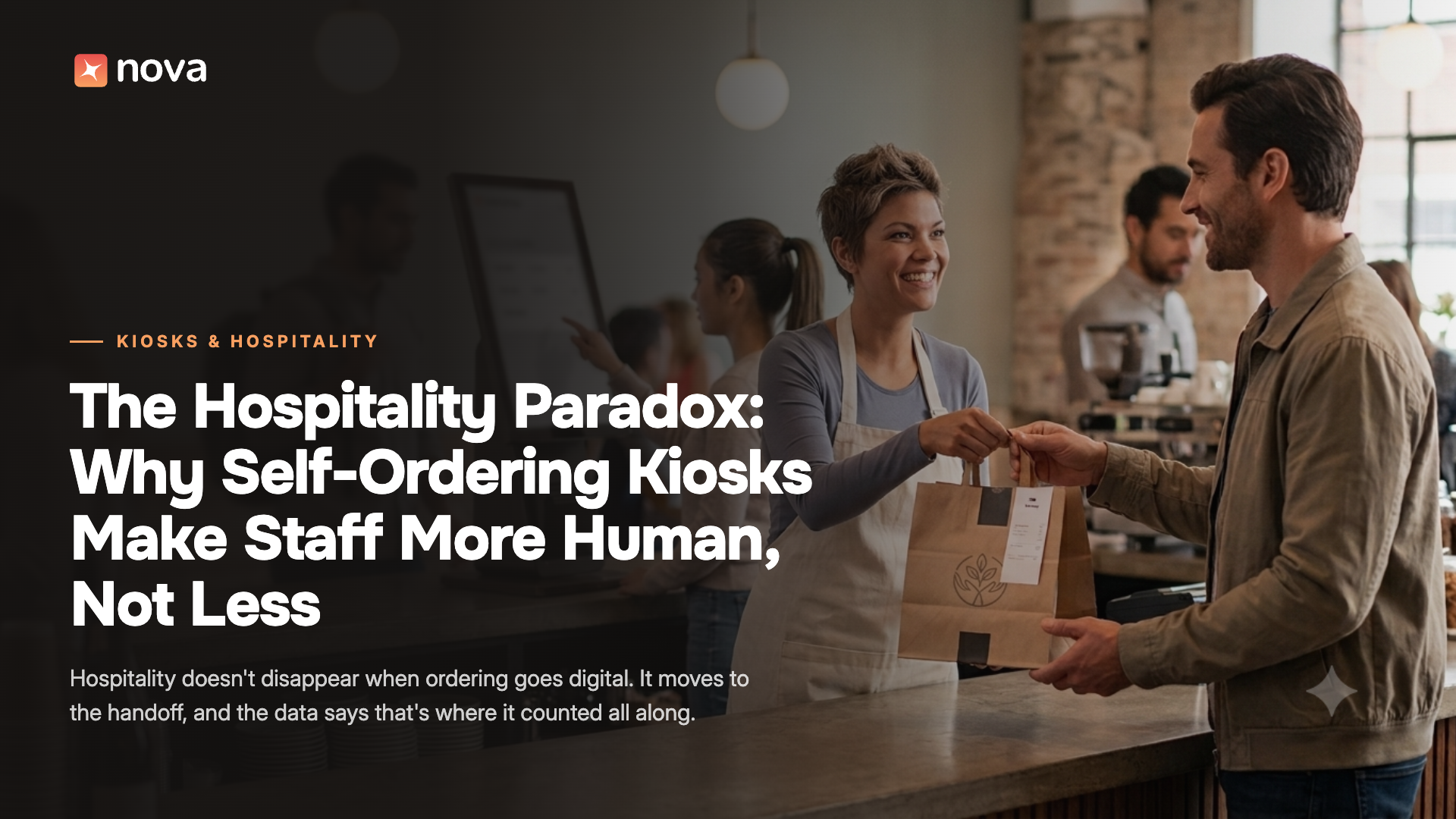
A 2026 mystery-shop study gives a much more precise answer than the industry has had before, and it's not the answer most kiosk companies are selling. Hospitality doesn't go away when ordering goes digital. It moves. And it turns out it moves to exactly the moment where it counts most.
Where the Warmth Actually Comes From
InTouch Insight ran 449 mystery shops across nine major QSR brands in 2026, including Chick-fil-A, McDonald's, Chipotle, and Dunkin', tracking what happens after a customer places a digital order. The ordering step itself turned out to be a non-issue. 84% of customers said speed met or beat their expectations. What actually swung satisfaction up or down was the pickup.
A few numbers make the point better than any framing could:
Eye contact from an employee at pickup raised perceived friendliness by 59 percentage points. A pleasant demeanor added another 54 points. Just saying "thank you" was worth 30 points on its own. And 86% of customers had some kind of employee interaction during pickup, even on a digital order, which tells you the human moment wasn't optional in the first place. It was already happening. The study just measured how much it mattered.
None of that has anything to do with which screen the customer tapped to place the order. It has everything to do with who was standing there when the bag changed hands. That's the detail most kiosk marketing skips, probably because it complicates a simple "automation replaces people" story. For an operator worried about hospitality, though, it's the useful part: the warmth a customer remembers was never coming from whoever rang them up. It was coming from whoever handed them their food.
The Industry Is Already Saying the Quiet Part Out Loud
This isn't just one study. QSR Magazine's 2026 trends coverage flagged the same shift at the brand level. After a few years of automation-first messaging, hospitality and personality are coming back as the thing that actually separates brands. Potbelly now runs 42% of its business through digital orders. Nine in ten consumers scan a restaurant QR code in a given week. And yet the brands pulling ahead aren't the ones automating the most; they're the ones using automation to buy back staff time for the parts of the visit a screen can't do.
Put those two findings side by side, and the paradox mostly resolves itself. Taking an order is not a hospitality moment. It's friction, for the customer standing there repeating themselves and for the employee trying to get through a lunch rush. Pickup, on the other hand, is a hospitality moment, and the data backs that up directly. A kiosk doesn't remove staff from the experience. It moves them from the part of the job that never built loyalty to the part that does.
Speed Was Never the Real Metric. Reliability Is.
This isn't a conclusion resting on one study. Three separate pieces of research, different methods, different samples, different research groups, all land in the same place: consistency beats speed, by a wide margin.
Start with the mobile order-ahead data already covered above. Satisfaction was 97% when an order was ready on time and dropped to 76% when it was late, and about one in five orders weren't ready when promised. That gap tracked directly to process: locations with an efficient ordering flow had orders ready on time 87% of the time, versus just 38% at locations with an inefficient one.
Now look at the 25th Annual Drive-Thru Study, run separately by Intouch Insight and QSR Magazine across more than 2,000 undercover visits in 2025, covering 13 major chains. Taco Bell posted the fastest average drive-thru time in the study, around 4 minutes, and still didn't top the satisfaction rankings. That went to Chick-fil-A and Dutch Bros, tied for the highest satisfaction scores despite being among the slowest chains measured. Across all 13 brands, average order accuracy came in at 87%, and the study's own conclusion was blunt: accuracy and friendliness, not speed, were the strongest drivers of satisfaction. Even the AI-powered drive-thru lanes in the study, which ran faster than human-staffed ones (3:53 versus 4:15), came with slightly lower accuracy (83%), which suggests the novelty of the tech was masking exactly the kind of error rate that erodes trust once it wears off.
Then there's the American Customer Satisfaction Index's 2026 restaurant study, an independent research body with no connection to either study above. QSR satisfaction held flat at a score of 79 for a third straight year running, and the study's own framing was that "consistency across the full experience is what separates the leaders right now," calling out order accuracy and the digital experience specifically as the metrics actually moving the needle.
Three studies, three methodologies, one answer. Customers don't remember how fast the order went in. They remember whether what came out matched what they asked for, and whether it showed up when they were told it would.
That's the real risk in judging a kiosk purely on how fast it lets someone place an order. Only 65% of the locations in the mobile pickup study even had a clearly marked pickup spot, and just 66% of orders were confirmed before being handed off. Those aren't technology problems. They're process problems, and they matter more to satisfaction than shaving a few seconds off order entry ever will.
This is exactly why a kiosk rollout needs a pickup and staffing plan attached to it, not just new hardware bolted onto the same counter layout that existed before. A kiosk that speeds up the order but feeds into a disorganized pickup counter doesn't remove friction; it just moves it a few feet down the line.
Must Read: Playbook for Self-ordering Kiosks
The Labor Story Is Bigger Than Payroll
Most kiosk ROI conversations stop at headcount and payroll. That's real money, but it undersells what's actually changing. Taking orders during a rush is one of the more repetitive, high-pressure jobs on the floor, and repetitive, high-pressure work is a well-known driver of turnover in this industry, where annual turnover routinely tops 100%.
Move staff off order-taking and onto pickup, table touches, and problem-solving, and you're not just improving a satisfaction score. You're changing what the shift actually feels like for the person working it. That's a retention lever as much as an efficiency one, and it's worth more in a tight labor market than most kiosk pitches give it credit for.
There's a revenue angle here too, and it points the same direction. Mobile orders in the InTouch study included a suggestive sell 71% of the time, compared with 61% in person and 58% at the drive-thru. A calmer, more consistent ordering flow doesn't just reduce stress on staff; it upsells more reliably than a rushed human interaction does. That frees the human interaction to do what it's actually good at.
So, Does a Kiosk Make Things Feel Colder?
Honestly, it depends on you, not the kiosk. The data doesn't say kiosks automatically make things warmer. It says the outcome depends entirely on what happens after the order is placed: whether pickup is organized, whether a staff member is actually there and paying attention at handoff, and whether the technology is reliable enough that it never becomes the story of the visit. Technical glitches were rare in the study, showing up in only 8% of orders, but an order with a glitch was roughly 20 times more likely to leave the customer frustrated.
So the honest answer to "won't this feel cold" is: it depends on what you do with the staff time you just got back. Treat the kiosk as a pure cost cut and skip the pickup redesign, and you'll probably get exactly the cold, transactional experience you were worried about. Use that freed-up time to double down on the handoff, and the data says you'll see the opposite.
Where Nova Fits Into This
Here's the part most kiosk vendors miss entirely: the reliability problems in the InTouch data, orders not confirmed before handoff, unclear pickup zones, kitchens out of sync with the front counter aren't really kiosk problems. They're integration problems. They happen when the kiosk, the restaurant POS, and the kitchen are three separate systems that don't talk to each other in real time.
That's the actual argument for Nova. One platform, every restaurant operation: self-ordering kiosks, POS and payments, a kitchen display system, handheld POS for tableside service, online ordering, AI-powered loyalty, and workforce and inventory tools, all running on the same AI-native system instead of self-fix disconnected ones. When the kiosk and the KDS share the same order data in real time, "confirmed before handoff" stops being something you have to train staff to remember. It's just how the system behaves.
Less time your team spends reconciling systems and chasing down whether an order actually made it to the kitchen is more time they spend at the counter, present, making eye contact, saying thank you. That's the whole hospitality paradox in practice.
Book a free demo to see how Nova's kiosk, POS, and KDS work together to fix the handoff moment, not just the order screen.
FAQ
Do self-ordering kiosks reduce the quality of customer service?
Not on their own. Satisfaction on digital-order visits is driven almost entirely by staff behavior at pickup, things like eye contact, friendliness, and a simple thank you, not by how the order was placed. Kiosks shift staff time toward those moments instead of removing human interaction from the visit.
What's the biggest mistake operators make when they add kiosks?
Treating it as a standalone labor cut instead of redesigning pickup around it. Without a clear pickup spot, an order confirmation step, and a staff member actually present at handoff, the time saved at ordering gets lost to friction later in the visit.
Will kiosks actually help with staff turnover?
Indirectly, yes. Kiosks take staff off one of the more repetitive, high-pressure parts of the job, peak-hour order-taking, and free them for guest-facing work that's generally more engaging. That matters in an industry where turnover commonly runs above 100% a year.
How reliable do kiosks need to be for this to work?
Very. Technical issues are uncommon, around 8% of digital orders in recent research, but they do outsized damage when they happen. An order with a glitch is roughly 20 times more likely to leave a customer frustrated. Reliability should carry as much weight as speed in an evaluation.
Is this only relevant to large QSR chains?
No. The core idea, freeing staff from order-taking so they can focus on the guest, applies to any restaurant with counter or self-service ordering, independents and multi-unit operators alike.