Handheld POS Systems: Faster Service & Higher Table Turnover for Full-Service Restaurants
.svg)
Think about the last time you went out to eat. How long did you wait to place your order? And how frustrating was it when you were ready to pay but couldn’t find your server? Today’s diners notice these moments more than ever. Speed, convenience, and smooth service are no longer “nice to have” but expected.
At the same time, restaurants are dealing with staff shortages, busy floors, and rising operational pressure. Traditional workflows, where servers walk back and forth to a fixed terminal, are starting to feel outdated and inefficient.
This is exactly where handheld point of sale systems step in. They’re quietly transforming how full-service restaurants operate by reducing delays, improving accuracy, and helping teams serve more guests in less time.
What Is a Handheld Point of Sale System?
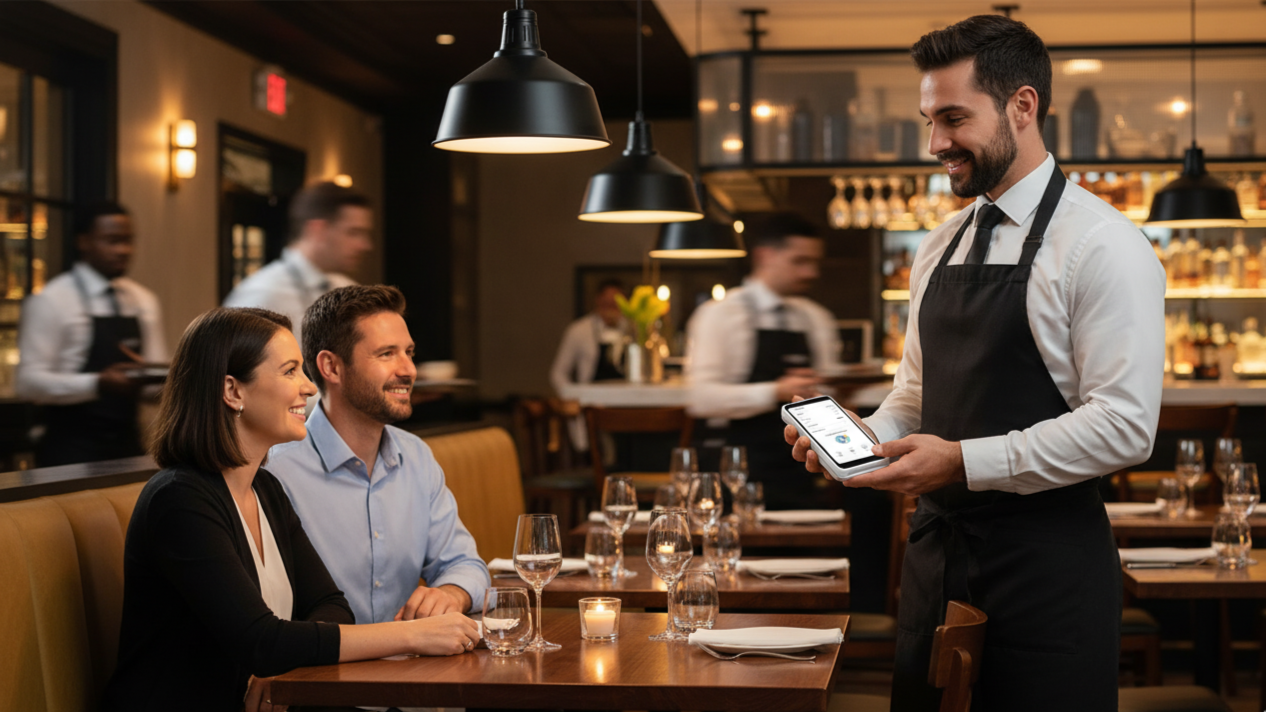
A handheld point of sale system is a portable point of sale system that enables a server to accept orders, process transactions, and manage tables directly at the table. This means that, unlike a traditional point of sale system, where a server has to go to a point of sale terminal to perform transactions, a handheld point of sale system enables a server to perform transactions directly at the table.
A handheld point of sale system directly connects to the kitchen, bar, and payment systems in real time. This means that as soon as a server enters an order, it is sent to the kitchen immediately. There is no waiting, no intermediary step.
Why Traditional POS Slows Down Full-Service Restaurants
Most restaurant owners don’t realize how much time is lost in small movements. A server walking back and forth to a POS terminal may not seem like a big deal, but multiply that by every table, every shift, and every day, and it adds up fast.
Here’s what usually happens with traditional systems:
- Servers leave the table to enter orders
- Orders reach the kitchen with a delay
- Guests wait longer for confirmation
- Payments take several minutes to process
- Bottlenecks form during peak hours
Key Benefits of Handheld Point of Sale Systems
In a 2025 national survey, almost half of diners (48%) said speed is what really decides where they eat. And honestly, it shows that people have very little patience for waiting around anymore. Long queues for a table, slow ordering, or chasing the bill at the end? That’s exactly the kind of stuff that ruins the whole experience.
This is where handheld POS systems quietly change the game. Instead of making guests wait at every step, they speed things up in a way that just feels seamless. Orders go in instantly, billing happens right at the table, and tables free up faster without it feeling rushed.
Handheld point of sale systems are changing the way full-service restaurants operate on a daily basis. Here are some major benefits:
Faster Table Turnover
With handheld point of sale systems, orders go directly to the kitchen the moment they are taken. Payments can also be completed instantly at the table.
The result:
- Faster ordering
- Faster food preparation start time
- Faster bill settlement
This directly increases table turnover and boosts revenue without increasing seating capacity.
Improved Order Accuracy
With handheld point of sale systems, orders are entered directly into the system with all modifiers clearly selected.
Benefits include:
- Reduced miscommunication with the kitchen
- Fewer order corrections
- Better guest satisfaction
Accuracy builds confidence. And confident guests are more likely to return.
Tableside Payments
One of the biggest friction points in dining is the payment process. Waiting for the bill, waiting for the card machine, waiting for the receipt. It breaks the experience.
Handheld point of sale systems remove this delay completely. Guests can pay the moment they’re ready.
Advantages:
- Shorter payment cycles
- Faster table availability
- Higher tips due to smoother experience
There’s also a subtle psychological effect here. When payment feels effortless, the entire dining experience feels premium.
Increased Revenue Opportunities
Upselling works best when it feels natural, not forced. With a restaurant handheld ordering system, servers can suggest add-ons, drinks, or desserts while taking the order, without breaking the flow of conversation.
For example:
- Suggesting a wine pairing while entering the main course
- Recommending a dessert before closing the order
- Highlighting specials with visuals on the device
This increases average order value without making the guest feel pressured.
Features to Look for in a Handheld POS System
Not all handheld point of sale systems are built the same. On the surface, many of them offer similar features, but the real difference shows up during a busy Friday night when your staff is stretched and every second matters. That’s when the right system feels invisible; it just works.
Instead of looking at a checklist, think of this as choosing a system that removes friction from your floor. The best handheld point of sale systems don’t just add features; they quietly fix the small inefficiencies that slow your team down every day.
Let’s break down what actually matters.
Real-time kitchen integration
This is the backbone of speed. The moment a server taps “confirm order,” it should appear in the kitchen instantly. No syncing delays, no manual push, no confusion.
But here’s what most people miss: it’s not just about speed, it’s about clarity. A good system ensures:
- Modifiers are clearly visible to the kitchen
- Courses are timed properly
- Special instructions don’t get lost
When the kitchen trusts what they see on the screen, they move faster and make fewer mistakes. That trust is what keeps service flowing smoothly.
Secure mobile payments
Payments are the final impression of your service. If this step feels slow or awkward, it sticks with the guest.
A strong handheld point of sale system should support:
- Card payments (tap, insert, swipe)
- UPI and QR-based payments
- Contactless wallets
But beyond options, speed and reliability matter more. The transaction should take seconds, not minutes.
There’s also a psychological angle here. When guests can pay quickly without handing over their card or waiting for a machine, they feel more in control. That sense of control improves their overall perception of your restaurant.
Offline functionality
Internet issues are not rare. And when your system depends entirely on being online, even a short disruption can bring service to a halt.
This is why offline capability is not a bonus; it’s a safety net.
A reliable system should:
- Continue taking orders without internet
- Store data securely
- Sync automatically once the connection is restored
Your team shouldn’t even have to think about it. Service continues as usual, and guests never notice a thing.
Table and order management
Your floor is like a live map that keeps changing every minute. Tables open up, orders move through stages, and guests request changes.
A good handheld system gives your staff a clear view of:
- Which tables are occupied, reserved, or ready
- Order status in real time
- Course progression
This reduces confusion between team members and avoids those awkward moments where guests feel ignored because no one is sure who’s handling their table.
Menu control from a central system
Menus change more often than people think. Items run out, prices update, specials come and go.
If your system makes menu updates complicated, your staff ends up working with outdated information, and that leads to mistakes.
A strong system allows you to:
- Update items instantly across all devices
- Add or remove dishes in seconds
- Modify pricing or availability without disruption
This becomes especially powerful during peak hours. Imagine marking a sold-out dish unavailable instantly instead of having servers repeatedly apologize to guests. Small change, big impact.
Built-in analytics
Here’s the thing: restaurants that actually pay attention to their data tend to stick around longer. They’re about 23% more likely to survive, and that’s not by chance. It usually comes down to understanding what’s working and what’s quietly dragging them down.
And it goes beyond just staying afloat. When you really start looking at your numbers, like what dishes are moving, what times get chaotic, or where money slips through the cracks, the impact is real. Restaurants have seen revenue go up by around 10%, costs come down by about 5%, and profits get that extra push as well.
Good handheld point of sale systems provide insights like:
- Which items are selling the most
- Peak ordering times
- Average table duration
- Staff performance patterns
This helps you make smarter decisions on the go. For example, if you notice a spike in a certain dish, you can push it more or manage kitchen prep better.
Staff management tools
Your system should not just track sales, it should support your team.
Built-in staff tools can help you:
- Monitor individual performance
- Track order handling speed
- Assign sections efficiently
- Reduce dependency on manual supervision
There’s also a behavioral shift that happens here. When staff know their performance is visible, they naturally become more attentive and efficient.
How Handheld POS Improves Restaurant Operations
The real impact of handheld point of sale systems goes beyond speed. It changes how the entire restaurant functions.
Here’s what improves operationally:
- Faster kitchen communication: No delays in order transmission mean better prep timing.
- Reduced front-of-house congestion: No crowding around handheld POS for restaurant terminals during peak hours.
- Better coordination between staff: Everyone works with real-time information.
- More efficient peak-hour service: High-pressure situations become more manageable.
Modern platforms are also combining handheld POS for restaurants with analytics, operations, and guest engagement tools. This gives restaurant owners a complete view of their business in one place.
How NOVA Powers Modern Restaurants
NOVA isn’t just another tool you add to your stack. It’s built around how restaurants actually run during peak hours, when decisions are quick, pressure is high, and there’s no room for delays.
At its core, NOVA’s handheld point of sale systems are designed to remove the small gaps in service that quietly cost you time and money every single day.
Here’s what that looks like on your floor.
Service That Moves as Fast as Your Guests
With NOVA, your servers don’t need to step away from the table to get things done. Orders are taken right where the guest is sitting and sent to the kitchen instantly.
That one shift alone changes the pace of your entire service. Guests feel attended to, and your kitchen gets a head start on every order.
Payments That Don’t Break the Experience
The last few minutes of a meal often decide how guests remember the entire experience. NOVA makes sure that the moment is smooth.
Servers can process secure tableside payments in seconds, whether it’s card, UPI, or contactless. No chasing machines, no back-and-forth, no waiting around. Guests leave with a good impression, and your tables free up faster.
A Kitchen That’s Always in Sync
Miscommunication between the floor and the kitchen is one of the highest hidden costs in a restaurant. NOVA removes that completely.
Every order, every modifier, every special instruction is sent in real time, exactly as entered.
This means:
- Fewer errors
- Faster prep times
- Better coordination during rush hours
When the kitchen trusts the system, the entire operation runs more smoothly.
Control Without Complexity
Menus change. Prices change. Availability changes. NOVA gives you the ability to manage all of it from one place without slowing down your team. You can update items, push promotions, or adjust pricing instantly across all devices.
Decisions Backed by Real Data
Most restaurants rely on gut feeling. NOVA gives you clarity. With real-time insights, you can see what’s selling, when your peak hours hit, and how your team is performing, all while service is still running. This allows you to act in the moment, not after the day is over.
Why NOVA Isn’t Just a POS, It’s Your Growth Engine
NOVA doesn’t just replace your old system; it removes the everyday friction that slows your restaurant down. Whether that’s faster orders and seamless tableside payments to real-time insights that help you make smarter decisions, everything is built to keep your service moving and your tables turning.
The result is simple but powerful. Happier guests, a more efficient team, and higher revenue from the same number of tables.
In a business where small delays add up quickly, NOVA helps you stay one step ahead by turning speed and efficiency into your biggest advantage.