Running a restaurant is one of the most demanding business ventures in the United States. It demands the right location, a compelling menu, a well-trained team, tight financial discipline, and the ability to adapt quickly when conditions shift. While passion drives many operators into the industry, passion alone does not determine whether a restaurant survives. Strategy does.
The good news is that the widely repeated narrative about restaurants is more pessimistic than the data actually supports. The reality is more nuanced, and for operators who plan carefully, the odds are better than the headlines suggest. Understanding the real restaurant success rate and the real failure rate is the first step toward building a business that lasts.
17% of independent restaurant outlets fail in their first year of operation. The commonly cited '90% fail' statistic has been widely debunked; actual first-year closure rates are far lower.
~50% of restaurants that survive their first year will still be operating at the five-year mark, according to Bureau of Labor Statistics data.
35% of restaurants that open today will still be operating after ten years, meaning roughly two-thirds do not make it to a decade.
What Percent of Restaurants Fail? The Real Numbers
This is one of the most-searched questions in the restaurant industry, and one of the most misunderstood. The popular claim that 90% of restaurants fail in their first year has been cited so frequently that many people accept it as fact. It is not. The statistic has been traced back to an American Express commercial from 2003 and has no credible data behind it.
So what percent of restaurants actually fail? The most-cited academic research, published by H.G. Parsa and widely referenced by the National Restaurant Association, puts the first-year failure rate at between 14% and 30%, depending on the market, location, and restaurant type. More recent data from Datassential puts the 2025 first-yearfailure rate at under 1% for tracked restaurant units, though that figure reflects conditions within a specific data set and should be read alongside the broader context.
A reliable middle-ground estimate, supported by Bureau of Labor Statistics data, is that approximately 17% of independent restaurant outlets close within their first year. That figure rises significantly over time. Roughly half of all restaurants that survive year one will have closed by the end of year five. By the ten-year mark, only aroundone-third of restaurants that originally opened are still in business.
What these numbers tell us is important: the first year is not necessarily the deadliest. Many restaurants that survive their opening stretch go on to face challenges in years two through five, when the initial enthusiasm fades, deferred costs catch up, and the business needs to prove it can sustain itself without the novelty factor. Understanding this curve helps operators plan for the full lifecycle of the business, not just the launch.
What Percentage of Restaurants Fail by Restaurant Type?
Not all restaurant formats carry the same risk profile. The percentage of restaurants that fail varies considerably depending on the type of operation, the ownership structure, and the price point being served. Understanding these differences helps operators make more informed decisions about the format they choose to enter.
Fine Dining
Fine dining restaurants carry the highest failure rate of any restaurant segment. Recent data puts the annual closure rate for fine dining at approximately 4.9%, well above the industry average. This reflects the high overhead costs associated with premium locations, skilled kitchen staff, and the elevated level of service infrastructure required to compete at the top end of the market. Fine dining is also the most sensitive to economic downturns, as it is the first discretionary spend that consumers cut back when budgets tighten. The reward for success is significant, but the risk profile demands stronger capitalization, longer runway, and deep operational expertise.
Fast Casual and Quick Service
At the other end of the risk spectrum, fast casual and quick service restaurants have the lowest failure rates, often cited at 0.5% to 1% per year for established segment operators. These formats benefit from lower labor costs per cover, faster table turns, higher transaction volume, and more predictable demand patterns. The operational model is also simpler, which reduces the number of variables that can go wrong. For operators entering the restaurant industry for the first time, fast casual represents a more forgiving learning environment than full-service formats.
Casual and Mid-Scale Dining
Casual and mid-scale dining formats sit in the middle of the risk curve. These restaurants face a challenging competitive environment in 2026: squeezed between fast casual operators on price and QSR operators on speed, while also competing with full-service restaurants for experience-driven diners. The casual dining segment has seen some of the most publicized chain closures in recent years precisely because the format is under structural pressure from changing consumer preferences.
Independent vs. Franchise
Independent restaurants fail at meaningfully higher rates than franchise or chain operations. Franchised restaurants benefit from established brand equity, proven operational systems, centralized marketing, and supply chain efficiencies that are unavailable to independent operators. Independent full-service restaurants have a first-year failure rate of approximately 17%, while franchised concepts within the same segment typically outperform that benchmark by a significant margin. That said, franchise fees, royalties, and the constraints on menu and operational flexibility mean that the financial upside for successful franchisees is also more limited.
The key takeaway is that while all restaurants face failure risk, that risk is not evenly distributed. Format choice, ownership structure, and price point all meaningfully affect the probability of long-term survival.
Popular Restaurant Chains That Closed in 2025 and 2026
The challenges facing independent operators are also playing out at scale among established restaurant chains. Even brands with decades of history and national recognition have been unable to avoid financial distress as rising costs, shifting guest preferences, andpost-pandemic debt loads have converged. Here is a look at the most significant chain closures and restructurings from 2025 and 2026.
Hooters
Hooters filed for Chapter 11bankruptcy protection in April 2025, carrying more than $330 million in debt. The company announced the sale of its company-owned restaurant portfolio as part of the restructuring, and locations across multiple states have continued closing in the aftermath. The Hooters closure is significant because the brand had been in operation for over 40 years: a reminder that longevity and brand recognition do not insulate a restaurant from structural business problems.
On The Border
On The Border Mexican Grill and Cantina, the Tex-Mex chain with locations across the US, filed for Chapter 11bankruptcy in March 2025. Shortly after, the parent entity filed for Chapter 7and shut down all company-owned US restaurants, effectively ending operations. The closure marked one of the more complete collapses of a national casual dining chain in recent memory, with no acquirer stepping in to revive the brand at scale.
FAT Brands and Smokey Bones
FAT Brands, the parent company of multiple restaurant chains, filed for Chapter 11 bankruptcy protection in January 2026, listing over $582 million in assets and more than $95 million in debts. As part of the restructuring, all remaining Smokey Bones locations were permanently closed in April 2026, alongside closures of Johnny Rockets and Yalla Mediterranean units. The FAT Brands situation illustrates the risks of rapid multi-brand expansion in a challenging cost environment.
Bravo Brio Restaurants
The Italian casual dining group operating Bravo and Brio restaurant brands filed for Chapter 11 bankruptcy for the second time in five years in August 2025. The repeat bankruptcy underscores how difficult it has been for mid-scale Italian casual concepts to compete in the current market, even after prior restructuring attempts.
Denny's
Denny's closed approximately 70underperforming locations in 2025, following closures of 88 restaurants in2024. The company has described the closures as part of a deliberate portfolio optimization strategy aimed at improving average unit economics and cash flow. Denny's continues to operate as a major national chain, but the scale of closures reflects the pressure on legacy breakfast-focused casual dining concepts.
Noodles and Company
The Colorado-based fast-casual chain announced the closure of 32 locations in 2025 despite reporting sales growth, citing net losses that made the underperforming locations unsustainable to carry. Noodles and Company's situation highlights a dynamic that affects many fast casual operators: growing revenue does not automatically translate to profitable unit economics across every location in a portfolio.
TGI Fridays
TGI Fridays filed for Chapter 11bankruptcy in late 2024 and closed more than 80 US locations as part of the restructuring. The brand, once one of the defining casual dining chains of the 1980s and 1990s, has been in a multi-year struggle to adapt its format and value proposition to a market where guest expectations have fundamentally shifted.
The pattern across these closures is consistent: high fixed costs, debt accumulated during and after the pandemic, and a failure to adapt quickly enough to changing consumer preferences around value, speed, and experience. These are not isolated failures: they are a signal about what the market now demands from restaurant operators at every scale.
Why Restaurants Struggle
Running a restaurant is more than serving great food; it’s about balancing dozens of moving parts, from finances and staffing to marketing and guest experience. Even well-run establishments can stumble if critical foundations aren’t in place.
Below are the most common reasons restaurants struggle and what operators can do differently to improve their restaurant success rate.
Wrong Location Choices
According to Hilton, only 1 in 5 people travel specifically to seek out new restaurants. Selecting the right location is essential to ensure a high restaurant success rate. Any location that causes low sales, high operational costs, or customer dissatisfaction can be considered the wrong choice. You can look for parameters like,
- High rental costs
- Low footfall
- Parking issues
- Weather conditions
- Unsafe neighborhood
Selecting the right location can boost sales instantly. On the other hand, even a well-run restaurant with great food can fail if customers simply can’t or won’t get to it.
Menu-Market Incompatibility
The market you are catering to must be a vital factor in how you design the menu. Even great food in the wrong market can lead to low sales. For instance, if you open a fine-dining French-based outlet in a suburban area with a budget-conscious population, it can lead to a low restaurant success rate. Therefore, you must keep the local communities' preferences and dining habits in mind before designing the menu.
Weak Marketing Strategies
In the age of social media, no industry can rule out the importance of a good marketing function. Marketing today is not just about awareness; it’s about storytelling and creating emotional connections. Hence, restaurants that neglect it can find themselves with low market visibility or a bad brand image.
Poor Inventory Management
Improper management of inventory can lead to significant wastage, spoilage, or overstocking, thereby increasing COGS. According to Oracle, average COGS should be 30% or less, with 30% for food sales, 15% or less for nonalcoholic beverages, and a cost range of between 18% and 40% for liquor. On the other hand, a lack of real-time visibility into inventory can cause understocking, which causes customer dissatisfaction.
Inappropriate Menu Pricing
Pricing can make or break a restaurant. Overpriced menus can cause low footfall, while underpriced ones can yield low profits. Many owners fail to strike the right balance between affordability and profitability, leading to financial instability.
Fragmented Tech Stack
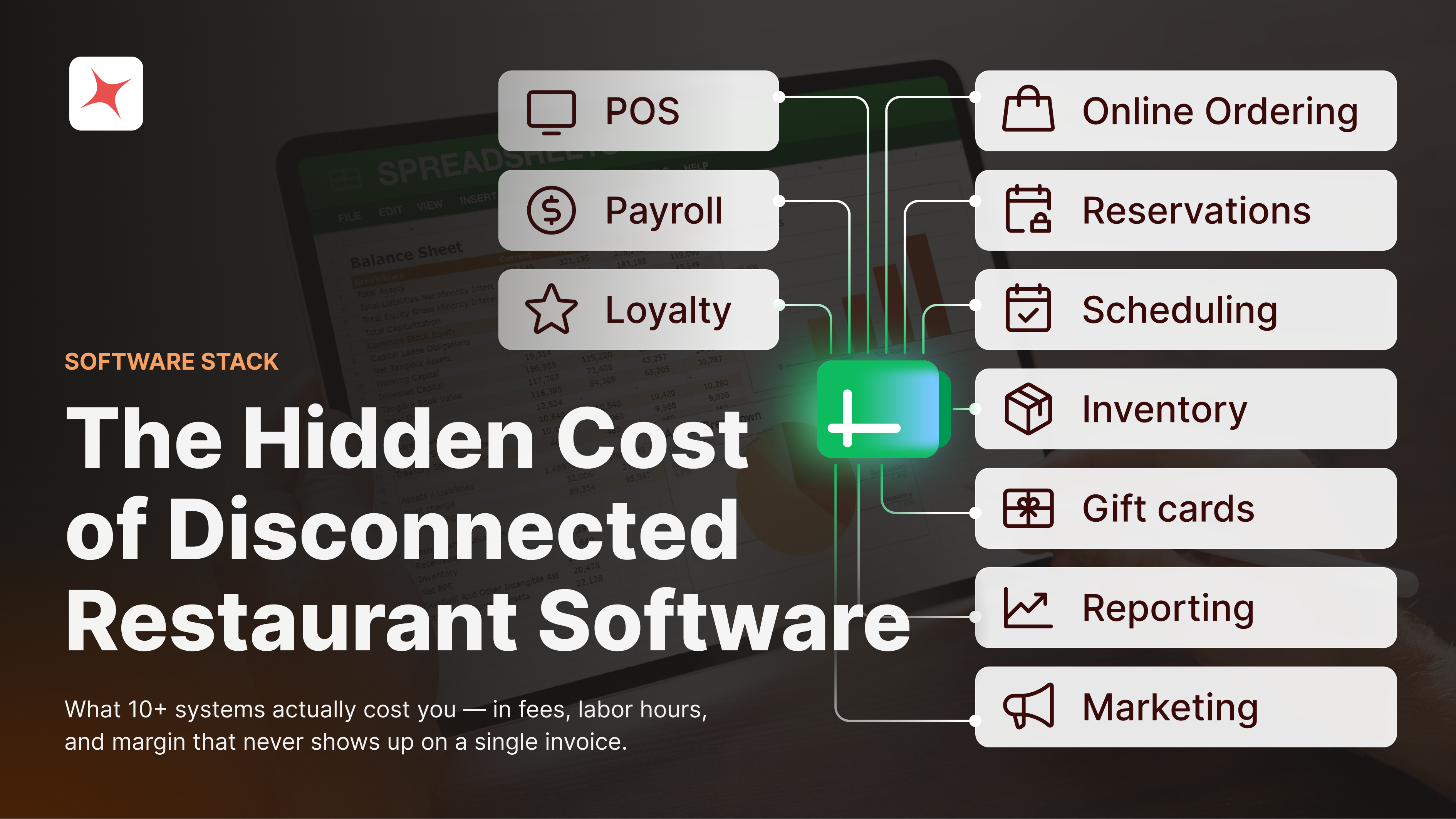
A restaurant deploys multiple tools to accomplish operations, such as ordering, payroll, customer management, and inventory management. If these belong to different vendors, there can be integration and compatibility issues, leading to low operational efficiency. For instance, if the server takes the order and it reaches the kitchen staff late, the guest will have to wait longer.
Inconsistent Food Quality
Food quality is the ultimate factor in a restaurant's success. However, some restaurants fail to maintain a consistent food quality and portion sizes. This is even more common for enterprise restaurant chains. Lack of consistent food quality can be caused by various factors, including multiple suppliers, incompetent staff, or standardized recipes. Serving dishes with different tastes or portions can not only cause low customer retention but also a bad reputation.
Unsatisfactory Customer Service
Some restaurants serve the best cuisine but fail to offer satisfactory customer service. Slow response times, inattentive staff, or unwelcoming attitudes can ruin the dining experience. This leads to lower footfall, ultimately hampering the restaurant's success rate. Customers nowadays expect a more personalized experience from restaurants. If restaurants fail to do so, it can cause bad online reviews.
Undercapitalization and Cash Flow Mismanagement
Running short of cash is the single most common reason restaurants close, even when the food and concept are strong. Most new operators underestimate how much working capital they need to survive the ramp-up period before revenue stabilizes. A restaurant may need three to six months of operating expenses in reserve just to cover payroll, rent, and supplier invoices while building a customer base. Beyond the launch phase, seasonal slowdowns, unexpected equipment failures, and rent increases can quickly erode a cash position that looked healthy on paper. Operators who do not monitor weekly cash flow, maintain an emergency reserve, and plan for slow periods are continuously at risk of a solvency crisis that has nothing to do with how good the food is.
Failure to Adapt to Changing Consumer Preferences
The restaurant market of 2026 looks fundamentally different from even five years ago. Guest expectations around ordering technology, dietary accommodations, speed of service, and sustainability have shifted in ways that reward operators who adapt and punish those who do not. Restaurants that still rely exclusively on paper menus, cash-only payments, or phone-in orders are losing ground to competitors who offer QR ordering, mobile payments, and online reservation management as standard. Similarly, operators who have not addressed plant-based options, allergen transparency, or reduced-waste sourcing on their menus are increasingly out of step with where a significant portion of the dining public has moved. The restaurants that survive long-term are not necessarily the ones with the best original concept -- they are the ones that treat adaptation as an ongoing operating discipline rather than a one-time decision.
Must Read: How can restaurants stay ahead of shifting consumer preferences in 2026?
How Can Restaurants Increase Their Success Rate
Ensure Customer Retention
Loyal customers are essential to ensure a high restaurant success rate. However, the hospitality industry has one of the lowest customer retention rates of only 55%. To ensure retention, here are certain strategies you can adopt-
- Offer personalized experiences to customers through AI-based restaurant management solutions.
- Training staff regularly in customer service protocols
- Deploying loyalty programs integrated with restaurant POS, ordering apps, and marketing engines.
Small gestures, like birthday emails, can go a long way in increasing customer retention.
Strategize the Right Marketing Approach
To ensure constant success in the market, you must take a hyper-focused approach to marketing. You can do so by
- Establishing a clear and unique brand
- Conducting thorough research on competitors, demographics, regulations, suppliers, etc.
- Taking an omni-channel approach by targeting different platforms like social media, email, SMS, and more.
- Optimize your website for the best ordering and payment experience.
- Introduce personalized loyalty programs and promotions.
- Measure the performance of marketing campaigns through relevant KPIs
- Test and reiterate marketing strategies for better results
Smart marketing builds recognition, trust, and a strong emotional connection with diners, facilitating profitability.
Plan for Staff Retention
The restaurant industry has a high turnover rate of 73%, which leads to high training and onboarding costs. Therefore, for a restaurant to succeed, it is imperative to retain staff. You can start by creating a positive work culture. Conduct regular training for employees so they do not feel stagnant. Implement an incentive program to encourage them and boost morale. Staff who feel respected and supported are more motivated to deliver great service and represent the brand well.
Focus on Financial Planning and Cost Control
Optimizing expenses and financial management is vital to ensure long-term sustainability for any restaurant. Most restaurants fail not because of low profits but their inability to monitor and manage expenses. Efficient cost control helps you stand your ground even during low-sales periods and save revenue for emergencies and unanticipated expenses. Restaurants can opt for financial consultation services or hire an expert in-house team to handle their finances.
Deploy an Integrated Restaurant Management Solution
An integrated restaurant management solution offers all the tools (hardware and software) required for the restaurant to operate. Opting for a complete restaurant management platform like NOVA leads to seamless integration of all FoH and BoH tools.
This enables an uninterrupted data flow between all tools, which gives you key insights to make data-driven decisions.
Technology as a Success Multiplier
In today’s competitive restaurant industry, technology isn’t just a tool: it’s a survival multiplier. Data shows that restaurants using modern POS and integrated management platforms see up to 20–30% higher profit margins compared to those running on fragmented systems (National Restaurant Association, 2024).
Tech-driven operators gain three key advantages:
- Smarter Forecasting & Planning – AI-powered platforms help predict demand, optimize labor scheduling, and reduce over-ordering. Restaurants using predictive analytics report a 15% reduction in food waste and more consistent margins.
- Streamlined Operations – Instead of juggling multiple disconnected systems for POS, payroll, inventory, and marketing, integrated platforms create a single source of truth. This reduces errors, speeds up service, and ensures better staff coordination.
- Personalized Guest Experiences – Nearly half of diners (49%) say they’re more likely to become repeat customers after a personalized experience. With the right technology, restaurants can harness guest data to build loyalty, increase repeat visits, and ultimately drive higher check sizes.
The bottom line? Restaurants that leverage integrated, AI-powered systems not only survive longer but also scale smarter. As Deloitte highlights, “restaurants that deploy AI across operations: from demand forecasting to personalization, see measurable improvements in revenue growth, cost efficiency, and guest satisfaction.”
.png)
NOVA: Boosting Your Restaurant’s Success Rate
NOVA is an all-in-one restaurant management solution that not only boosts sales but also ensures long-term success. The AI-native platform offers deep insights to identify operational bottlenecks, increase profits, enhance staff efficiency, and reduce costs. Let’s see what NOVA can do for you.
Enhance Marketing
Streamline your marketing process with AI-powered marketing. NOVA automates your marketing campaigns by analyzing customer preferences, dining behavior, most-sold items, and more. Launch email campaigns across channels in minutes with automatic message creation.
Deliver Memorable Guest Experiences
Today’s diners expect more than good food; they want fast, seamless, and personalized experiences. NOVA makes this possible with:
- Tableside Ordering & Payments: Reduce wait times and boost table turns with handheld POS devices.
- Integrated Loyalty Programs: Automatically recognize guests, apply rewards, and personalize offers.
- Frictionless Checkout: From mobile pay to contactless tipping, make every interaction smooth and guest-friendly.
The result: faster service, happier guests, and repeat business that drives a higher restaurant success rate.
Make Data-Driven Decisions
NOVA is a complete restaurant management solution, offering comprehensive FoH and BoH features and tools, including POS, CRM, and kitchen display systems, payment platforms, loyalty programs, shift management, and payroll. This enables our AI-native platform to offer actionable insights for cost savings, sales growth, menu management, and more.
Increase Customer Retention
Ensure customer retention with NOVA’s built-in customer loyalty programs. Ensure real-time visibility of loyalty points for the customer. The loyalty program is integrated with every ordering platform and marketing function, so repeat customers get their rewards at the right time.
Optimize Workforce Management
Rising labor costs can hamper your restaurant’s success rate. NOVA’s workforce scheduling feature enables you to manage shifts, track employee time, and make the payroll process hassle-free.
Financial Control & Cost Optimization
Behind the scenes, NOVA helps operators stay financially resilient. Real-time inventory tracking reduces waste, while AI-powered insights keep food costs in check. With all POS, payroll, scheduling, and kitchen data unified, restaurant owners can make smarter, data-driven decisions on staffing, menu pricing, and resource allocation.
Scalability for Multi-Location Growth
Success isn’t just about running one outlet well; it’s about replicating that success consistently. NOVA supports growth with:
- Multi-location Management for menus, pricing, and promotions.
- Enterprise Reporting that tracks sales, labor costs, and guest insights across all outlets.
Whether you’re managing two locations or two hundred, NOVA ensures consistency and visibility at every scale.
Built-In Operational Resilience
Disruptions are inevitable, but downtime doesn’t have to be. NOVA keeps operations running with:
- Offline Mode to continue taking orders and payments during outages.
- Real-Time Alerts for low stock, delayed orders, or unusual sales patterns.
This resilience builds trust and keeps guests happy, even in challenging moments.
Conclusion
Restaurants that do not focus on critical considerations like location, menu, customer retention, and food quality fail to make it in the highly competitive restaurant industry. They need a restaurant management solution like NOVA that can enhance profits, operational efficiency, menu management, and customer satisfaction while reducing costs and workforce efforts.
Are you looking to boost the chances of your restaurant's success? Schedule a Free Demo Now.