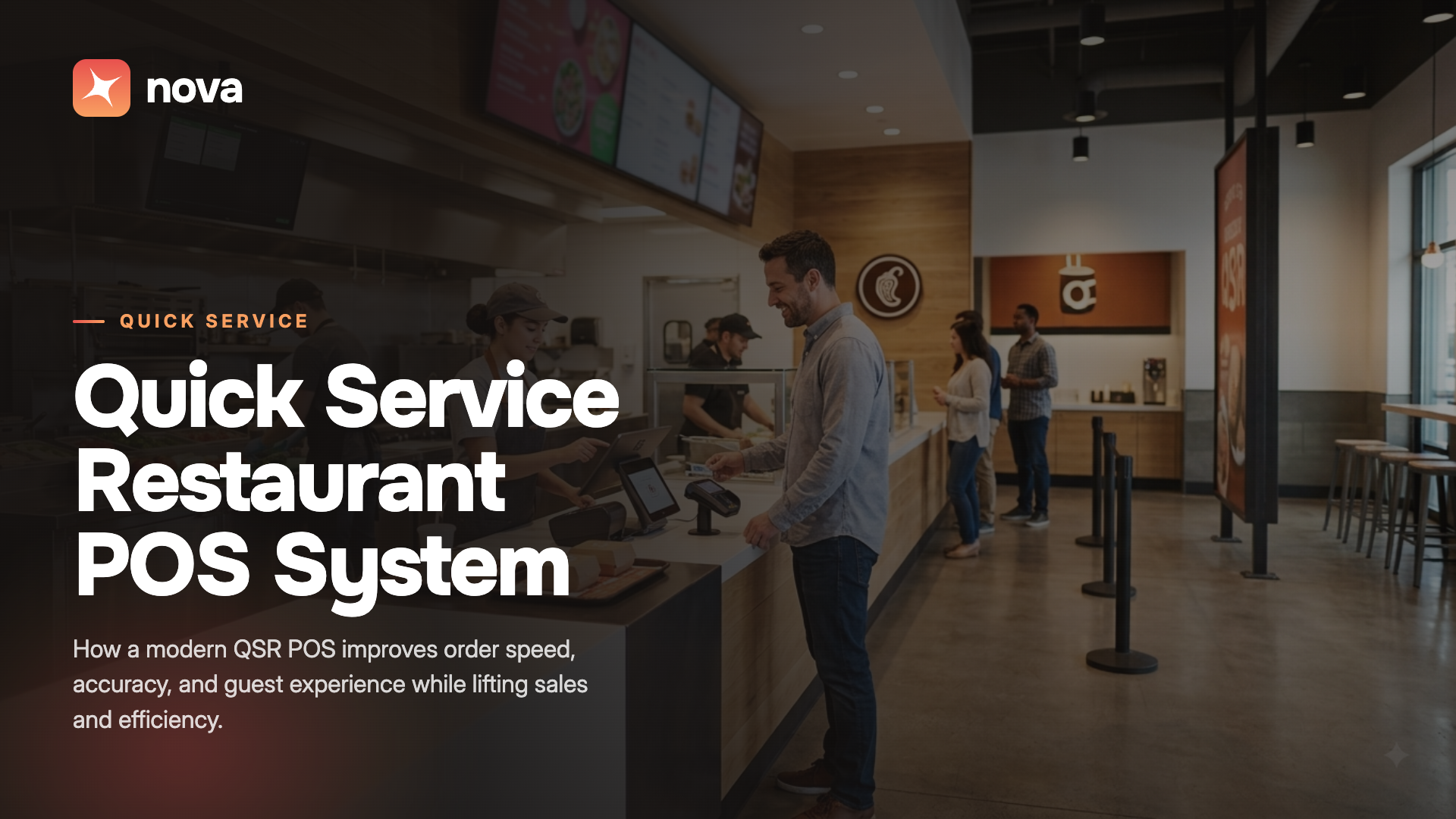

The quick service restaurant industry runs on seconds, not minutes. Every extra second a customer waits at the counter or in a kiosk queue is a second closer to walking away, and the right quick-serve restaurant POS system is what separates a chain that scales smoothly from one that buckles under its own volume.
The QSR sector's growth isn't slowing down either: industry estimates put the global quick service restaurant market on track to grow well into the hundreds of billions of dollars over the next several years, driven almost entirely by digital ordering, off-premise dining, and self-service technology. That growth is exactly why the POS you choose in 2026 needs to do more than ring up orders. It needs to run your whole front of house.
This guide breaks down what a quick-serve POS system actually is, the trends shaping it going into 2026 and beyond, the features that matter most, and how to evaluate options for your own restaurant.
What is a Quick-Serve Restaurant POS System?
A quick-serve restaurant POS system is point-of-sale software and hardware purpose-built for high-volume, fast-paced ordering environments: quick service restaurants (QSRs), fast casual chains, and counter service concepts where speed and throughput matter more than table service.
Unlike a general restaurant POS designed around table management and course timing, it's built around a simpler goal: get an accurate order from the customer to the kitchen and back again as fast as possible, across every channel: counter, kiosk, mobile app, drive-thru, and third-party delivery.
Core components typically include:
- Order entry (counter, kiosk, mobile, online)
- Kitchen Display System (KDS) integration
- Payment processing (card, tap to pay, digital wallets)
- Inventory and menu management
- Reporting and multi-location analytics
Current Challenges Faced by Quick Service Restaurants
Nowadays, quick service isn’t just fast food. It is a totally different experience. QSR owners today are dealing with pressures that have never existed in the past decade, along with increased competition in the market.
There are more options, higher expectations, and loyalty can vanish in seconds if given even the slightest reason to. While everything else seems to increase in price, consumers expect QSRs to continue to absorb the additional cost and maintain their prices, which only adds to the pressure to serve flawlessly.
Here are some challenging issues QSRs are now dealing with:
1. Long queues and slow order fulfilment
Patrons want to be served quickly and now don't have the patience to wait in long lines. Long lines will affect your sales; customers just walk away and won't wait in line.
2. Balancing delivery, dine-in, and takeout
QSRs have to somehow accommodate all orders at once. If there is no connected system, orders will take longer and will easily get crossed up.
3. Errors during peak hours
When the crew is going as fast as they can, it is easy to mess up an order. Every incorrect order costs money, slows the kitchen down, and hurts the customer's experience.
4. Staffing shortages
Labor pressure and costs keep increasing, and there is always a struggle to find someone who works hard. This summary of challenges may have them looking for tools to help take men's workload off of them.
Why Self-Ordering Kiosks Are a Game Changer?
Self-ordering kiosks have shifted the way customers engage with QSRs. Data shows that over 60% of customers use kiosks at least sometimes, and 26% use them frequently. When asked why, most of them mention:
- Faster service (51%)
- Easy customization (34%)
- Time to browse the menu (36%)
- Better accuracy (28%)
This proves customers want control and convenience. But self-ordering kiosks for restaurants also help restaurants on the operational side:
1. Faster service without hiring extra staff
A kiosk takes orders nonstop, never gets tired, and keeps lines moving.
2. Fewer mistakes
Guests choose exactly what they want, reducing errors caused by miscommunication.
3. Bigger orders
Large screens show add-ons, combos, and popular items visually. People are more likely to pick something extra when they can see it.
4. Less counter congestion
Customers who prefer self-service step aside from the main line, making your front counter more organized.
However, kiosk quality and its integration with your POS matter more than just having one.
Must-Have Features in a QSR POS System
If you’re evaluating technology for your restaurant, here are the features in a QSR kiosk POS that actually move the needle:
1. Kiosk integration with POS + KDS
This ensures that whatever customers order at the self-order kiosk instantly appears in the kitchen. No delays. No manual entry.
2. Smart payments
Fast, secure payment support such as tap-to-pay, and wallets keeps the line moving.
3. AI-powered recommendations and upsells
Your POS for quick-service restaurants can suggest combos or add-ons based on customer behavior, time of day, or order patterns. It’s like having your best salesperson working every shift.
4. Real-time inventory sync
If an item runs out, the system updates the kiosk, POS, and delivery menus instantly. No awkward “Sorry, that’s unavailable” moments.
5. Loyalty and CRM automation
A strong POS for quick service restaurants should identify returning customers and apply rewards automatically.
6. Reporting and multi-location management
If you run more than one outlet, centralized reporting helps you see trends, compare performance, and make decisions based on real data.
These features turn your POS from a billing tool into a growth engine.
Operational & Financial Benefits That Move Your QSR Forward
A modern quick-service restaurant POS system can transform your daily operations. Here’s how:
1. Shorter queues
When customers place orders quickly, your restaurant flows better. Shorter wait times create happier guests and give your brand a reputation for speed.
2. Higher accuracy
Fewer mistakes mean fewer remakes, fewer refunds, and less frustration.
3. Better table turns and throughput
Speed at the counter speeds up everything else. More customers served per hour means more revenue without more seats.
4. Increased revenue from upsells
Kiosks display add-ons in a more compelling way than verbal suggestions. Many QSRs report double-digit increases in average order value when kiosks are added.
5. Reduced dependency on counter staff
With kiosks and automation, you can operate with a leaner team or reassign staff to areas that improve customer service.
Self-Ordering & Backend Integrations That Power Faster Service
The kiosk or counter screen is only half the equation. What happens behind it determines whether that speed actually holds up during a rush. A well-integrated system connects:
- Kitchen Display Systems that route and prioritize tickets automatically
- Inventory platforms that update in real time as items sell
- Payment processors that settle transactions without manual reconciliation
- Loyalty and CRM tools that recognize repeat customers automatically, even through a kiosk
When these systems are unified instead of stitched together after the fact, the front-of-house speed customers see is backed by a kitchen and back office that can actually keep pace.
How to Choose the Right Quick Serve Restaurant POS System
When comparing options, run each candidate through the same checklist:
Pricing across the category generally runs from free tiers up to a few hundred dollars a month in software fees, plus card processing typically in the low single digits per transaction. The real cost difference usually shows up in hardware requirements, contract length, and how much you end up paying third parties to bridge features the POS doesn't include natively.
Why Choose NOVA Platform for QSRs?
Customers judge your service speed long before they taste your food. With 80% of consumers saying good technology influences their choice of QSR, NOVA gives you the edge you need to run faster, cleaner, and more profitably.
1. Automation That Lightens Your Team’s Load
NOVA cuts manual tasks across ordering, payments, and kitchen workflows. Orders move smoothly from the counter or kiosk to the kitchen, giving your staff more time to focus on serving guests.
2. One Connected System for POS, Kiosks, and KDS
No more juggling separate tools. NOVA unifies your POS, kiosks, kitchen screens, loyalty, and reporting so everything updates instantly. Fewer errors, fewer delays, and far better rush-hour performance with POS with kiosk integration for QSR.
3. Quick Setup with Minimal Training
Your team learns NOVA fast. New staff members become productive within minutes, helping you maintain consistency even during high turnover periods.
4. Real ROI You Can See on the Floor
QSR operators using NOVA have reported:
- 22% higher average order value from kiosk upsells
- 38% less front-counter congestion
- 30% faster order processing
These aren’t small improvements; they directly boost revenue and guest satisfaction.
5. Designed for Growth and Multi-Location Control
Whether you manage one store or many, NOVA keeps menus, pricing, inventory, and reports unified. You get a clear view of performance across every location without extra effort.
6. Future-Ready QSR Technology
With continuous enhancements, smarter automations, and kiosk-first workflows, NOVA grows with your restaurant instead of holding it back.
FAQs About Quick Serve POS Systems
What is a quick serve restaurant POS system?
A quick serve restaurant POS system is point-of-sale software and hardware built for fast-paced, high-volume ordering environments, combining order entry, kitchen display integration, payments, and self-service kiosks into one platform designed to move lines quickly.
How is a quick serve POS system different from a general restaurant POS?
It's optimized for speed and volume rather than table service, prioritizing fast order entry, kiosk and mobile ordering, and kitchen display routing over features like table management or course timing.
Do I need self-ordering kiosks to use a quick-serve POS system?
No. Kiosks are optional but recommended. Most modern quick-serve POS systems support counter, kiosk, mobile, and online ordering from the same backend, so you can start with a counter setup and add kiosks later.
How much does a quick serve restaurant POS system cost?
Pricing typically ranges from around $0 to $400+ per month in software fees depending on the provider and number of terminals, plus card processing fees generally between 2.3% and 3.1% per transaction. Hardware and kiosk costs are usually separate.
Your QSR Can Run Faster with the Right Tech: NOVA
Lines don't have to be the cost of doing business, and neither does slow service, inconsistent order accuracy, or a tech stack that can't keep up with how customers want to order today. The quick service restaurants that hold onto their edge through 2026 and beyond will be the ones that treat their POS as core infrastructure, not just a cash register, investing in a system built for their specific pace of business rather than retrofitting a generic retail tool.
With the right quick-serve restaurant POS system, faster service, fewer errors, and higher order values happen at the same time, not as a trade-off. Kiosk integration reduces line pressure during rush hours. Real-time inventory and unified reporting cut down on the manual work that eats into a manager's day. AI-driven upsells and loyalty automation add revenue without adding headcount. None of this requires ripping out your entire operation. It starts with choosing a quick-serve POS built around how your restaurant actually runs.
Book a Demo to see NOVA's platform in action, or explore how NOVA compares across POS, scheduling, and menu management built specifically for quick-service restaurants. Whether you're opening your first location or scaling to fifty, NOVA gives you one system that grows with you instead of one you'll outgrow.