.svg)
Running a coffee shop in 2026 feels a little different than it did even two or three years ago. Rent is higher, labor is harder to manage, and the cost of beans, milk, and packaging keeps creeping up. Yet customers still expect fast service, fair pricing, and a great experience every single time. So the big question most café owners are quietly asking is this: Am I actually making enough profit to justify all this effort?
And if the margins are thin right now, is that just the reality of the business, or is there room to improve without burning out or cutting quality?
This blog answers those exact questions. We’ll break down what coffee shop profit margins really look like in 2026, what a “good” margin means today, and why so many cafés struggle to hit it.
Why Coffee Shop Margins Are Tighter Than Ever
Coffee shop owners everywhere are feeling a quiet but very real shift in their numbers. Sales may still look steady; customers may still be lining up every morning, yet the profitability at the end of the month feels tighter than it did just a few years ago. What makes the situation more concerning is that these pressures are not coming from a single area; they are hitting labor, sourcing, and supply chains all at once.
Labor Cost Surge Is Reshaping Operating Budgets
Minimum-wage increases across 19 U.S. states are expected to benefit more than 8.3 million workers, adding close to $5 billion in additional wages. While this is a positive shift for employees, for café operators, it means payroll expenses are rising faster than menu prices can realistically keep up, forcing many businesses to rethink staffing models, scheduling, and service formats.
Coffee Prices Are No Longer Predictable
Global supply pressures pushed Arabica coffee prices to $4.41 per pound, significantly above the five-year average. For a product where coffee beans sit at the core of every sale, even small fluctuations quickly compound across thousands of cups, quietly shrinking margins that were already narrow.
Trade Disruptions Are Adding Uncertainty to Procurement
Political and tariff-driven changes disrupted long-standing sourcing flows, with U.S. imports of coffee from Brazil dropping by 46% in a single month. Such sudden supply-chain shocks make procurement planning more difficult and can push operators into higher-cost sourcing decisions with very little warning.
Taken together, these trends signal something deeper than a temporary cost increase. They point to a structural shift in how coffee businesses need to operate - where profitability will depend less on how many cups are sold and more on how intelligently every cost, supplier decision, and operational process is managed.
The Opportunity: Data-Driven Operations and Smart POS Systems
The most lucrative cafes in 2026 do not work anymore, but they work smarter. They also allow real-time data to inform pricing, staffing, inventory, and promotions as opposed to guessing.
The modern restaurant POS systems are not limited to taking payments. They demonstrate what beverages actually generate revenue, when labor expenses increase, where waste is generated, and how the behavior of the customers changes over the day. These patterns can be observed by the owners who are capable of sealing small holes before they burst into huge losses.
This is the reactive-to-proactive shift that defines the difference between average cafes and those that are highly profitable.
What Is a Coffee Shop Profit Margin?
Profit margin displays the amount of money that is left after all expenses. It is normally quantified in two ways.
Gross profit margin is calculated as revenue less cost of goods sold, which includes beans, milk, syrups, cups, and food.
The net profit margin deducts all operating expenses, labor, rent, utilities, marketing, technology, and delivery expenses.
Profit Margin = (Profit/Revenue) x 100.
To illustrate, when a cafe makes 50,000 every month and retains 5,000 after deduction of all other costs, the net profit margin is 10%. Profits are more important than sales. Sales do not translate to high profit. A low-margin busy cafe may not be able to compete, whereas a smaller shop with good margins may perform well.
Key Costs That Impact Coffee Shop Profit Margins
Understanding where money goes is the first step toward improving the average coffee shop profit margin. Below is a typical cost breakdown for U.S. coffee shops.
Even small inefficiencies in any one category can quietly drain profits over time.
Profit Margins by Coffee Shop Format
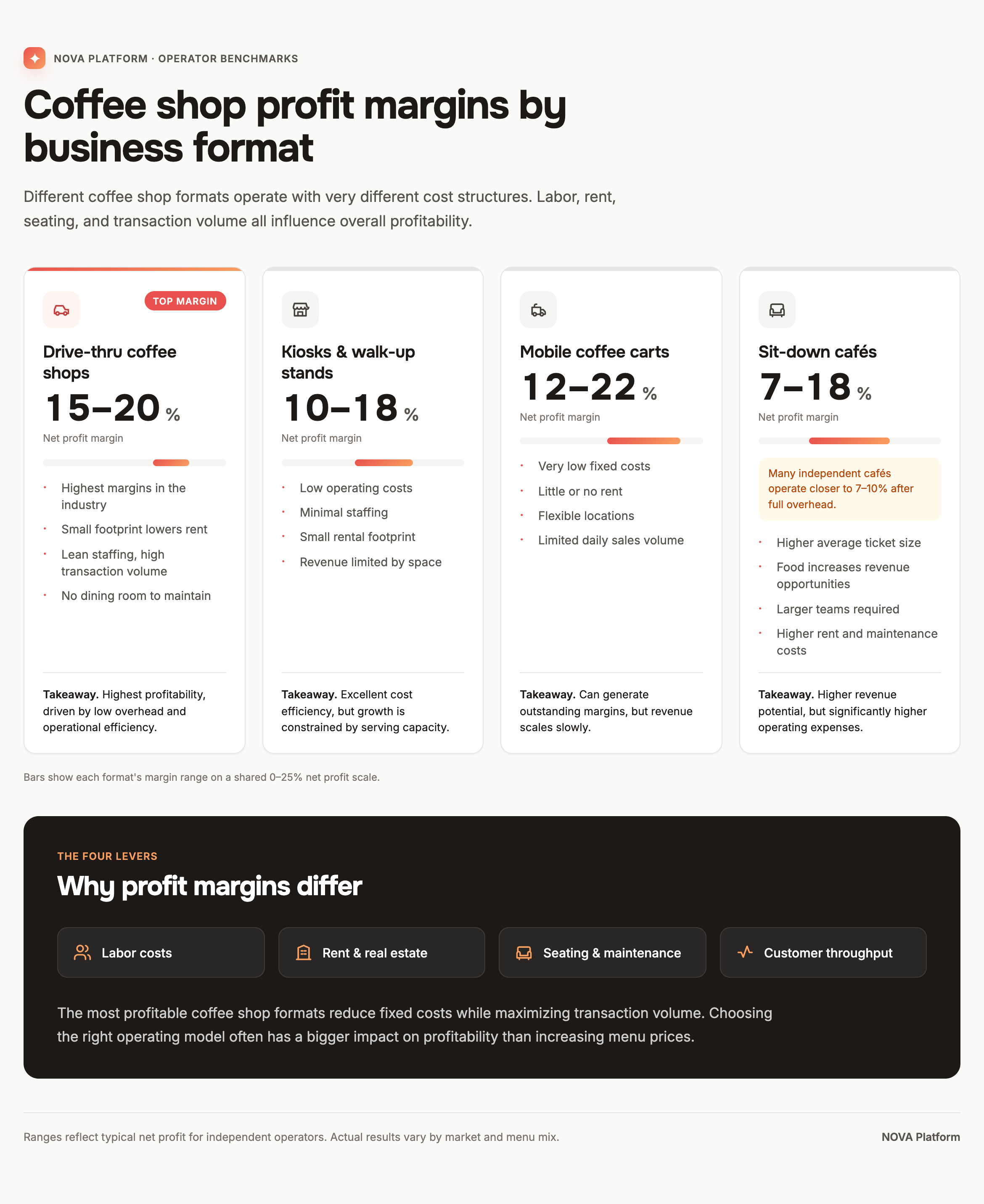
Not all cafés are playing the same game. Format alone can swing net margin by 10 points or more, mostly by changing how much a shop spends on labor and real estate per transaction.
Drive-Thru Locations Post the Highest Margins
Drive-thru-only coffee shops typically net 15–20%, the strongest margin range in the category. With no dining room, there's no bussing, less cleaning, and a smaller lease footprint. Combined with fast, high-volume transactions and lean staffing, drive-thrus minimize the two costs that eat into every other format's margin: labor and rent.
Kiosks and Walk-Up Stands Trade Revenue Ceiling for Low Overhead
Kiosks and walk-up stands generally land in the 10–18% range. Overhead is minimal since there's no seating area to staff or maintain, but the small footprint also caps how much revenue a single location can generate. Some high-volume franchise kiosks push well past this range, but for most independents, it's a low-cost, low-ceiling model.
Mobile Coffee Carts Run Lean but Cap Out Fast
Mobile carts can post some of the widest margins in coffee, often 12–22%, simply because there's little to no rent or utility cost to carry. The tradeoff is volume: a cart can only serve so many customers in a given window, which limits total revenue even when the margin percentage looks strong.
Sit-Down Cafés Look Strong on Paper, Thinner in Practice
Traditional sit-down cafés typically show 12–18% margins on paper, but many independents net closer to 7–10% once full overhead is factored in. Sit-down formats earn higher average ticket sizes through extended visits and food sales, but that upside is offset by dining space, bussing, and a larger, fully staffed team.
The takeaway isn't that one format is "better": it's that a sit-down café and a drive-thru window are fundamentally different financial models, and benchmarking your margin against the wrong format will make a perfectly healthy café look like it's underperforming (or vice versa).
Common Reasons Why Coffee Shop Margins Stay Low
Most cafes do not perform well due to laziness, but also due to blind spots. Competitive prices are a common trend, as opposed to actual margins. The number of staff might not be in relation to the foot traffic, which leads to overstaffing at times of low demand. High commissions on profits are reduced because of the heavy reliance on the delivery apps.
The big picture is obscured by manual processes and disintegrated tools. In the absence of item-level understanding, owners will not be able to distinguish between drinks that are actually profit-driving and those that are merely volume-driving. Margin is affected when making decisions without data.
How to Increase Coffee Shop Profits: 9 Proven Strategies
Engineer Your Menu on High-Margin Items
Drinks are not equal. Beverages of espresso and add-ons have a higher margin than complex and low-volume beverages. Place the lucrative items on the menu, package these with pastries, and silently eliminate those that do not sell and make operations difficult. Your coffee shop POS menu analytics will reveal where you make your money.
Maximize Pricing and still retain customers
Customers are not often responsive to slight price increments on their beverages of choice. An increment of 0.25 on the top-selling products can be of great help in boosting the margins within a month. Apply charm pricing, position high-priced goods strategically, and use location-based pricing as necessary. Smart pricing is fair and does not jeopardize profitability.
Eliminate Wastes through improved Inventory
Profits are silently devoured by spoilage and over-ordering. Monitor ingredient consumption on a daily basis and place orders according to real sales trends and not on a routine. Inventory forecasting based on sales assists cafes in ordering only the required stock, particularly of milk, pastries, and seasonal products.
Smart Scheduling Control Labor
One of the largest expenses of a cafe is labor. Align the shifts with hourly sales rather than regular schedules. With the right staffing at the right demand, the service remains uninterrupted, and labor expenses remain in check. This adjustment is a lot easier with real-time labor vs. sales dashboards.
Growth in Average Order Value
An increase in average order value will imply additional revenue without increasing customer numbers. Promote ancillaries such as syrups, size upgrades, and pastries. Make QR ordering prompts and combo offers helpful instead of pushy.
Motivate Repeat Business with Loyalty Programs
Retaining a customer is less expensive than acquiring a customer. Basic loyalty programs with rewards for frequent visits increase lifetime value. Loyalty that is based on POS data is the ability to offer personalized and considerate deals.
Switch to Direct Ordering to Evade Favorable Commissions
Third-party delivery is convenient, but it is costly. Online ordering and in-store QRs are branded to assist cafes in retaining more of each sale. Having customer data also gives an opportunity for targeted marketing and repeat business.
Daily Decision Making with Data
Monitor best-selling hours, top items, and the performance of staff. You see something at a glance when it slips. The daily insights enable the owners to rectify any problems before they become losses at the end of the month.
Automate and Insight with AI-Powered POS
AI-based POS systems anticipate demand, automate reports, and raise red flags on abnormal cost increases. The owners receive clear actions that can be performed without taking hours on spreadsheets.
How NOVA Helps Coffee Shops Increase Profit Margins
NOVA is built for modern coffee shops that want to grow without chaos, guesswork, or constant firefighting. It turns everyday operations into clear, profit-focused decisions.
Here’s how NOVA directly improves coffee shop profit margins:
See what actually makes you money
Instantly identify high-margin drinks, low-margin menu clutter, and items that look popular but quietly drain profits.
Fix cost leaks before they become losses
Smart alerts flag unusual spikes in food cost, labor, or wastage so you can act in real time, not at the month end.
Staff smarter, not heavier
AI-driven sales forecasting aligns staffing with real footfall, reducing overstaffing during slow hours without hurting service.
Reduce delivery commissions without losing orders
First-party online ordering through your branded restaurant webstore and in-store QR code ordering help cafés shift customers away from high-fee aggregators and keep more of every sale.
Increase repeat visits automatically
Built-in loyalty and CRM tools turn one-time visitors into regulars with personalized offers that feel natural, not spammy.
Make daily decisions in minutes, not hours
Real-time dashboards show sales, labor percentage, and margins at a glance, so owners don’t need spreadsheets to stay in control.
NOVA doesn’t just show you data. It tells you where to focus so every decision pushes margins in the right direction.
KPIs Every Coffee Shop Owner Should Track
Running a profitable coffee shop isn’t about tracking everything. It’s about tracking the right numbers consistently and acting on them fast. These KPIs show where money is earned, where it’s lost, and where small changes make the biggest difference.
- Gross margin by item
- Net profit margin
- Labor percentage of sales
- Food and beverage cost percentage
- Average order value
- Repeat customer rate
- Sales per labor hour
These metrics tell the real story behind your café’s performance and guide smarter decisions day after day.
Frequently Asked Questions
What is a good profit margin for a coffee shop?
A net profit margin of 5–10% is considered healthy, and anything above 10% is strong. Mature, well-run independent specialty cafés average closer to 10–25% net, with an industry-wide average around 13.8%. Many independents, especially in the first few years, run closer to 2.5–7%.
How much profit does a coffee shop make per month?
It depends heavily on revenue and format. A $300,000/year café at an 11% margin nets roughly $2,750/month; a $600,000/year café at a 17% margin nets closer to $8,500/month. Format, location, and labor efficiency drive most of that gap.
What's the difference between gross and net profit margin for a café?
Gross margin only subtracts the cost of goods sold - beans, milk, syrups, cups, food - from revenue, and it's typically high (70–85% for beverages). Net margin subtracts everything: labor, rent, utilities, marketing, technology, and delivery fees. Net margin is the number that actually reflects take-home profit.
Which coffee shop format has the highest profit margin?
Drive-thru and kiosk formats typically post the highest net margins (15–20%+), since they carry the lowest labor and real estate cost per transaction. Sit-down cafés often have higher ticket sizes but lower net margins once full staffing and dining space are factored in.
Is opening a coffee shop a profitable business?
Yes, but margins are thin industry-wide, and profitability depends far more on cost control and format than on how busy the shop looks. The cafés that consistently hit the higher end of the range are the ones tracking cost and labor data daily rather than reacting at month-end.
Build a More Profitable Coffee Shop in 2026
Coffee shop profit margins are tighter than ever, but they are far from out of your control. The cafés winning in 2026 are not working longer hours or cutting corners. They are using data, automation, and clarity to make better decisions every single day.
Profitability today comes from visibility. Knowing what sells, what costs too much, and what needs attention before it becomes a problem.
Technology is no longer just a support tool. It’s the foundation of sustainable, scalable growth. See how NOVA helps coffee shops boost margins with AI-native insights and all-in-one operations. Book a free demo today.