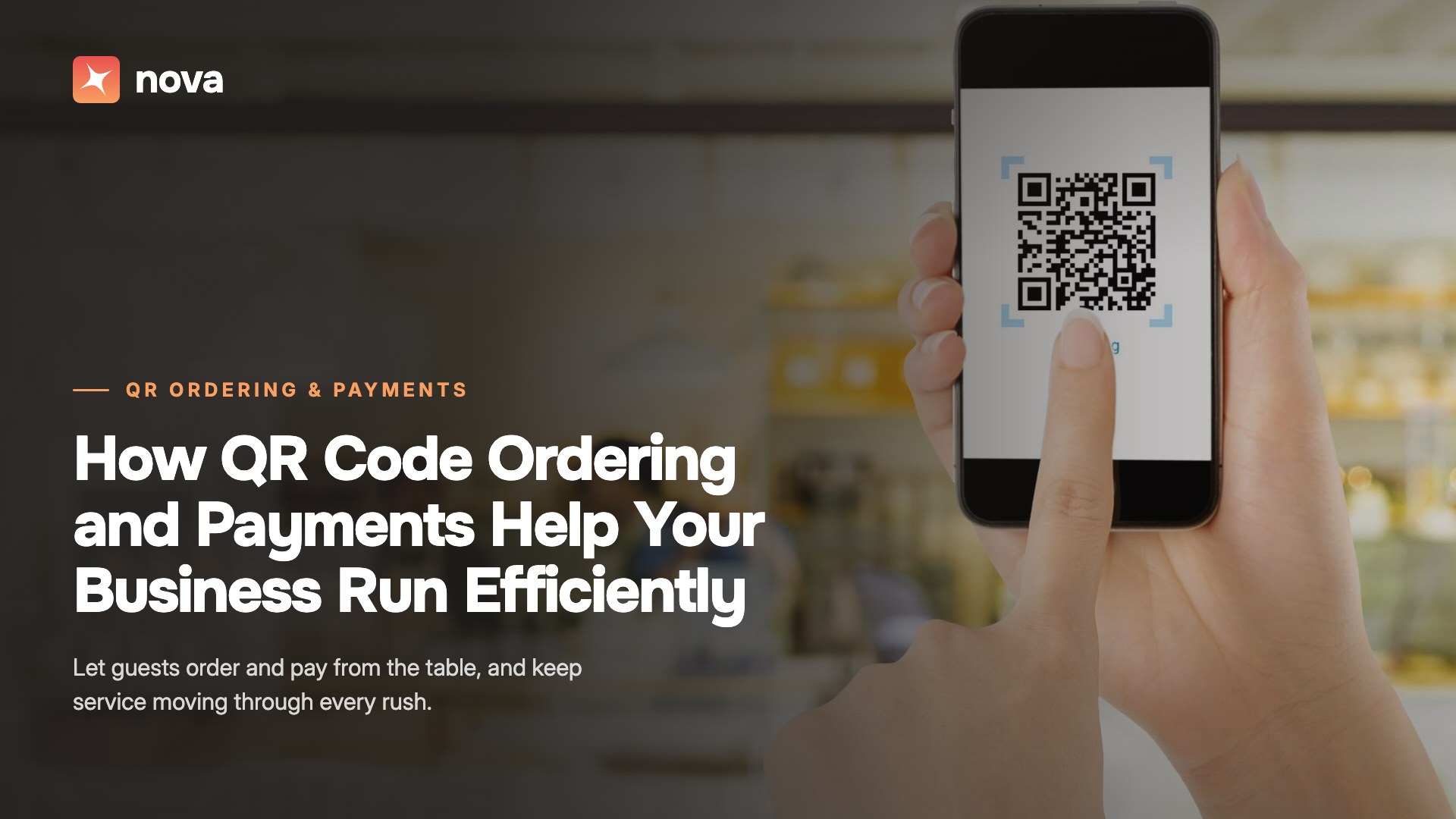
How QR Code Ordering and Payments Can Help Your Business Run Efficiently
Discover how QR code ordering and payments can enhance efficiency in your restaurant. By speeding up the ordering process, reducing payment wait times, and improving workflow, QR codes help streamline operations and enhance the customer experience.
.svg)
QR code ordering has stopped being a pandemic-era workaround and has become the default way guests interact with a menu. eMarketer forecasts that roughly 102.6 million people in the US will use a QR scanner this year, and restaurants and hospitality businesses post the highest adoption rate of any industry, at 75 percent. For an operator weighing whether to invest further in QR code ordering, the question isn't really "should we do this" anymore. It's "how do we run it well, at scale, and securely."
This guide covers what QR code ordering looks like in 2026: the data behind its growth, the operational and financial case for it, what changes when you're rolling it out across dozens or hundreds of locations, and the security and compliance questions IT and procurement teams are now asking before they'll sign off on it.
What Is QR Code Ordering?
QR code ordering lets guests scan a code, whether on a table tent, receipt, sticker, or digital display, to pull up a restaurant's menu on their own phone, then browse, customize, and submit an order without waiting for a server. Many implementations extend the same flow to payment, so a guest can order, pay, and tip from the same session, closing out a table without ever flagging down staff.
It's a deceptively simple mechanic built on infrastructure that has matured considerably since 2020: dynamic codes that can be updated in real time, POS integrations that route orders straight to the kitchen, and payment processing that meets the same security bar as a card swipe at the counter.
Why QR Code Ordering Matters More in 2026
Three shifts explain why QR code ordering has moved from "nice to have" to core infrastructure.
Guest expectations have hardened into habit. In hospitality specifically, adoption is now around 75 percent, and industry surveys put guest preference for QR ordering and payment over a printed menu at roughly 78 percent. This isn't a novelty anymore. For a large share of your guests, it's the expected way to order.
The payoff shows up in the numbers that matter to operators. Restaurants running QR code ordering and payment report table turnover gains of around 15 percent, driven by faster ordering and checkout cycles that don't depend on staff availability. Faster turns on the same footprint is one of the few ways to grow revenue without adding square footage or headcount.
The technology underneath it has changed. QR code ordering in 2026 isn't just "scan and see a PDF menu." Dynamic, centrally managed codes, real-time menu and 86'd-item updates, loyalty and personalization tied to a guest profile, and increasingly, AI systems that place orders on a guest's behalf, are all now part of the same QR-triggered flow. The code is the entry point. What happens after the scan is where the real evolution is happening.
Core Benefits of QR Code Ordering
Faster, More Accurate Orders
When guests enter their own order directly into the system, you eliminate the transcription step where a server relays a spoken order to a POS terminal, and with it, a meaningful share of order errors, missed modifiers, and "that's not what I ordered" comps. Orders also queue to the kitchen the moment they're submitted, rather than waiting for a server to have a free moment to key them in.
Streamlined, Contactless Payments
Pairing QR code ordering with QR code payment lets guests close out whenever they're ready, split checks themselves, and add a tip, all without waiting for a server to notice an empty glass or a raised hand. For the business, that means faster table turns and payment collection that doesn't depend on staffing levels during a rush.
Lower Labor Costs, Better Staff Allocation
QR code ordering doesn't eliminate the need for staff. It changes what they spend their time on. Order-taking and check delivery, two of the more repetitive front-of-house tasks, move to the guest's phone, freeing servers to focus on hospitality: checking in, resolving issues, upselling, and managing more tables at once. For operators managing labor as a percentage of sales, that reallocation is often the difference between a shift that's adequately staffed and one that isn't.
Elevated, Personalized Guest Experience
Modern QR code ordering platforms tie a scan to a guest profile, enabling loyalty point accrual, saved preferences, past-order reordering, and targeted promotions, the same kind of personalization guests expect from any other app on their phone. Done well, it doesn't feel transactional. It feels like the restaurant remembers them.
QR Code Ordering at Enterprise Scale
Everything above holds true for a single location. Once you're managing QR code ordering across a multi-location group, a franchise system, or several brands, the operational questions change shape.
Centralized Menu and Brand Governance
At a handful of restaurants, updating a menu is a five-minute task. Across 50 or 500 locations, it's a governance problem: which locations run which menu version, who has permission to change pricing, and how quickly a recall or 86'd item propagates everywhere it needs to. Enterprise QR code ordering has to run on a platform with centralized menu management and role-based access, one source of truth that pushes to every location's codes simultaneously, rather than each store maintaining its own.
Unified Data and Reporting Across Every Site
A QR code ordering rollout that isn't feeding a single, consistent data layer creates blind spots exactly where enterprise operators need visibility most: comparing sell-through by location, spotting a site whose QR conversion rate has quietly dropped, or rolling location-level data up into brand-level reporting for the board. The value of QR ordering data compounds when it's unified. Fragmented, it's just noise per store.
Consistent Experience Across Formats and Brands
Enterprise restaurant groups rarely run one format. A group might operate quick-service counters alongside full-service dining rooms, or several distinct brands under one back office. QR code ordering needs to flex to each format's flow, counter pickup versus table service, single-brand versus multi-brand menus, without guests or franchisees experiencing a patchwork of different systems depending on which location they're in.
Security, Compliance, and IT Considerations
This is the section that didn't need much attention in 2020 and now determines whether IT and procurement will approve a QR code ordering rollout at all.
PCI DSS and Payment Security
Any QR code ordering flow that touches payment has to meet PCI DSS requirements the same way a traditional terminal does: tokenized card data, encrypted transmission, and a payment processor that can demonstrate compliance, not just claim it. For a single restaurant, this is largely handled by the vendor. Across an enterprise group, IT teams should expect to see documentation, including attestations of compliance, network segmentation for payment traffic, and clarity on where card data is stored (ideally, nowhere on your own infrastructure).
Quishing and QR Code Fraud Prevention
QR code phishing, known as "quishing," has grown sharply. Some estimates put QR codes behind roughly 12 percent of phishing incidents, with attacks against decision-makers occurring dozens of times more often than against general staff. In a restaurant context, the risk is a fraudulent sticker placed over a legitimate table code, redirecting guests to a lookalike payment page. Enterprise QR code ordering programs mitigate this with dynamic codes tied to verified, owned domains rather than generic short links, tamper-evident physical placement, and the ability to instantly deactivate or reissue a compromised code across every affected location.
Integration, Uptime, and API Requirements
For an enterprise buyer, "does it work" is table stakes. The real diligence is on how QR code ordering fits into everything around it. Does it integrate with your existing POS, kitchen display, and inventory systems through a documented API, or does it require staff to manually re-key orders from a separate tablet? What's the uptime SLA, and what happens to an in-progress order if connectivity drops mid-scan? These questions matter more as order volume scales, because a workaround that's tolerable at one location becomes an operational liability at five hundred.
What's Next: AI and Agentic Ordering
The next shift in QR code ordering is already visible: AI agents placing orders on a guest's behalf. Instead of a person scanning a code and browsing a menu themselves, an assistant handles the whole interaction, for example, "order a gluten-aware dinner for four under my usual preferences," searching, customizing, and checking out automatically. Analysts project agentic commerce broadly to reach several trillion dollars in transaction volume in 2026, with restaurants and food ordering representing a meaningful share of that shift over the next few years.
The operational implication for restaurants is less about building AI and more about foundations. If your QR code ordering system still depends on staff manually retyping orders from a tablet into the POS, it can't keep pace with machine-speed ordering. Clean, standardized menu data, accurate real-time inventory, and a single order pipeline, rather than several disconnected ones per channel, aren't just good practice today. They're what make a restaurant ready to accept orders from an AI agent tomorrow.
How Nova Powers QR Code Ordering, From a Single Counter to an Enterprise Group
Nova's Modern POS is built so QR code ordering isn't a bolted-on feature. It's part of the same system running your kitchen, your payments, and your reporting. A scanned code routes straight into the same order pipeline as your counter and kiosk traffic, feeding the Kitchen Display System in real time and rolling up into the same reporting layer whether you're running one location or several hundred.
For multi-location and enterprise groups, that means centralized menu and pricing control that pushes to every site at once, unified data across every format you run, whether quick-service, full-service, or a mix, and a payment stack built to meet PCI DSS requirements without extra integration work on your end. Nova's AI Platform layers on top of that same order data, from voice AI that catches orders a guest doesn't type in themselves to insights that flag which locations need attention. It's the same foundation that keeps QR code ordering ready for what's next, including AI agents ordering on a guest's behalf.
If you're evaluating QR code ordering for the first time or replacing a system that can't keep up with where the category is headed, see how it fits into Nova's full platform, or read more on building a digital ordering system that scales with you.
FAQs
Is QR code ordering secure enough for payment processing?
Yes, when it's built on a PCI DSS-compliant payment stack with tokenized card data and encrypted transmission. Ask any vendor for their compliance documentation rather than taking security claims at face value, especially if you're deploying across multiple locations.
Does QR code ordering work for multi-location and franchise restaurant groups?
It does, but the platform matters more than the QR code itself. Look for centralized menu management, role-based access controls, and unified reporting. Without those, each location ends up running its own disconnected version of QR ordering.
How does QR code ordering integrate with an existing POS system?
On a unified platform, QR orders route directly into the same order pipeline as counter, kiosk, and phone orders, with no manual re-entry. If a vendor's QR ordering system requires staff to retype orders from a separate device, that's a sign it isn't natively integrated.
What's the ROI of QR code ordering?
Operators typically see it in two places: faster table turnover, commonly cited around a 15 percent increase, from guests ordering and paying without waiting on staff, and lower labor cost per transaction as front-of-house time shifts from order-taking to hospitality.
Will AI change how QR code ordering works?
It's already starting to. AI agents placing orders on a guest's behalf are an emerging channel, and restaurants with clean menu data, accurate inventory, and a single integrated order pipeline will be best positioned to accept those orders as the trend grows.