.svg)
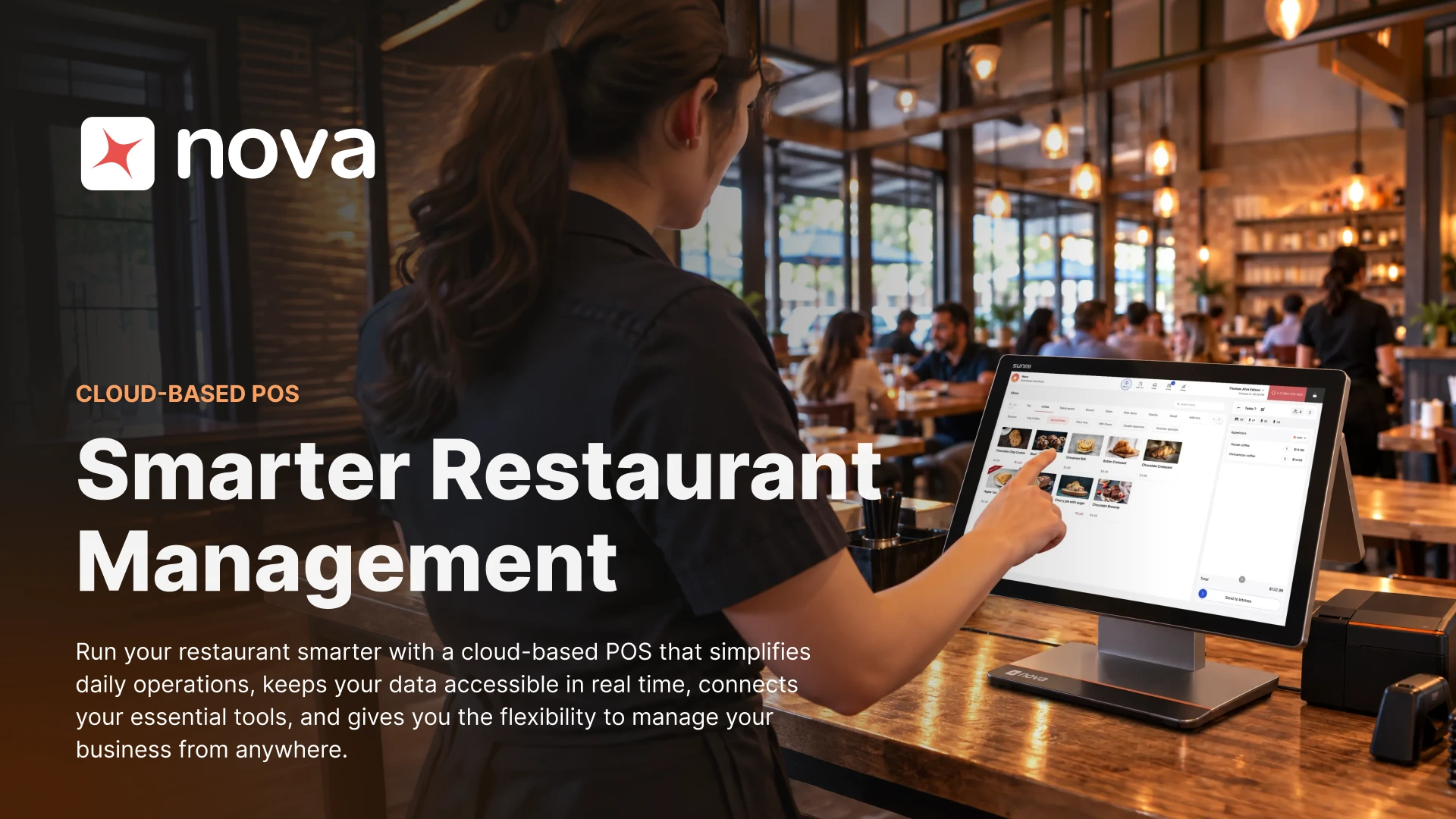
A cloud-based point of sale is a restaurant POS that runs its software and stores its data on remote servers instead of a single computer in the back office. Orders, payments, menus, inventory, labor, and guest data sync to the cloud in real time, so owners and managers can see and control every location from any device.
That shift matters more in 2026 than it did even two years ago. The National Restaurant Association projects U.S. restaurant and foodservice sales will reach $1.55 trillion in 2026, yet 42% of operators said their restaurant was not profitable the year before. When demand is strong, but margins are thin, the system that captures every order and every dollar has to do more than ring up checks. This guide explains how a cloud-based point of sale works, what it costs, where it falls short, and how to choose and migrate to one without disrupting service.
What Is a Cloud-Based Point of Sale System?
A cloud-based point of sale system stores data online rather than on local devices. Restaurant owners and managers can access sales, inventory, and customer information from anywhere, and automatic backups protect that data if a device fails, is lost, or is damaged.
In a traditional (on-premise or "legacy") POS, the software lives on a local server in the restaurant. Reports, menu changes, and updates usually have to happen on site, and if that server fails, your data can go with it. A cloud-based point of sale flips that model: terminals, tablets, and handhelds act as connected front ends, while the "brain" of the system runs securely in the cloud.
How a Cloud-Based Point of Sale Works
Most modern systems follow the same basic flow:
- Order capture. A server, cashier, kiosk, or online ordering page enters the order on a connected device.
- Instant routing. The order is sent to the kitchen display system (KDS) or printer and recorded in the cloud at the same moment.
- Payment processing. An integrated payment terminal authorizes the card, tap, or mobile wallet transaction.
- Real-time sync. Sales, item counts, labor, and guest data update across every device and every location.
- Offline fallback. If the internet drops, a well-built cloud-based point of sale keeps taking orders locally and syncs automatically once the connection returns.
That last step is where systems differ most, and it is worth testing before you sign any contract.
Why Restaurants Are Moving to Cloud-Based Point of Sale in 2026
Several industry shifts are pushing operators away from legacy terminals.
Off-premises ordering now dominates traffic. The National Restaurant Association's 2025 Off-Premises Restaurant Trends report found that nearly 75% of all restaurant traffic now happens off-premises, and three-quarters of delivery customers value tech-enabled ordering and payments. Takeout, delivery, curbside, and catering orders all need to land in one system, which a cloud-based point of sale is built to do.
Costs are squeezing margins. In its 2026 State of the Restaurant Industry report, the Association found more than 9 in 10 operators consider food, labor, insurance, energy, and swipe fees significant challenges. Real-time cost visibility is no longer optional.
Labor remains hard to find and hard to schedule. In Toast's 2025 Voice of the Restaurant Industry survey of 712 restaurant decision-makers (fielded April to May 2025, published October 2025), 47% reported moderate or extreme hiring challenges, and 39% planned to optimize shift scheduling. Scheduling, time clocks, and sales forecasts work best when they share the same live data.
Technology investment is rising. According to the National Restaurant Association's 2026 research, 60% of operators plan to increase technology investment to improve the customer experience, and 26% already use AI-related tools. AI features such as forecasting, upsell prompts, and natural-language reporting depend on centralized, clean data, which a cloud-based point of sale provides by design.
Key Benefits of a Cloud-Based Point of Sale System for Restaurants
Benefit #1: Manage Your Restaurant from Anywhere with Real-Time Data
With a cloud-based point of sale, managers can monitor operations from a phone, tablet, or laptop without being on site. You can check hourly sales, watch labor as a percentage of sales, spot an item that is about to 86, or approve a comp from across town. Faster visibility leads to faster decisions about inventory, staffing, and promotions, and it lets owners spend less time behind the office desk and more time on growth.
Benefit #2: Sync with Inventory, Payments, and More Through Seamless Integrations
A cloud-based point of sale connects with inventory management, online ordering, payment processors, delivery marketplaces, accounting software, and loyalty programs through APIs. Data flows automatically, so staff stop re-keying tablet orders or reconciling spreadsheets at close. One menu that updates everywhere at once also prevents the costly mismatches that happen when an item price changes in-store but not online.
Benefit #3: Automatic Updates and Stronger Cybersecurity
A cloud-based point of sale receives software updates automatically, often overnight, with no technician visit or downtime. Leading providers pair this with encryption, tokenization of card data, automatic backups, and role-based permissions.
Security is not a minor detail. IBM's 2025 Cost of a Data Breach Report put the average U.S. breach cost at $10.22 million, a record high, against a $4.44 million global average. Payment security standards have also tightened: the remaining future-dated requirements of PCI DSS v4.x became mandatory on March 31, 2025. A cloud provider that maintains its own PCI compliance and patches vulnerabilities centrally takes much of that burden off individual restaurants, though you remain responsible for your own staff practices and network hygiene.
Benefit #4: Cost-Effective and Scalable with a Pay-as-You-Grow Model
Because the heavy computing happens in the cloud, restaurants need less proprietary hardware. Many systems run on commercial tablets and handhelds, and subscription pricing replaces large upfront license fees. Adding a terminal, a kiosk, or a new location becomes a configuration task rather than a capital project, which is why a cloud-based point of sale suits growing restaurant groups and franchise operators.
Benefit #5: Better Guest Experience with Faster Checkouts and Contactless Payments
A cloud-based point of sale supports QR code ordering, tableside ordering on handhelds, pay-at-table, and self-service kiosks, all of which shorten wait times and turn tables faster. Speed is what guests notice most: in the National Restaurant Association's off-premises research, 94% of consumers said speed is critical. When orders move directly from the guest or server to the kitchen screen, errors drop and ticket times improve.
Cloud-Based vs. Traditional POS: Which One Wins?
For most restaurants, the cloud model wins on flexibility, cost of entry, and data access. The one historical advantage of on-premise systems, working without internet, has largely been closed by modern offline modes, which is why that feature should sit at the top of your evaluation list.
How a Cloud-Based Point of Sale Empowers Different Restaurant Types
Quick-Service Restaurants (QSRs): Speed and Efficiency
QSRs live and die by throughput. Online ordering, self-service kiosks, and drive-thru orders flow into one queue, and kitchen display systems keep preparation accurate and in sequence. Real-time item counts help managers prevent sell-outs during rushes.
Fine Dining: Personalized Guest Experience
With a cloud-based point of sale, staff can view guest preferences, allergies noted in profiles, and visit history, then process payments tableside. Coursing, split checks, and wine pairings are easier when every server sees the same live check.
Cafés: Simplified Operations and Loyalty Programs
Real-time inventory tracking in a cloud-based point of sale keeps milk, beans, and pastries in stock, while integrated loyalty lets guests earn and redeem rewards without a separate punch card or app.
Food Trucks: Mobility and Remote Access
A cloud-based point of sale with mobile transactions, remote menu updates, and offline mode lets food trucks sell reliably at events and locations with weak connectivity, then sync sales when back online.
Multi-Location Groups and Franchises: Centralized Control
This is where a cloud-based point of sale delivers its biggest strategic advantage. Operators can push menu and price changes to every store at once, compare performance across locations on one dashboard, set role-based permissions by site, and roll out new stores in days instead of weeks. Franchisors gain consistent data for royalty reporting and brand standards without chasing store-level exports.
Limitations of a Cloud-Based Point of Sale (and How to Reduce Them)
No system is perfect. Understanding the trade-offs helps you ask sharper questions during demos.
- Internet outages. Without an offline mode, a cloud-based point of sale can stop taking card payments or routing orders. Mitigation: choose a system that keeps taking orders offline with automatic recovery, and add a cellular backup connection.
- Ongoing subscription costs. Monthly fees add up over five years. Mitigation: compare total cost of ownership, not just upfront price.
- Vendor lock-in. Some providers bundle mandatory payment processing or proprietary hardware. Mitigation: ask about contract length, early termination fees, data export rights, and processing rates before signing.
- Data ownership and privacy. Your guest and sales data sits on a third party's servers. Mitigation: confirm in writing that you own your data and can export it at any time.
- Integration sprawl. Too many disconnected add-ons recreate the silos you were trying to remove. Mitigation: favor platforms where POS, KDS, online ordering, loyalty, and scheduling are native or tightly integrated.
How Much Does a Cloud-Based Point of Sale Cost?
Pricing varies widely by provider, number of terminals, and the modules you need, so treat any single "price per month" claim with caution. A useful way to compare quotes is to break total cost of ownership into five components:
- Software subscription. Usually charged per location or per terminal, with higher tiers adding features such as advanced reporting, inventory, or multi-location management.
- Payment processing. Often the largest ongoing cost. Check whether rates are flat, interchange-plus, or tied to a required in-house processor.
- Hardware. Terminals, handhelds, kiosks, KDS screens, card readers, printers, and cash drawers. Ask whether you can buy, lease, or reuse existing devices.
- Add-on modules. Online ordering, loyalty, scheduling, gift cards, and delivery integrations may be priced separately.
- Implementation and support. Onboarding, menu build, staff training, and 24/7 support can be included or billed as extras.
Model these costs over three to five years and weigh them against measurable gains: labor hours saved, fewer order errors, higher check averages from upsell prompts, and new revenue from digital channels. The cheapest cloud-based point of sale on paper is rarely the cheapest in practice.
How to Choose the Right Cloud-Based Point of Sale: A Checklist
Use this checklist during vendor demos:
How to Migrate to a Cloud-Based Point of Sale: Step by Step
Switching to a cloud-based point of sale is manageable with a clear plan.
- Audit your current setup. List every device, integration, report, and workflow your team relies on today.
- Export historical data. Pull sales history, guest lists, and menu data from your legacy system before the contract ends.
- Rebuild and simplify your menu. Use the move as a chance to remove low performers and standardize modifiers across channels.
- Test the network. Confirm Wi-Fi coverage at every station and set up a backup connection.
- Train staff in short sessions. Focus on the daily flows each role uses, and choose a slow daypart for go-live.
- Run a pilot. For multi-location groups, launch at one store first, fix issues, then roll out in waves.
- Review results after 30 and 90 days. Compare ticket times, order accuracy, labor percentage, and average check against your pre-launch baseline.
The Future of Cloud-Based Point of Sale: What's Next?
The market data points in one direction. Research and Markets estimates the global cloud POS market grew from $6.9 billion in 2024 to $8.37 billion in 2025 and forecasts it will reach $20.67 billion by 2029, a compound annual growth rate of about 25%. Three trends will shape the next generation of cloud-based point of sale platforms:
- AI built into daily operations. In Toast's 2025 survey, 86% of operators said they are comfortable using AI and 81% plan to use it more. Expect AI upsell prompts, demand forecasting, voice ordering, and natural-language reporting to become standard.
- Unified commerce. Dine-in, takeout, delivery, catering, kiosks, and loyalty will run on one guest profile and one menu rather than a patchwork of apps.
- Security as a core feature. With breach costs at record highs in the U.S., providers that handle compliance, monitoring, and encryption centrally will have an edge.
NOVA POS: An All-in-One Cloud-Based Point of Sale for Restaurants
NOVA is an AI-native restaurant POS system built for restaurant owners, QSRs, franchise operators, and multi-location groups. It combines one menu and one guest profile across every channel, real-time sync between POS and kitchen, and offline operation with automatic recovery. Key capabilities include:
- Kitchen Display System (KDS) for real-time order routing
- Restaurant scheduling software to align labor with demand
- A loyalty system for restaurants tied to unified guest profiles
- Real-Time Analytics & Reporting accessible from any device
- Online ordering, handhelds, kiosks, and catering order management
- AI-powered upsell recommendations, real-time operational alerts, voice AI ordering, and natural-language reporting
- Role-based permissions by location for multi-unit control
Frequently Asked Questions About Cloud-Based Point of Sale
What is a cloud-based point of sale?
A cloud-based point of sale is a POS system that runs its software and stores its data on remote servers accessed over the internet. It syncs orders, payments, inventory, and reports across devices and locations in real time.
Does a cloud-based point of sale work without internet?
Many do. Systems with an offline mode keep taking orders and, depending on the provider and payment setup, card payments during an outage, then sync automatically when the connection returns. Always confirm exactly what works offline before you buy.
Is a cloud-based point of sale secure?
A reputable cloud-based point of sale is typically more secure than an unmaintained local server, because the provider handles encryption, tokenization, patching, and backups centrally. Restaurants still need strong passwords, role-based access, and a secure network.
What is the difference between cloud POS and traditional POS?
A cloud-based point of sale stores data online and updates automatically, while a traditional POS stores data on a local server and requires manual updates. Cloud systems offer remote access and easier scaling; traditional systems run without internet but cost more up front and are harder to integrate.
How much does a cloud-based point of sale cost for a restaurant?
Costs depend on the number of terminals, locations, and modules, plus payment processing and hardware. Compare total cost of ownership over three to five years rather than the monthly subscription alone.
Is a cloud-based point of sale good for multi-location restaurants?
Yes. Centralized menu and price management, cross-location reporting, and role-based permissions make a cloud-based point of sale especially valuable for restaurant groups and franchises.
Conclusion
A cloud-based point of sale has moved from nice-to-have to operational backbone. With most traffic now off-premises, labor still tight, and margins under pressure, restaurants need one connected system that captures every order, syncs every channel, and puts live data in front of decision-makers wherever they are. Evaluate options on offline reliability, integrations, security, multi-location control, and total cost of ownership, and the right cloud-based point of sale will pay for itself in time saved and revenue protected.
Book a call with us to see how NOVA can simplify your restaurant operations.