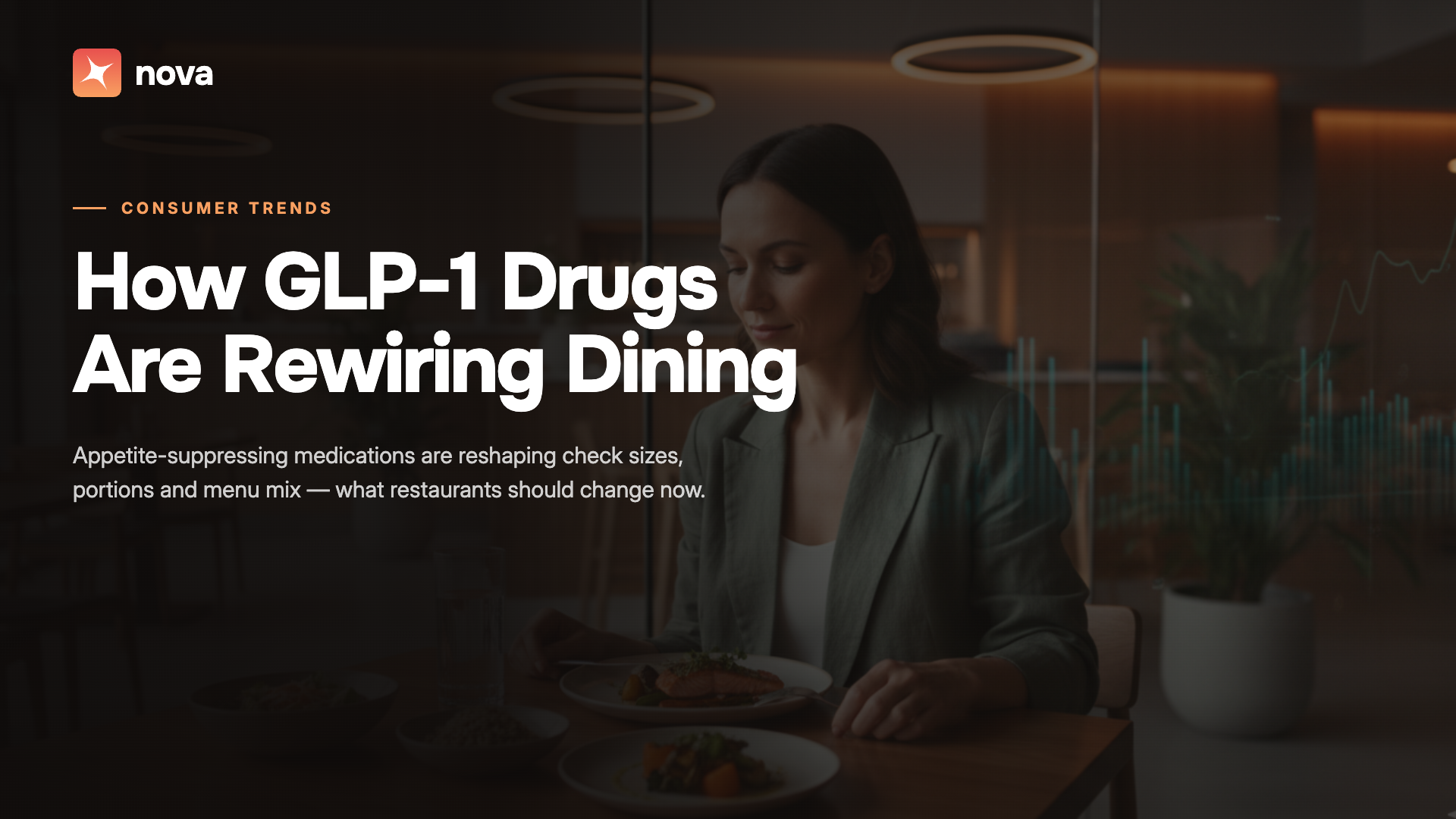

For decades, restaurant growth was powered by bigger plates, larger portions, and rising check averages.
That model is now under pressure.
GLP-1 medications such as Ozempic, Wegovy, and Mounjaro have moved from medical clinics into everyday life, quietly reshaping how people experience hunger, fullness, and satisfaction from food.
For restaurant owners and menu leaders, this is not a passing health trend. It is a structural shift in demand.
Guests are ordering less, paying closer attention to nutrition, and approaching dining with greater intention. Early signals across key markets already point to meaningful changes, including:
- Reduced average order sizes
- Lower visit frequency for heavy-plate concepts
- Rising demand for lighter, plant-forward, and shareable options
The economics of appetite are changing, and operators who continue to rely on volume-driven consumption risk seeing traffic and check sizes erode over time.
The critical question now is not whether this shift will affect restaurants, but how quickly operators adapt. The strategies that follow outline how forward-thinking restaurants are redesigning menus, pricing, and guest experience to stay profitable in a world where customers feel full sooner and expect more value from less food.
What GLP-1 drugs actually change in eating behavior
GLP-1 medications were originally developed for diabetes and are now widely used for weight loss. They work by slowing gastric emptying, increasing feelings of fullness, and acting on brain pathways related to hunger and reward.
The result is not just “people eat less.” Eating behavior changes in specific ways:
- Hunger levels drop significantly
- Cravings for sugary, fatty, and highly processed foods decrease
- Portion tolerance goes down
- Protein and nutrient-dense foods often become more appealing
- Some users report altered taste preferences and reduced interest in alcohol or snacking
Clinical and observational studies show meaningful reductions in appetite and cravings among semaglutide and tirzepatide users, often within weeks of starting treatment.
For restaurants, this translates into a different order profile, not just smaller checks.
The data signals restaurants cannot ignore
This shift is already visible in consumer and industry data.
1. Households on GLP-1 drugs spend less on food overall
Research shows households with a GLP-1 user reduce grocery spending by roughly 5 to 6 percent within months of adoption. The drop is even higher in higher-income households. This suggests less overall consumption and a move away from ultra-processed and snack-heavy baskets.
2. Food companies are already reacting
Major food and beverage companies have publicly acknowledged that GLP-1 drugs are changing demand patterns. Event menus, promotions, and product pipelines are increasingly leaning toward lighter, protein-forward, and “better for you” options.
3. Restaurant behavior is shifting, not disappearing
Market research indicates GLP-1 users still dine out. However, they order differently:
- More focus on mains rather than multiple sides
- Fewer fries, breads, and desserts
- Greater preference for vegetables and protein
- In some cases, higher spend per visit because they choose higher-quality or premium items in smaller quantities
This is the key nuance. Fewer items per order does not automatically mean lower revenue per guest.
4. Certain formats are more exposed
Analysts have flagged snack-heavy, bakery, and indulgence-driven formats as more vulnerable. Meanwhile, concepts that can flex into protein bowls, smaller plates and nutrient-dense meals are better positioned.
For operators, the question is not whether this affects you. It is how fast you respond.
5. Adoption has nearly quadrupled in two years - this is no longer a niche audience
Gallup's 2026 tracking data shows 11 percent of U.S. adults currently take a GLP-1 medication for weight loss, up from just 3 percent in 2024. Lifetime usage has climbed to 15 percent of adults, and awareness of these drugs is now at 91 percent of the population. Separate consumer-spending research puts current household exposure even higher, with roughly 23 percent of U.S. households reporting someone on a GLP-1 medication.
This is the point worth sitting with: what looked like an emerging trend two years ago is now a mainstream behavior. A menu built for 2023 appetites is already out of step with 2026 demand.
6. Dining-out frequency splits three ways, not one
The National Restaurant Association's latest economic analysis complicates the "GLP-1 users eat out less" narrative. Among current users: nearly half have cut back on how often they eat out, about one in four have actually increased their visits, and roughly three in ten report no meaningful change at all.
Zoom out, and GLP-1 users are still more engaged with restaurants than non-users overall - averaging 7.6 restaurant purchases a week (meals, snacks, or beverages) versus 5.1 for non-users. Generational data from Acosta Group sharpens this further: while 34 percent of GLP-1 users overall say they dine out less, 48 percent of Gen Z and Millennial users say they dine out more, and 42 percent of younger users now split entrées more often than before.
The takeaway for operators: this is not one customer behaving one way. It's several distinct segments, and a single "smaller portions for everyone" response will miss most of them.
7. These guests want to spend: if the menu makes it easy
Willingness to pay is not the obstacle. Surveyed GLP-1 users report that 87 percent still enjoy going to restaurants, and 71 percent consider dining out "essential to their lifestyle" - notably higher than the 61 percent of all adults who say the same. Seventy-six percent say they're willing to pay premium prices for menu items built around their needs (right-sized portions, protein-forward, clearly labeled).
The gap is on the restaurant side, not the guest side: 89 percent of GLP-1 users believe restaurants could do a better job highlighting healthy options, and about half of current and lapsed users say restaurants simply haven't adapted to what they need yet. That gap is the opportunity.
What this means for restaurant economics
Historically, many menus were engineered around volume. Large portions, multiple sides, and add-ons drove check size.
GLP-1 influenced diners flip that logic:
- They may not want volume
- They may be willing to pay for quality, protein, and health alignment
- They need clearer cues to identify suitable options
- They will pay a premium specifically when the format matches their needs, not as a blanket price increase, but for dishes engineered around portion size, protein content, and clarity
That creates an opportunity to shift from quantity-driven revenue to value-driven revenue.
This shift is already showing up in hard category data, not just survey sentiment. Recent volume tracking (2024 to 2025) shows protein bars and shakes up 18.3 percent, cottage cheese up 14.0 percent, and Greek yogurt up 9.4 percent, while confectionery is down 12.4 percent, bakery products down 6.7 percent, and salty snacks down 3.2 percent. The pattern is consistent: dollars are migrating toward protein and nutrient density, and away from indulgence and volume categories, at a measurable pace.
On the restaurant side specifically, the picture supports this same claim rather than contradicting it: casual dining spending among GLP-1 users rose 4.1 percent over a year on the medication, even as quick-service visits stayed roughly flat. Guests are consolidating spend into fewer, better visits rather than disappearing. Equity research from William Blair puts the aggregate stakes in perspective too: even if GLP-1 adoption doubles over the next five years, industry-wide restaurant sales growth is projected to move by less than one percentage point, with traffic down roughly 5 percent. That is a real headwind, but a manageable one for operators who adapt pricing and portioning now, and a compounding one for those who wait.
12 practical actions restaurant owners can take now
These are not theoretical. They are operational levers you can test in weeks.
1. Add a “high-protein” or “lighter plates” section
Create a clearly labeled section with 3 to 5 protein-forward, nutrient-dense mains. Use concise menu tags such as “high protein,” “low sugar”, or “lighter option.”
Measure: Share of orders from this section and average check of those orders.
2. Introduce smaller plated options or half portions
Offer half portions at around 65 to 75 percent of the full price, or design smaller signature plates with premium ingredients.
Measure: Conversion rate between full and smaller portions and revenue per seat.
3. Make protein add-ons an easy upsell
Default dishes to a vegetable or grain base with optional grilled protein add-ons. Train staff to suggest protein as a quality upgrade.
Measure: Attach rate of protein add-ons and incremental revenue.
4. Rebalance sides toward nutrient-dense options
Replace or complement fries and heavy sides with roasted vegetables, legume-based sides, or fresh slaws.
Measure: Side selection mix and food cost percentage.
5. Create premium micro-portion experiences
Offer tasting-style small plates or multi-course, smaller portion menus at a premium price.
Measure: Per-cover revenue and repeat purchase of these formats.
6. Use clear menu signaling
Icons and short descriptors reduce decision friction for health-conscious guests.
Measure: Sales lift on tagged items versus non-tagged.
7. Build “lean” bundles
Design a lunch or dinner bundle with a main, healthy side, and beverage positioned around balance and convenience.
Measure: Bundle attach rate and average check.
8. Train staff on the new value story
Servers should frame smaller or lighter options as premium, balanced, and satisfying, not as “less food.”
Measure: Upsell and add-on rates before and after training.
9. Engineer menus with data, not assumptions
Test placement, pricing, and descriptions for lighter and protein-forward items.
Measure: Item-level sales, margin per dish, and price sensitivity.
10. Tighten portion control
Smaller plates must be precisely costed to protect margins.
Measure: Food cost percentage and variance by dish.
11. Segment and target through loyalty
Health-oriented diners are a valuable segment. Send them targeted offers for lighter items and bundles.
Measure: Campaign conversion and repeat visit rate.
12. Partner with local health voices
Events with nutritionists or fitness communities can reposition your brand as a smart choice, not just an indulgent one.
Measure: New customer acquisition and event-driven traffic.
A simple 6-week experiment plan
You do not need a full rebrand. You need structured testing.
Weeks 0 to 2
Capture baseline metrics: average check, item mix, add-on rates, and food cost.
Weeks 3 to 4
Launch:
- A lighter or high-protein menu section
- A lean bundle
- Staff prompts for protein add-ons
Weeks 5 to 6
Test half portions or smaller plates on select items.
At the end, compare:
- Average check
- Revenue per cover
- Item mix shifts
- Add-on attach rates
- Food cost percentage
Double down on what lifts both guest satisfaction and margin.
Where technology becomes critical
This shift is not a one-time menu tweak. It is an ongoing behavioral transition. As GLP-1 adoption grows, guest expectations around portions, nutrition, and value will keep evolving. What works today may underperform in six months.
That means gut instinct and quarterly menu overhauls are no longer enough. Restaurants need continuous visibility and the ability to adjust fast. This is where a modern, AI-native restaurant management platform like NOVA Platform becomes a strategic advantage, not just an operational tool.
A modern restaurant platform should help you:
1. See demand shifts in real time, not months later
You need item-level intelligence, not just total sales.
Technology should show:
- Which “lighter” or high-protein items are gaining share
- Whether guests are dropping sides but upgrading mains
- How do add-ons like extra protein or premium ingredients affect check size
Instead of guessing whether health-driven behavior is affecting you, you can see mix changes week by week and act before trends hit margins.
--------------------------------------------------------
Must Read: Restaurant Data Analytics
--------------------------------------------------------
2. Run menu experiments without operational chaos
Adapting to GLP-1-influenced diners requires testing.
Your system should let you:
- Add new menu sections such as “high protein” or “lighter plates” quickly
- Test half portions or smaller plate formats on select items
- Adjust pricing or descriptions without reprinting and retraining every time
Fast, low-friction changes turn your menu into a live experiment, not a static document.
3. Protect margins while portions get smaller
Smaller plates do not automatically mean better margins. If portions creep or recipes are not tightly controlled, profits shrink.
Technology should support:
- Standardized recipes and portion guidance
- Ingredient-level costing
- Alerts when food cost percentages drift
This ensures “smarter plates” stay profitable plates.
-----------------------------------------------------------------------------
Must Read: Restaurant Industry Average Profit Margin
-----------------------------------------------------------------------------
4. Turn behavioral data into targeted marketing
Not every guest is on a GLP-1 drug. But many are health-minded, portion-conscious, or protein-focused. Those are high-value segments.
Your platform should help you:
- Identify guests who frequently order lighter or protein-forward items
- Send targeted offers such as lean lunch bundles or premium bowl promotions
- Measure who returns and what they buy next
This moves you from generic discounts to precision marketing aligned with emerging habits.
-------------------------------------------------------------------
Must Read: AI Native Marketing for Restaurants
-------------------------------------------------------------------
5. Optimize bundles and upsells scientifically
If guests order fewer items, every upsell matters more.
Technology should reveal:
- Which add-ons have the highest attach rates
- Which bundles increase check size without hurting conversion
- Where staff prompts are working and where they are not
That lets you redesign value around quality and relevance rather than quantity alone.
-----------------------------------------------------------------------------
Must read: The Ultimate Guide to Restaurant Upselling
-----------------------------------------------------------------------------
6. Align front-of-house and kitchen execution
New portion strategies and menu formats only work if execution is consistent.
An integrated platform should connect:
- Menu changes at the restaurant POS
- Clear prep instructions in the kitchen
- Consistent portioning and plating
This reduces variation, improves guest experience, and protects cost control at the same time.
7. Move at the speed of consumer change
The biggest risk in the GLP-1 era is not smaller appetites. It is slow decision-making.
When technology allows you to:
- Spot shifts early
- Launch new items or formats quickly
- Measure results within days
You move from reactive to adaptive. That is the difference between being disrupted by changing food behavior and leading through it.
In a world where appetite itself is being reshaped by medicine, the restaurants that win will not just cook well. They will measure, test, and adjust faster than everyone else.
The bottom line
GLP-1 drugs are not just a healthcare story. They are a demand pattern story.
Some guests will eat less. But many will pay for better. Restaurants that cling to portion-driven logic may feel pressure. Restaurants that redesign around protein, clarity, smaller premium plates, and smart menu engineering can emerge stronger.
The winners in this era will not be the biggest plates. They will be the smartest menus.