When you think of what makes a restaurant successful, your mind probably goes straight to great food, friendly service, and maybe a good location. But there’s another part of the business that’s just as important, yet often overlooked: restaurant back-of-house software (BoH).
What’s happening behind the scenes can make or break a restaurant. So here’s the big question: how well are you managing your kitchen operations, inventory, staff scheduling, and vendor relationships?
If your answer involves spreadsheets, manual logs, or disconnected software tools, it’s time to rethink things. The BoH is the engine room of your restaurant. It’s where cost control, efficiency, and consistency happen, or don’t.
In this blog post, we’ll talk about what back of house software does, the problems with using too many tools, and why a platform like NOVA Tech is the smarter way forward.
What Does BOH Mean in a Restaurant?
BOH stands for back of house. In a restaurant, the back of house refers to every area and operation that guests do not see directly - the kitchen, prep stations, walk-in coolers and dry storage, the dishwashing area, and the receiving dock where deliveries come in. It is everything that happens behind the pass, from the moment raw ingredients arrive to the moment a finished plate leaves the kitchen.
The back of house is distinct from the front of house, which covers all guest-facing operations: the dining room, bar, host stand, and service staff. The two halves of a restaurant are deeply dependent on each other, but they operate under very different conditions. FOH runs on hospitality and guest interaction. The restaurant back of house runs on timing, precision, and coordinated execution under pressure.
In practical terms, back of house operations include food preparation and cooking, inventory management, recipe execution and quality control, kitchen staffing and scheduling, vendor ordering and receiving, food safety and sanitation compliance, and waste management. All of these functions happen simultaneously during a service period, and each one affects how quickly and consistently food reaches the guest.
Understanding what BOH means is important not just for operators, but for anyone building or evaluating a restaurant technology stack. Software described as "back of house" should cover the full operational scope of the kitchen and its supporting systems - not just one piece of it.
Back of House Restaurant Positions: Who Makes Up the BOH Team?
The restaurant back of house is not a single role - it is a structured team with distinct responsibilities at every level. Understanding the positions within a BOH team matters for hiring, scheduling, payroll, and technology configuration. Back of house restaurant positions vary by the size and format of the operation, but most restaurants share a common core structure.
Executive Chef
The executive chef sits at the top of the kitchen hierarchy. They are responsible for menu development, food cost management, sourcing relationships, and the overall culinary direction of the restaurant. In larger operations or restaurant groups, the executive chef may oversee multiple locations and spend less time on the line, focusing instead on standards, training, and cost performance.
Head Chef or Chef de Cuisine
In restaurants where an executive chef operates at a group level, the head chef or chef de cuisine runs the day-to-day kitchen at a specific location. They own service execution, manage the kitchen team during shifts, and are accountable for consistency and quality on the plate.
Sous Chef
The sous chef is the second-in-command in the kitchen. They manage the line during service, assign station responsibilities, step into any role where there is a gap, and oversee the practical execution of the chef's vision. In smaller restaurants without a dedicated executive chef, the sous chef often absorbs those responsibilities as well.
Line Cooks
Line cooks execute the actual cooking during service. Each line cook typically owns a specific station - grill, sauté, fry, cold prep - and is responsible for the speed, accuracy, and quality of every dish that leaves their station. Line cooks are the backbone of BOH service operations, and their performance directly determines how quickly and consistently food reaches the guest.
Prep Cooks
Prep cooks handle all food preparation before service begins. This includes breaking down proteins, chopping vegetables, making stocks and sauces, and portioning ingredients to par levels. Strong prep work is what allows line cooks to execute quickly during service. A kitchen with poor prep is a kitchen that falls behind at the worst possible moment.
Pastry Chef
In restaurants with a dessert program, the pastry chef handles all sweet course production. Pastry work often happens on a different schedule from the main kitchen, with significant prep happening earlier in the day, and requires a separate set of ingredients, equipment, and storage considerations.
Kitchen Manager
The kitchen manager oversees the operational and administrative side of the BOH. This includes managing inventory, placing vendor orders, tracking food costs, maintaining compliance with health and safety standards, and coordinating staff schedules. In many restaurants, kitchen management responsibilities are shared between the head chef and a dedicated operations role, particularly in higher-volume locations.
Dishwashers and Kitchen Porters
Dishwashers and kitchen porters handle sanitation, equipment cleaning, waste removal, and kitchen organization throughout service. These roles are operationally critical and often underappreciated. A restaurant that falls behind on dishwashing during a busy service period will feel the impact across every station on the line.
Why BOH Staffing Matters for Your Technology Stack
A back of house team with this range of roles - each working on different schedules, at different pay rates, with different responsibilities - requires software that can handle that complexity. Scheduling a sous chef, three line cooks, two prep cooks, and a dishwasher for a Saturday dinner service is not the same as scheduling a retail shift. Restaurant back of house software that does not account for role-specific configurations, multi-rate payroll, and shift-by-shift labor cost visibility is not built for how kitchens actually operate.
Why Back of House Operations Are Crucial.
The restaurant back of house is where a restaurant's financial performance is either protected or eroded, shift by shift. While guests experience the dining room, it is the kitchen that determines whether the business behind it is sustainable. Food costs, labor efficiency, waste management, and order accuracy are all back-of-house functions - and together they account for the majority of a restaurant's controllable costs.
The Numbers Behind BOH Performance
Labor is the single largest controllable expense in most restaurants, running between 30 and 40% of total revenue. 88% of operators reported increased restaurant labor costs in 2024, and the majority expect that pressure to continue through 2026. In the back of house, where staffing is driven by service volume, prep requirements, and shift structure, even small inefficiencies in scheduling compound quickly across a week of service.
Food cost adds another 25 to 35% of revenue on average, bringing the combined food and labor burden - known as prime cost - to 55 to 75% of total sales for most restaurants. Keeping prime cost below 65% is the standard industry benchmark for financial health. When back-of-house operations are running well, this number is manageable. When they are not, there is very little margin left to absorb anything else.
Food waste compounds the challenge significantly. The average restaurant wastes between 4% and 10% of all food purchased through spoilage, over-preparation, and plate waste. Across the US restaurant industry, that adds up to over $162 billion in waste-related costs annually. For an individual restaurant spending $200,000 per year on ingredients, a 7% waste rate means $14,000 lost before accounting for disposal costs and the prep labor invested in food that never reached a guest.
BOH Efficiency Directly Affects the Guest Experience
A slow kitchen affects more than food costs - it affects every guest in the dining room. Ticket times that run long create a cascade effect: tables back up, servers lose momentum, and guests who arrived hungry and expectant begin to disengage. Research consistently shows that 32% of consumers will stop visiting a restaurant they previously liked after a single bad experience. In a full-service restaurant, a meaningful share of those bad experiences trace back to kitchen execution rather than service quality.
Order accuracy is equally tied to BOH performance. Mistakes made at the prep or line cook level reach the table as the wrong dish, a missing modification, or an allergen that should have been avoided. Each of those outcomes carries a service cost, a potential health risk, and a reputational risk that can outlast the meal itself through online reviews.
Why the Right Systems Make the Difference
The restaurants that manage these pressures most effectively are not necessarily the ones with the best chefs or the most experienced teams. They are the ones with the clearest visibility into what is happening in their back of house in real time. Operators who can see food cost, labor cost, and waste trending in a single dashboard can make targeted decisions before problems escalate. Those running on manual processes and disconnected systems often find out something went wrong after it has already affected the week's margins.
Modern restaurant back-of-house software closes the gap between what is happening in the kitchen and what the operator knows about it. When inventory, scheduling, ordering, and kitchen management are connected in one platform, the data becomes actionable instead of historical - and that is the difference between managing a restaurant and reacting to one.
What Great BoH Software Should Do for You?
The right software doesn’t just “help”, it transforms your back of house into a well-oiled machine.
Look for features that reduce chaos and give you more control where it matters most. Here are the key functions every restaurant should expect from its BoH tech.
Smart Inventory Management That Cuts Waste
One of the biggest drains on restaurant profits is wasted ingredients. A good BoH system tracks what’s coming in, what’s being used, and what’s being tossed out. Instead of guessing or doing end-of-day counts by hand, you get real-time data on stock levels.
When your inventory syncs with your sales, it’s easier to plan ahead, reduce over-ordering, and spot trends that could save you thousands.
Order Management and Kitchen Display Systems That Keep You Moving
KDS (kitchen display systems) have replaced the old ticket rail for good reason. They keep the kitchen organized, reduce errors, and speed up prep times.
When your restaurant back-of-house software includes a built-in KDS that connects directly to the POS, every order flows seamlessly from the front to the back. No missing tickets, no delays, just smooth communication and faster service.
Staff Scheduling and Payroll That Actually Make Sense
Managing schedules on paper or in separate restaurant scheduling apps creates chaos, especially during rush hours or staff shortages. With integrated restaurant back-of-house software, you can build smarter schedules based on sales trends, not just guesses.
Add payroll to the mix, and you’ve got one place to handle time tracking, overtime, and paycheck processing, without exporting files or entering hours manually.
Vendor and Supply Chain Management Made Simple
Ordering from multiple suppliers? A proper BoH platform helps you track purchase orders, monitor delivery times, and keep vendor costs in check. You’ll be able to compare prices, forecast future needs, and make sure the ingredients you need are always on hand, without overstocking or wasting money.
Reports That Go Beyond the Basics
You can’t fix what you can’t see. That’s why detailed analytics are a must. Restaurant back of house software software gives you clear reports on food costs, labor efficiency, waste, and vendor performance. These insights help you make better calls about pricing, staffing, and ordering, and they’re much easier to get when everything is connected in one system.
Restaurant Back of House: KPIs and Metrics Every Operator Should Track
Most restaurant operators have a general sense of how their kitchen is performing. Food feels expensive. Service feels slow some nights. Waste feels high but is hard to quantify. In 2026, "a general sense" is not enough. The back of house generates more operational data than any other part of the restaurant, and operators who measure it precisely have a structural advantage over those who do not.
These are the key back of house KPIs every restaurant should track, and what the numbers should actually look like.
Food Cost Percentage
Food cost percentage is the share of your total revenue spent on ingredients. It is calculated by dividing your total food costs for a period by your total food revenue and multiplying by 100. Industry benchmarks place healthy food cost between 25 and 35% of revenue, though the right target varies by concept - a fine dining restaurant with premium ingredients will naturally run higher than a QSR with a tightly controlled menu.
Tracking food cost weekly rather than monthly gives you the visibility to catch overruns before they compound. A food cost that creeps from 30% to 34% over six weeks signals a problem - in portioning, purchasing, pricing, or waste - that monthly reporting will not catch in time to address.
Food Waste Percentage
Restaurants waste between 4% and 10% of all food purchased on average, through spoilage, over-preparation, and plate waste. On a restaurant spending $200,000 annually on ingredients, a 7% waste rate means $14,000 lost before factoring in disposal and prep labor costs. Research shows that every $1 saved on food waste generates the equivalent of $14 in additional revenue needed to produce the same profit impact - making waste reduction one of the highest-return operational improvements a restaurant can make.
The good news is that this number responds directly to better systems. Restaurants using inventory management software have seen average waste rates decline 10 to 15% over time compared to those running manual processes. Real-time inventory tracking, accurate par levels, and prep based on actual forecast demand are the three levers that move this metric most reliably.
Labor Cost Percentage
Labor is the highest controllable cost in most restaurants, running 30 to 40% of total revenue across the industry. 88% of restaurant operators reported increased labor costs in 2024, with the majority expecting further increases through 2026. For back-of-house operations specifically, labor cost is driven by scheduling efficiency, overtime management, and how well staffing levels match actual service demand.
A BOH team that is overstaffed on a slow Tuesday costs the same in wages as a team that is perfectly calibrated -- but one of those decisions is based on data and the other is based on habit. Restaurants that connect their scheduling tools to sales forecasts and historical covers data consistently outperform those that staff by gut feel.
Ticket Time
Ticket time measures how long it takes from when an order is placed to when food is ready to leave the kitchen. It is one of the most direct measures of BOH execution quality and directly affects table turnover, guest satisfaction, and how many covers you can run per shift.
Healthy ticket times vary by concept - a fast casual kitchen targets different times than a full-service dinner restaurant - but what matters most is consistency. Wide variance in ticket times during a service period is a signal of communication breakdowns, station imbalances, or prep shortfalls. Kitchen display systems that track average ticket time by station and by shift make this visible in a way that printed ticket rails simply cannot.
Inventory Turnover Rate
Inventory turnover measures how quickly your restaurant cycles through its ingredient stock. A high turnover rate indicates that you are ordering accurately, using ingredients efficiently, and not holding excess stock that risks spoilage. A low turnover rate points to over-ordering, slow-moving menu items, or inconsistent prep usage.
For perishable-heavy kitchens, tracking turnover by ingredient category - proteins, produce, dairy - gives you a more granular view of where ordering and usage habits need adjustment. This is one of the metrics that AI-powered inventory systems are particularly effective at surfacing, because the patterns become visible across hundreds of data points that manual tracking cannot process at the same speed.
Prime Cost
Prime cost - food cost plus labor cost combined - is the single most important financial metric for any restaurant back-of-house operation. Industry standard is to keep prime cost below 65% of revenue. When both food and labor costs are trending upward simultaneously, prime cost is the metric that tells you how close you are to the margin cliff.
Tracking prime cost weekly, by location, and by day part gives operators the early warning signal they need to make targeted interventions - whether that means adjusting a prep schedule, renegotiating a vendor contract, or revisiting portion sizes on a high-cost menu item.
What Happens When You Use Too Many BoH Tools?
Too many tools can slow you down, cost you more, and confuse your team. Here’s what restaurant owners run into when BoH systems don’t talk to each other.
Disconnected Systems = Frustration and Errors
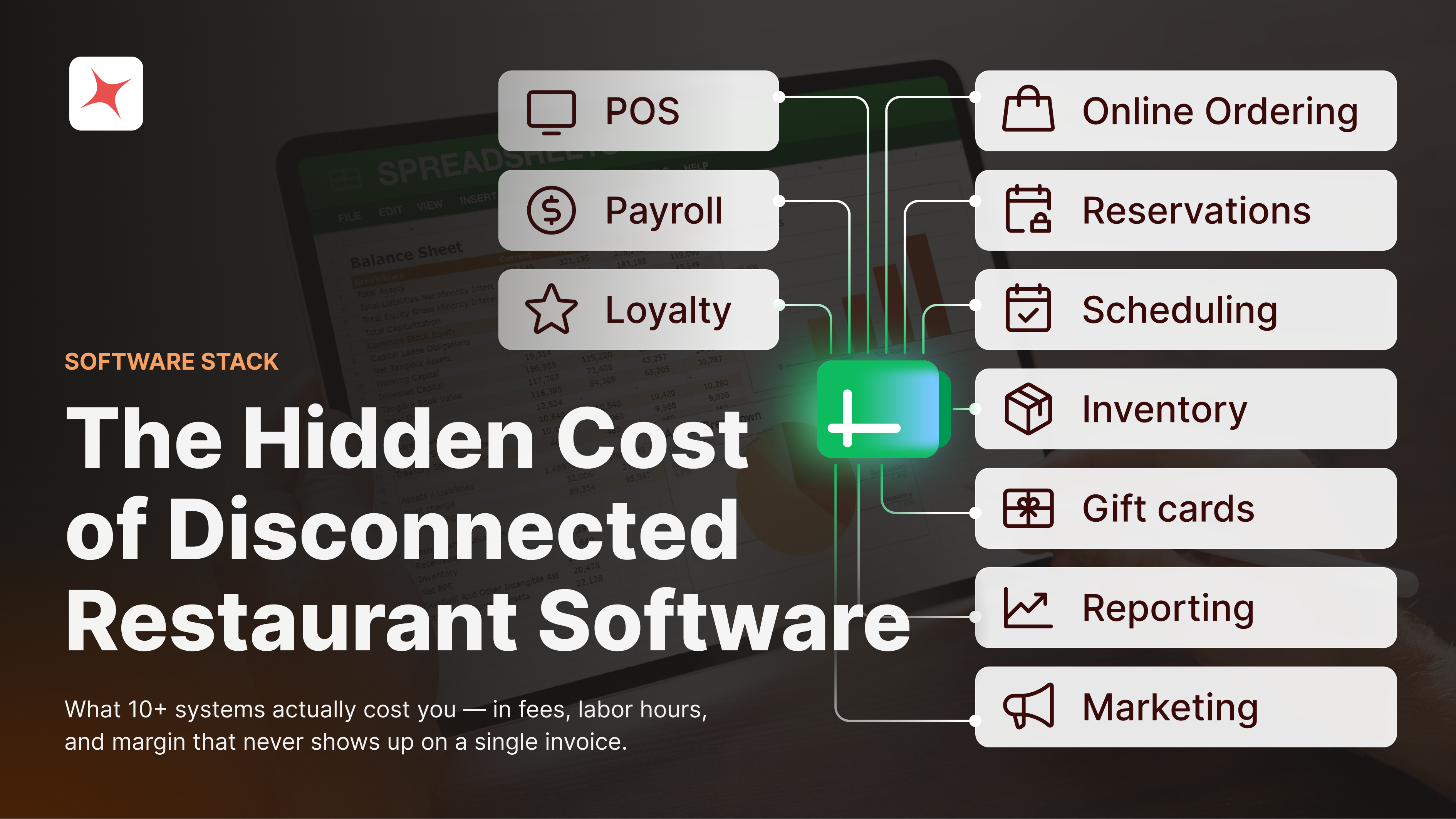
Using separate tools for scheduling, inventory, payroll, and order management means one thing: you’re constantly switching tabs, exporting data, and hoping everything lines up. But when data lives in silos, mistakes are inevitable. Staff gets scheduled during their time off, ingredients get double-ordered, and no one has a full view of what’s going on.
Your Tech Costs Start to Stack Up
Each system might seem affordable at first. But when you’re paying monthly fees for three or four different restaurant back-of-house software systems, plus integration costs and setup fees, it adds up. You also have to factor in the time spent training your team on each one and troubleshooting when something breaks.
Inefficiencies That Hurt Service and Profit
A mismanaged back of the house leads to delays in the kitchen, wasted food, and overworked staff. Without centralized data, you can’t react quickly when problems pop up, and you miss opportunities to optimize. This doesn’t just affect the bottom line; it impacts the guest experience, too.
Why Integration with Front of House Is Important
In a modern restaurant, the front and back of house can’t operate in silos. The kitchen’s speed, accuracy, and efficiency directly depend on what happens at the counter, on the POS, or through online orders. That’s why integration between your back-of-house software and front-of-house systems is essential for smooth, profitable operations.
:When these systems communicate in real time, every order flows seamlessly from the POS to the kitchen display, inventory automatically adjusts as items are sold, and managers can track sales, labor, and stock levels from one dashboard. This eliminates manual updates, reduces order errors, and ensures guests always get what’s available on the menu.
An integrated setup also helps with accurate forecasting and waste reduction. For instance, knowing which dishes sell most during peak hours allows chefs to prep smarter and managers to schedule staff more efficiently.
With a fully connected platform like NOVA, restaurants unify their front and back of house into one ecosystem - making operations faster, data smarter, and guests happier.
.png)
One Smart Platform to Handle It All: Meet NOVA
If you’re tired of juggling different systems and want one tool that brings it all together, you’re in the right place. NOVA platform is built to simplify the back of house and make life easier for restaurant operators. Let’s break down what makes NOVA Tech the better choice.
One Platform, Every Task Covered
NOVA Tech connects the dots between all your core operations, inventory, scheduling, vendor orders, KDS, and reporting, under one roof. No more switching between apps or worrying about integrations. Everything flows naturally from one part of the business to the next.
Real Savings, Real Efficiency
By replacing a handful of expensive tools with one smart platform, NOVA Tech helps cut your software budget without cutting corners. And because everything works together, you save time too, from fewer errors to faster decision-making.
Proven Results from Real Restaurants
Restaurants using NOVA Tech have reported faster kitchen turnaround times, more accurate inventory counts, and lower labor costs.
Why Settle for Complicated? Make BoH Simple with NOVA Tech
Back of house software shouldn’t be another challenge to manage; it should be the tool that makes your restaurant stronger. If you’re still piecing together your tech stack, it’s time to think about how much easier life could be with one connected system. NOVA Tech isn’t just software; it’s your partner in building a smarter, more efficient kitchen.
By unifying inventory, employee scheduling, order management, and restaurant analytics and reporting into one easy-to-use platform, NOVA Tech helps you focus on what you do best: running your restaurant and delighting your guests. No more wasted time, no more duplicated effort, just one system designed to work the way restaurants really operate.
Ready to upgrade your back of house?
Let NOVA Tech be the system that brings it all together. Book a demo spot for your team today!
FAQs on Restaurant Back-of-House Software
1. What is restaurant back-of-house software?
Restaurant back-of-house software helps manage everything behind the scenes — from inventory and supplier management to staff scheduling and kitchen operations. It centralizes your restaurant’s core operations to improve accuracy, efficiency, and profitability.
2. Why is back-of-house software important for restaurants?
Back-of-house software is essential because it streamlines daily operations like ordering, inventory tracking, and labor management. It reduces manual errors, minimizes food waste, and helps restaurants make data-driven decisions to optimize margins.
3. How does restaurant back-of-house software integrate with the front of house?
Modern back-of-house systems integrate directly with your POS and ordering platforms. This allows real-time order syncing, automatic inventory updates, and unified performance tracking — ensuring smooth coordination between kitchen, service, and management teams.
4. What features should I look for in a restaurant back-of-house software?
Look for key features such as automated inventory tracking, recipe costing, vendor management, labor scheduling, reporting, and analytics. The best back-of-house platforms, like NOVA, bring all these capabilities together in one AI-powered system.
5. Can back-of-house software help reduce food and labor costs?
Yes. By providing real-time visibility into ingredient usage, sales patterns, and staff productivity, back-of-house software helps restaurant operators reduce waste, optimize prep quantities, and align staffing levels with actual demand.
6. How does AI improve restaurant back-of-house operations?
AI-driven back-of-house software can forecast demand, suggest inventory reorder levels, and identify performance trends. NOVA’s AI-native platform uses predictive insights to help operators make smarter, faster operational decisions.
7. Is restaurant back-of-house software suitable for small or single-location restaurants?
Absolutely. Even small restaurants benefit from better control over inventory, costs, and labor. Cloud-based solutions like NOVA scale with your business — making them ideal for single locations, multi-unit brands, and everything in between.
8. How does NOVA’s restaurant back-of-house software stand out?
NOVA connects every part of your operation - POS, inventory, workforce, and analytics - under one modern platform. Its AI-native architecture eliminates data silos, giving operators real-time insights and automation tools to run smarter, more efficient restaurants.