The Slow-Tuesday Problem: Filling Your Worst Shifts With Targeted Promotions Instead of Blanket Discounts

Every independent operator has a Tuesday. Maybe it's a Tuesday, maybe it's the 2 pm to 5 pm stretch on a weekday, but there's a shift on the schedule that consistently seats a fraction of what Friday night does, and the usual fix, a sitewide 20% off coupon, ends up discounting the Friday crowd that would have shown up anyway. If the goal is to boost slow-shift restaurant sales without eating margin on the shifts that were already full, the discount has to follow the data, not a hunch.
Why blanket discounts solve the wrong problem
The margin for error here is thin: full-service restaurants average just 3 to 5 percent profit margins, and the National Restaurant Association found that 42 percent of operators weren't profitable at all in 2025.
A flat discount campaign, "20% off all week" or "kids eat free every night," treats every hour on the schedule as equally in need of help. It isn't. Saturday dinner doesn't need a coupon. It needs tables. Handing every guest a discount that day gives away margin on covers you would have gotten anyway, and the promotion shows up as a cost against revenue you didn't need to create in the first place.
The operators who run into this most often are the ones measuring performance by the week or the day, not the shift. A week that nets out fine can still be hiding a Tuesday afternoon that's barely covering labor. Averaging over seven days smooths the problem out of view.
What "slow" actually looks like, shift by shift
Pull covers by day and hour for a typical month, and the pattern usually isn't subtle. Lunch and dinner carry the week. Breakfast and the late window trail behind. And most restaurants have one weekday, often Tuesday, where every day-part underperforms its own weekly average, not just the slow parts of a strong day.
The chart below is illustrative, built from typical full-service demand patterns rather than a single restaurant's data, but the shape holds across a lot of concepts: afternoon and late-night on the slowest weekday running at roughly a third of Friday and Saturday's dinner volume.
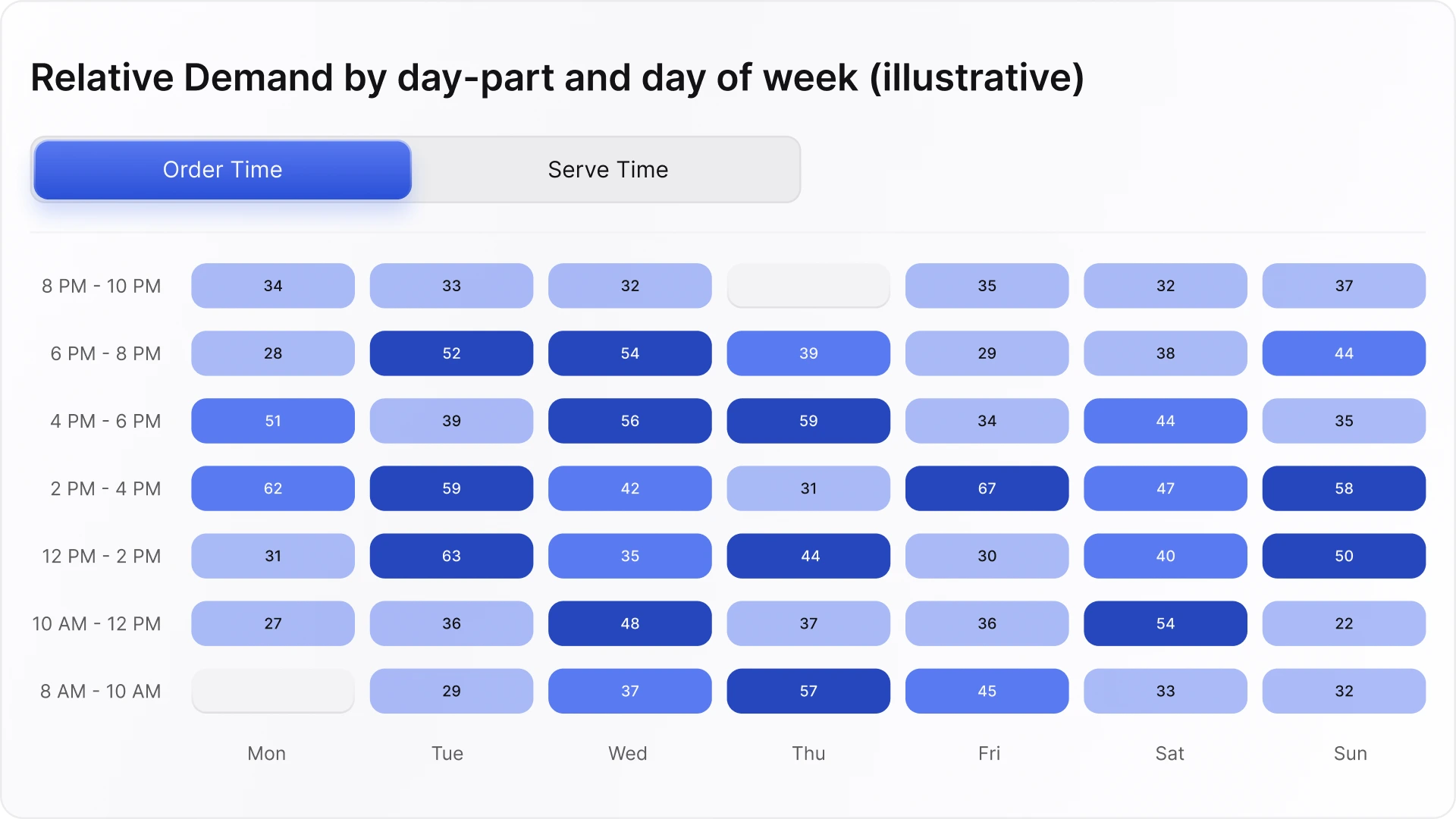
That gap between the slowest cell and the busiest one is the actual target. A promotion aimed at Tuesday 2 pm to 5 pm solves a real problem. The same promotion applied to Friday dinner solves nothing and costs money.
Why guessing burns margin twice
Operators without shift-level data tend to default to one of two moves. They discount everything, or they discount nothing and hope word of mouth fills the gap eventually. Neither move costs money in a way that shows up cleanly on a single line.
Discounting everything gives away margin on shifts that didn't need help. That's the easy half to see. Doing nothing lets a genuinely dead shift sit there week after week, covering rent and utilities but not contributing much beyond that. The restaurant ends up paying for the slow shift twice: once in the revenue it never generated, and again in a promotion that either missed the target entirely or landed on hours that were already full.
A guest who redeems a discount on a night the restaurant was already booked doesn't spend more because of it, doesn't come back sooner, and didn't need the incentive to walk through the door in the first place. The promotion budget for the month gets spent on hours that were fine on their own, and the actual slow shift is right where it started.
Targeting the promotion to the shift, not the day
Once the slow window is identified at the shift level, the fix looks different from a sitewide discount. A few approaches work well when they're scoped tightly to the actual gap instead of the whole day:
- A time-boxed offer that only activates during the specific window. A fixed discount from 2 to 5 pm on the day that lags, not a discount that runs all day and quietly covers dinner too.
- A different menu push for that window. A smaller, higher-margin item fills seats without cutting into the check average the way a percentage-off deal does across the board.
- A loyalty nudge sent only to guests who've visited during that daypart before. They're the ones most likely to respond to a reminder rather than needing a price cut to show up.
- A staffing or incentive adjustment tied to that specific shift's covers, which costs the restaurant nothing unless the shift actually improves.
None of these require guessing which day is soft. They require knowing it at the hour level, with enough history behind the number to trust the pattern instead of reacting to one slow Tuesday that might just have been the weather.
How Nova surfaces the pattern
This is where most independent operators hit a wall. The point of sale knows exactly how many covers came through at 2 pm on a Tuesday, but that number usually lives in a report nobody pulls until the month is already over, if it gets pulled at all.
Nova Platform tracks covers, check size, and revenue by day-part and hour as they happen, in the same dashboard as labor and inventory, so an operator can see the demand curve for a specific shift instead of reconstructing it from a spreadsheet at the end of the month. That's the difference between promoting the whole week and promoting the three hours that actually need it.
Seeing the pattern also means catching it early. A Tuesday afternoon that's been soft for six weeks straight looks different from a single bad week, and only shift-level data over time tells those two apart.
What to watch once the offer runs
A shift-level promotion needs a shift-level read on whether it worked. Checking total weekly revenue against last month tells an operator almost nothing about whether Tuesday afternoon specifically moved, since a strong Friday can mask a Tuesday that didn't budge at all.
The number that matters is covers during that exact window, compared to the same window in the weeks before the offer went live. Check average during the promotion matters too, since a discount that pulls in covers but tanks the average ticket can end up costing more than the empty seats did. Four weeks is usually enough to tell a real lift from noise, especially if the slow shift has been stable for a while before the test.
If the shift moves, the offer earned its place on the calendar. If it doesn't, that's useful information on its own. Either the incentive was wrong for that crowd, or the shift's slowness has a cause a discount can't touch, like staffing or a location factor outside the promotion's control.
Building the next slow-shift plan
The instinct to discount broadly comes from not knowing exactly where the gap is. Once that gap is visible by day-part and hour, the promotion gets smaller,cheaper, and more likely to work, because it's aimed at the three or four hours that are actually underperforming rather than the whole week around them.
Start with one month of shift-level data. Find the window that lags every other daypart on its worst day, not just the slow parts of a busy one. Build a single offer scoped to that window, run it for a few weeks, and check whether covers moved during that specific shift rather than the week overall.
Nova's daypart and hourly reporting is built to make that first step fast rather than a spreadsheet project. Schedule a walkthrough to see how it maps against your own slow shifts.