.svg)
Whether you own a fine dining or casual dining restaurant, mastering the art of table setting is imperative. A well-set table creates a good first impression and showcases your professionalism and etiquette. In 2026, when competition is immense, the smallest details can distinguish you from your competitors.
In this blog, we will discuss the best practices to set up tables in your restaurant, their importance, and common mistakes to avoid.
Why Proper Table Setting Matters
A well-set table complements your restaurant’s decor and ambiance. When guests sit at the table, the first thing they notice is the arrangement. A well-arranged table instantly gives a positive vibe. Moreover, it enhances efficiency as servers instantly know where each item is to be placed. Setting a table properly is not only about placement; it must be in accordance with the brand design and type of service.
Table Setting Basics: The Foundation of Impeccable Presentation
Set as per the Service Type
The style, speed, and presentation of every restaurant type are different. For instance, a casual dining table might be minimalistic, while a fine dining table requires multiple utensils and glassware. Therefore, it is wise to analyze the service style before setting the table.
Start with a Clean Slate
A clean and ironed tablecloth must be the first step towards setting up a table neatly. Its design and color should match your brand's aesthetics, decor, and menu. Try to maintain consistency across the restaurant.
Step-by-Step Table Setting Guide
Formal Table Setting
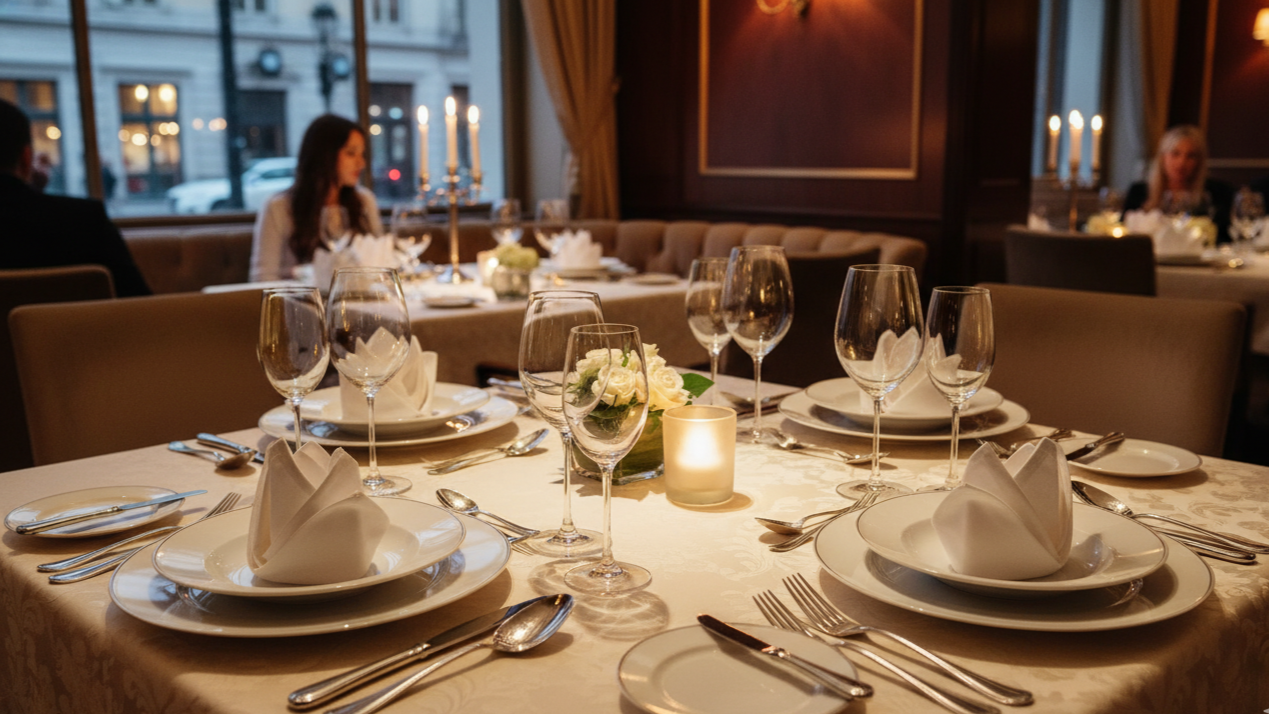
Here are the steps for setting up a table for fine dining.
- Charger Plate - Charger plates are decorative plates, not used for serving or consuming food. Place the charger plate right in the middle of the table.
- Dinner Plates - Dinner plates are placed on top of the charger plate, followed by the salad plate and soup bowls.
- Forks - Place the main course fork on the left side of the charger plate. Other forks, such as the salad fork and the fish fork, are to the left of the main course fork.
- Knives and Spoons - Knives and spoons should be on the right side of the charger plate, with dinner knives being the closest. The blade of the dinner knife should be facing inward. The dinner knife must be followed by the spoon. Forks and spoons can be turned upward. The dessert spoon and fork are placed above the charger plate.
- Glassware - Glasses must be on top of the dinner knife and aligned perfectly with its tip. Glasses must be placed diagonally above the knife, starting with the water glass, followed by the red wine glass, and the white wine glass.
- Bread Plate - The bread plate is placed above the forks. Place the butter knife on top of the bread plate with the edge pointing outward.
- Napkin - Napkins can be placed either on the dinner plate or to the left of the forks.
Casual Table Settings
Not every meal requires a formal layout. In a casual dining space, charger plates and additional utensils can be removed. For casual restaurant service:
- Place the dinner plate in the middle of the table
- Dinner fork to the left and knife and spoon to the right
- The water glass is placed above the knife
- The napkin is placed to the left of the fork
Innovations and Trends Shaping 2026 Table Service
Customers’ preferences are changing. In 2026, restaurants need to reinvent themselves and bring innovation to their table service. Here are some trends to look out for in 2026.
Sustainable and Eco-Friendly Tableware Choices
Adopting sustainable practices is not an option anymore; it’s a necessity. 73% of customers are willing to pay more for environmentally friendly restaurants. Hence, you must try to implement sustainable practices not only for food sources but also for table elements. Many establishments are moving away from disposable or single-use items and instead opting for bamboo or recycled flatware, durable, eco-conscious plates, and high-quality cloth napkins in place of paper. When guests realize your values align with theirs, they tend to become loyal customers.
Personalized Place Cards
According to a survey, 70% of respondents preferred restaurants that offer personalized menu recommendations. Personalization enhances guest experience and boosts the retention rate. In the case of table settings, custom-printed menus and place cards are becoming an effective tool to enhance guest experiences. Keeping personalized place cards adds an extra layer of hospitality, making guests feel recognized and valued.
Integrating Technology
A modern table setting is incomplete without the integration of technology. Smart restaurants are using multiple tools to streamline ordering and service. For instance, QR-code-based dynamic menus are replacing conventional ones. Moreover, restaurants are implementing handheld POS systems for ordering, tipping, and payments.
Troubleshooting Common Table Setting Mistakes
Here are some mistakes restaurants can avoid while setting tables.
Overcrowded Tables
Servers must ensure that they don’t place too many utensils at the table, even if they are not required. Overcrowding tables leads to clutter, making the experience chaotic. Excess flatware and glassware also increase the risk of spills and confusion during the meal. Hence, you must pre-set only the essential and common utensils and keep adding items when required.
Incorrect Placement
Misplaced utensils hamper the guest dining experience, especially in multi-course meals. Guests should be looking for forks and knives; they should be placed in perfect order and symmetry. Moreover, placement should be consistent across all tables.
Inaccurate Alignment
Proper table setting does not stop only at the correct placement. Servers must also ensure that utensils and flatware are perfectly aligned. Glasses placed at varying distances, plates set off-center, or crooked napkins can make the table appear untidy. Accurate alignment creates a symmetry that enhances table aesthetics.
Best Practices for Restaurant Managers
Here are some best practices that every restaurant must follow to ensure the perfect table setting and maintain consistency.
Create an SOP
Drafting an SOP (standard operating procedure) for table setting leads to consistency among all staff members. You must outline how to set up the table for different meals and occasions. An SOP gives staff clear instructions and reduces confusion.
Conduct Pre-shift Checks Before Service
Managers must conduct pre-shift checks to ensure cleanliness, table setup, and alignment. This step helps catch issues such as missing utensils, smudged glassware, or misaligned place settings early, reducing last-minute scrambling during service.
Train Your Staff
You must train your staff members to set up tables accurately yet quickly. In peak hours, staff must be capable of ensuring the right alignment without keeping guests waiting. You must conduct regular drills to help servers develop muscle memory for setting up tables.
.png)
Service Excellence Starts with NOVA
Setting tables optimally is just the first step to ensure a delightful guest experience. You need to ensure that the overall experience from entering the restaurant to stepping out is memorable. NOVA is a one-stop restaurant management platform that reduces wait times, ensures personalization, and reduces order errors.
NOVA ensures guest satisfaction with:
Floor Management
A well-managed dining floor is the backbone of great service. NOVA’s floor management tools give hosts and managers a real-time view of table availability, server sections, and guest flow.
Staff can optimize seating, balance server workloads, and turn tables faster without disrupting the guest experience. With clear visibility into the dining floor, restaurants can reduce wait times, improve coordination between front-of-house teams, and ensure every table receives timely attention.
Handhelds
NOVA’s handhelds make tableside ordering a cakewalk. Guests can order, pay, and tip right at the table. They can pay at the table with their preferred payment method. No more waiting for the server to get back with the card. They can also split the bill on the go.
Smart Loyalty Programs
NOVA’s AI-powered loyalty programs offer customized rewards and offers to guests. Loyalty programs are integrated with every ordering platform (online, POS, and mobile app) to give customers 24/7 visibility into their rewards.
Course Pacing
Avoid table clutter with NOVA’s course pacing feature. Set the right pace between meals with custom messages for the kitchen staff. Optimize preparation time and serve guests with courses not a minute sooner or later.
AI-Driven Personalization
NOVA is an AI-native solution that offers menu prompts to servers based on guests’ preferences and ordering history. It enables them to deliver personalized services, enhancing customers’ trust and retention.
Waitlist Management
It is essential to ensure guest satisfaction, even when they are waiting for tables. With NOVA, you can streamline waitlist management by facilitating real-time interaction. Send guest text messages informing them of their estimated wait time. Text guests with offers on their favorite item with the option to pre-order.
Table Turn Optimization
Maximizing table turnover without rushing guests is key to restaurant profitability. NOVA provides insights into table occupancy, dining duration, and service flow to help managers optimize seating and reduce idle time between guests.
FAQs About Setting a Table Properly
- Should the knives and forks be placed facing upwards or downwards?
Knives and forks should be placed facing upwards.
- How small are the dinner plates from the charger plate?
Dinner plates are usually 2 cm smaller than the charger plate.
- Where should the napkin be placed in a restaurant?
You can place the napkin either on the charger plate or the dinner plate, depending on the setup. Another option is to place it to the left of the forks.
- Do all restaurants need formal place settings?
No, not all restaurants require formal place settings. The level of formality should align with the restaurant’s concept, cuisine, and service style.
- What’s the difference between casual and formal settings?
There is not much difference between casual and formal settings, except that there are fewer utensils in a casual setting. Casual dining also does not require a charger plate.
Conclusion
Setting a table properly might seem frivolous, but it showcases your attention to detail. It forms a first impression that guests quickly connect with your food and services. Hence, depending on which type of restaurant you belong to, follow the practices mentioned in the blog and enhance guest experience.
If you are looking to enhance guest experiences with advanced technology, book a free demo of NOVA and see how it is done.