.svg)
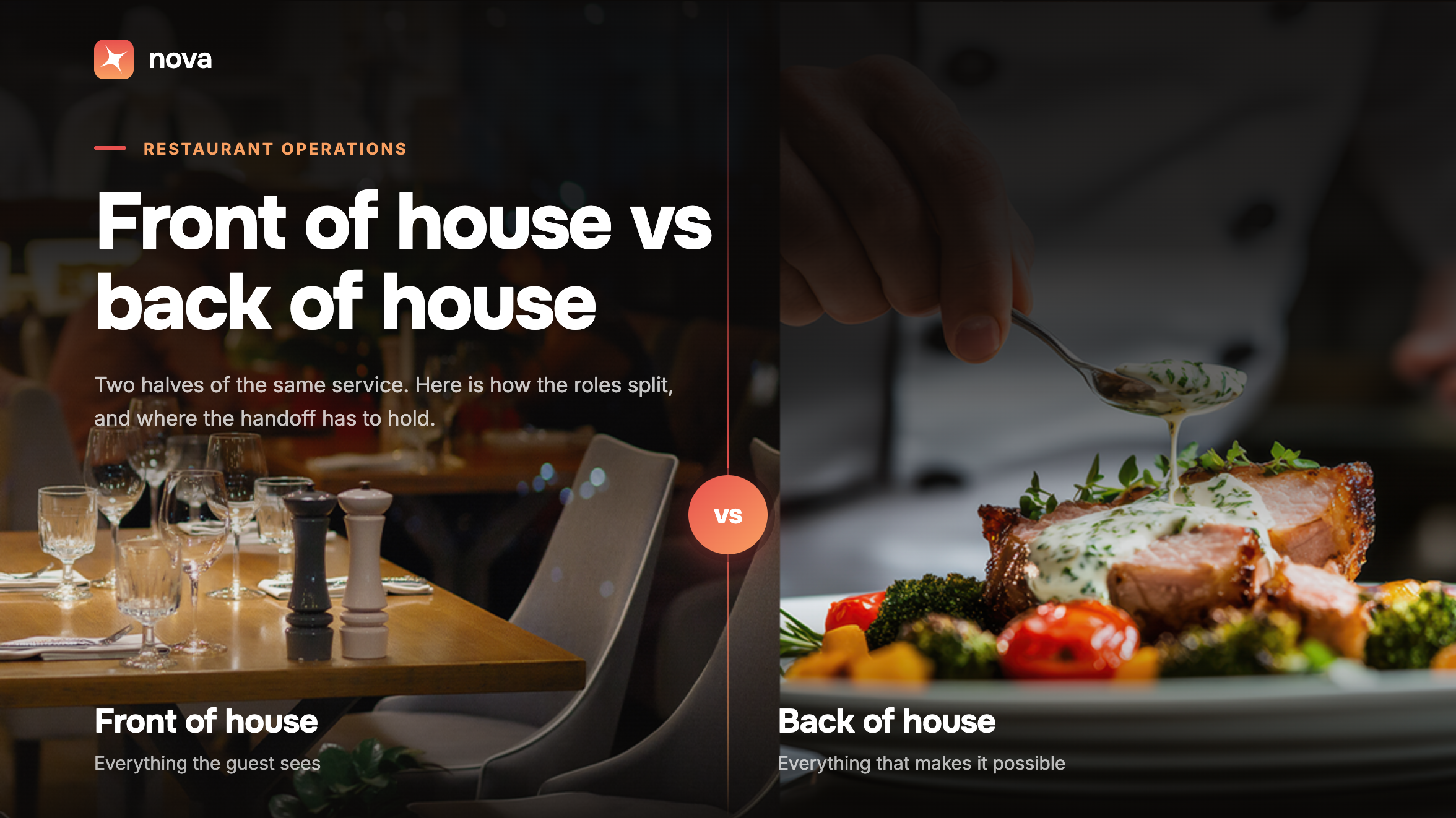
Every restaurant runs on two distinct halves. The front of house vs back of house divide is one of the most fundamental concepts in the restaurant industry, yet it is also one of the most common sources of operational friction. When these two sides of the business work in sync, guests barely notice the effort. When they do not, the breakdown is visible in every delayed dish, miscommunicated order, and frustrated table.
Restaurant labor costs now account for 25 to 35% of total restaurant revenue, and food costs consume another 25 to 35%. Both of these costs are managed, directly or indirectly, through how well your front of house and back of house operate - independently and together. This guide breaks down what each side covers, who works in each area, how they differ, and why the relationship between them determines so much of a restaurant's success.
What Is Front of House in a Restaurant?
The restaurant front of house refers to every area and operation that guests interact with directly. It is the part of the restaurant that shapes the guest's perception of the entire experience, from the moment they walk through the door to the moment they leave.
Front of house encompasses the dining room, bar, host stand, waiting area, and any outdoor seating. It includes every team member whose job involves direct guest interaction: hosts, servers, bartenders, bussers, and food runners. It also covers the technology and processes that manage guest flow, order entry, payments, and reservations.
In practical terms, restaurant front of house operations are defined by hospitality. The quality of a greeting, the attentiveness of a server, the speed of a payment, and the warmth of a farewell are all FOH functions. Guests rarely think of these as operational decisions - they experience them as feelings. But each one is the result of training, staffing, and systems that are squarely in the domain of front of house management.
Restaurant Front of House Positions
A restaurant front of house team is built around several distinct roles, each with its own responsibilities and its own contribution to the guest experience.
Host and Hostess
The host is typically the first person a guest interacts with and the last one they see on their way out. They manage reservations, maintain the waitlist, seat guests according to server rotation and kitchen capacity, and set the tone for the experience before a single order is taken. In high-volume restaurants, a skilled host who manages seating flow intelligently can meaningfully increase covers per shift without adding a single table.
Server
Servers are the primary point of contact between the restaurant and its guests throughout the meal. They take orders, communicate modifications to the kitchen, manage the pacing of each course, answer menu questions, make recommendations, and handle any issues that arise during the experience. Beyond hospitality, servers who know the menu well and upsell naturally and confidently are a direct revenue driver. Structured upselling programs increase restaurant revenue by 10 to 15%, and much of that impact comes from server-level execution.
Bartender
Bartenders serve guests at the bar and support table service by preparing drinks for the dining room. In full-service restaurants, the bar is often a significant revenue center in its own right, and bartenders are responsible for both the quality of the beverage program and the experience of guests who choose to dine at the bar. Bartenders also play a specific role in responsible alcohol service, which carries legal and liability implications the rest of the FOH team does not share to the same degree.
Busser and Food Runner
Bussers keep the dining room moving by clearing and resetting tables between covers. Food runners carry finished dishes from the kitchen pass to the correct tables. Both roles are support functions that sit between the FOH and BOH in terms of where their work happens, but they report to FOH management and their performance directly affects table turnover and the speed of service.
Front of House Manager
The FOH manager oversees all guest-facing operations during a shift. They supervise the host stand, manage server sections, monitor pacing and table turnover, handle guest complaints, and ensure service standards are consistently met. They are the communication link between the dining room and ownership, and in many restaurants they also handle scheduling, training, and end-of-night reporting.
What Is Back of House in a Restaurant?
The restaurant back of house refers to everything guests do not see. It includes the kitchen, prep stations, walk-in coolers and dry storage, the dishwashing area, and the receiving dock where deliveries come in. The back of house is where ingredients become food, where costs are either controlled or lost, and where operational efficiency determines whether the front of house can deliver what it promises.
Restaurant back of house operations are defined by precision and execution under pressure. Unlike the front of house, where success is measured by how guests feel, the back of house is measured by output, accuracy, and consistency. A kitchen that produces the same dish to the same standard across a two-hundred cover service is performing at the highest level, regardless of how invisible that performance is to the people eating the food.
BOH also carries the largest share of a restaurant's controllable costs. Food purchasing, prep labor, waste management, and inventory control are all back of house functions. Restaurants waste between 4 and 10% of all food purchased on average, representing thousands of dollars in lost margin per month. The back of house is where that number either gets managed or ignored.
Restaurant Back of House Positions
The restaurant back of house team is structured around a clear hierarchy, with each role contributing a specific function to the kitchen's overall output.
Executive Chef
The executive chef leads the culinary program at the highest level. They develop the menu, manage food costs, oversee sourcing relationships, set quality standards, and are ultimately responsible for the consistency of everything that leaves the kitchen. In larger restaurant groups, the executive chef may oversee multiple locations, focusing on standards and strategy rather than day-to-day line management.
Sous Chef
The sous chef is the second in command in the kitchen and the person most responsible for day-to-day service execution. They manage the line during service, assign station responsibilities, step in wherever there is a gap, and translate the executive chef's vision into consistent execution during every shift. In restaurants without a dedicated executive chef, the sous chef absorbs those responsibilities as well.
Line Cook
Line cooks execute the actual cooking during service. Each line cook typically owns a specific station - grill, sauté, fry, cold prep - and is responsible for the speed, accuracy, and quality of every dish from their station. Line cooks are the engine of BOH service, and their collective performance determines how quickly and consistently food reaches the pass.
Prep Cook
Prep cooks handle all food preparation before service begins: breaking down proteins, portioning vegetables, making stocks and sauces, and setting each station to its par levels. Strong prep work is what allows line cooks to execute quickly when service gets busy. A kitchen that enters service underprepared will fall behind quickly, and that pressure cascades directly to the front of house as delayed tickets and unhappy guests.
Kitchen Manager
The kitchen manager handles the operational and administrative side of BOH management: inventory ordering, vendor relationships, food cost tracking, health and safety compliance, and staff scheduling. In many restaurants, this role is shared between the head chef and a dedicated operations position, particularly in higher-volume locations where the administrative load is too significant for the kitchen leadership to absorb alone.
Dishwasher and Kitchen Porter
Dishwashers and kitchen porters manage sanitation, equipment cleaning, waste removal, and kitchen organization throughout service. These roles are operationally critical and consistently undervalued. A restaurant that falls behind on dishwashing during a busy service will feel the impact across every station on the line. Clean equipment, sanitized surfaces, and a clear kitchen floor are not aesthetic choices - they are food safety requirements and operational necessities.
Front of House vs Back of House: Key Differences
The front of house vs back of house distinction goes beyond which side of the kitchen pass the work happens on. The two halves of the restaurant operate under different conditions, measure performance differently, and require different skills from the people working in them.
The restaurant front of house is guest-visible and hospitality-driven. Its primary measure of success is how guests feel during and after their experience. Speed, warmth, attentiveness, and problem resolution are the metrics that matter. Front of house work is interpersonal by nature, and the best FOH performers are those who read people well and adapt to what each guest needs.
The restaurant back of house is invisible to guests and execution-driven. Its primary measures of success are output consistency, cost control, and timing. Back of house work is precision-based, and the best BOH performers are those who can maintain accuracy and speed under sustained pressure, often across a five or six hour service period.
Metrics differ significantly between the two. Restaurant front of house performance is measured through guest satisfaction scores, table turnover rate, average check per cover, upsell rate, and wait times. Restaurant back of house performance is measured through food cost percentage, waste percentage, ticket time, labor cost as a percentage of revenue, and inventory turnover. Both sets of metrics ultimately feed into the same outcome -- a restaurant that is profitable and well-regarded - but they require different management approaches to move in the right direction.
Staff management also differs. FOH teams are typically larger relative to revenue in full-service formats, where server-to-table ratios drive the experience. BOH teams are structured around a clear hierarchy with defined roles at each station. Turnover is high in both, but for different reasons: FOH attrition is often driven by scheduling unpredictability and tip income volatility, while BOH attrition is more commonly driven by physical demands, kitchen culture, and compensation pressure.
How Restaurant Front of House and Back of House Work Together
The relationship between FOH and BOH is where a restaurant either comes together or falls apart. Both sides can perform their individual functions well and still produce a poor guest experience if the coordination between them breaks down.
Pre-Shift Communication
The most reliable restaurants build structured communication habits before service begins. Pre-shift meetings bring FOH and BOH together to go over specials, 86'd items, large party reservations, allergen flags, and any operational changes that affect how the shift will run. When servers know what the kitchen is pushing and what is running low before the first guest sits down, they can guide ordering decisions proactively rather than scrambling to manage disappointment after the fact.
Real-Time Coordination During Service
During service, the communication demands between restaurant front of house and back of house are constant. A host who seats three large parties simultaneously without coordinating with the kitchen creates a rush the BOH cannot absorb cleanly. A server who puts in five courses all at once causes a different kind of problem. The best FOH and BOH teams have developed a shared operational language and clear protocols for managing these situations in real time.
Handling 86'd items is one of the most visible tests of this coordination. When the kitchen runs low on a dish, every server on the floor needs to know immediately - not after the next table has already ordered it. When that information travels slowly or inconsistently, guests end up disappointed, servers are put in an awkward position, and the kitchen absorbs pressure it should not have to deal with.
Shared Accountability for the Guest Experience
The healthiest restaurant cultures treat FOH and BOH as shared owners of the guest outcome rather than separate departments with separate accountabilities. The kitchen executes the food. The front of house delivers the experience around it. Neither can fully compensate for the other's failures, but both can raise the other's performance when the relationship is collaborative rather than siloed.
Research shows that almost 75% of consumers are willing to spend more with a business that delivers excellent service, while 32% will stop visiting a restaurant they previously liked after just one bad experience. That experience is almost never the result of just the kitchen or just the floor - it is the combined output of how the whole team performed together.
What Happens When FOH and BOH Are Disconnected
When restaurant front of house and back of house systems do not communicate in real time, the operational gaps become financial gaps quickly.
Orders entered at the POS that do not flow directly to the kitchen display system create ticket errors and delays. Inventory that does not update automatically as dishes are sold leads to 86'd situations that could have been anticipated and managed. Scheduling that is built without visibility into expected sales volume produces labor cost overruns that only become visible when the week is already done.
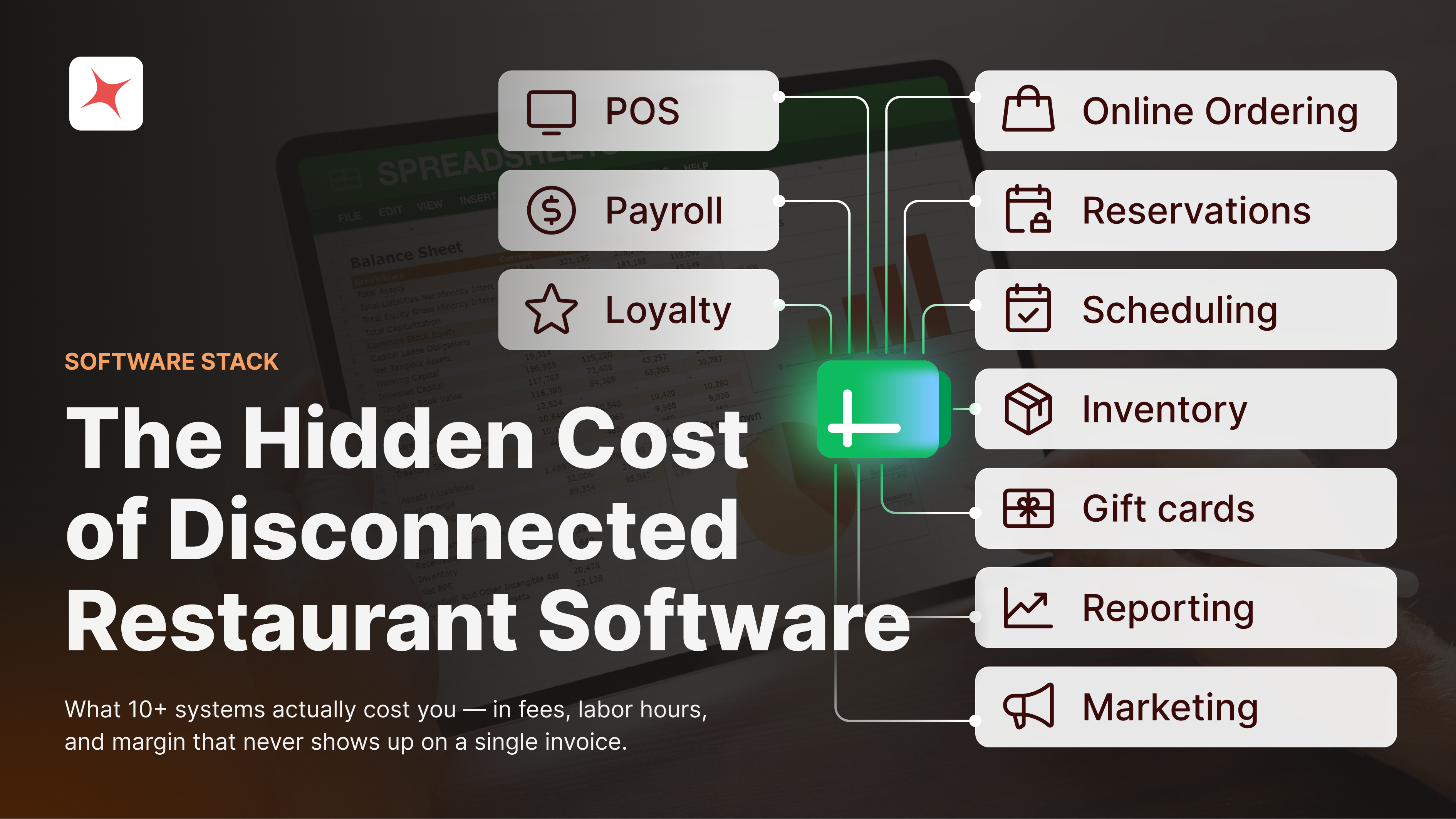
The financial cost of disconnected systems goes beyond operational friction. Restaurants operating multiple separate software platforms - one for scheduling, one for inventory, one for POS, one for reporting - pay for each tool individually and still end up with fragmented data that requires manual reconciliation. Technology spend now averages 3 to 5% of revenue for full-service restaurant operators. When that spend is distributed across disconnected tools rather than consolidated into a unified platform, operators are often paying more and getting less visibility.
The guest experience cost is equally real. 94% of diners read reviews before choosing a restaurant, and a single-star drop in average rating can reduce revenue meaningfully. Most negative reviews trace back to service breakdowns that originated in communication failures between FOH and BOH - a missed modification, a delayed course, a dish that was 86'd after the order was already placed.
How Technology Unifies Restaurant Front of House and Back of House
The most effective way to close the gap between FOH and BOH is through a platform that connects them in real time rather than forcing manual coordination across disconnected tools.
When the restaurant POS is integrated directly with a kitchen display system, orders flow from the server's handheld to the correct kitchen station the moment they are placed. When inventory is connected to the POS, stock levels update automatically as dishes are sold - which means 86'd situations are anticipated rather than discovered mid-service. When scheduling is connected to sales forecasting, staffing decisions for both FOH and BOH are based on actual expected demand rather than habit or guesswork.
NOVA is built as a unified restaurant management platform that connects every layer of restaurant operations - POS, KDS, inventory, scheduling, analytics, and online ordering - in a single system. The data that moves between restaurant front of house and back of house on the NOVA platform is real-time, meaning a change in one part of the operation is immediately visible to every part of the team that needs to know about it.
For multi-location operators, this connectivity extends across sites. Menu updates, pricing changes, and promotional configurations made in the NOVA dashboard publish across all locations simultaneously. Performance data from every site feeds into consolidated reporting that lets operators compare FOH and BOH metrics location by location, shift by shift, without pulling reports manually from separate systems.
Frequently Asked Questions
What is the difference between front of house and back of house in a restaurant?
Front of house refers to all guest-facing areas and operations: the dining room, bar, host stand, and the team members who interact directly with guests, including hosts, servers, and bartenders. Back of house refers to all non-guest-facing operations: the kitchen, prep areas, storage, and the team members who prepare and manage food, including chefs, line cooks, prep cooks, and dishwashers. The two sides share accountability for the guest experience but operate under different conditions and measure performance through different metrics.
What are the main restaurant front of house positions?
The core restaurant front of house positions are host or hostess, server, bartender, busser, food runner, and front of house manager. In larger or higher-volume operations, these roles may be further divided into specializations such as lead server, bar back, or floor manager.
What are the main restaurant back of house positions?
The core restaurant back of house positions are executive chef, sous chef, line cook, prep cook, kitchen manager, pastry chef, and dishwasher or kitchen porter. The specific structure varies by restaurant format and volume, but the hierarchy from executive chef down to prep and sanitation staff is consistent across most full-service operations.
Which pays more, front of house or back of house?
In tip-eligible formats like full-service casual dining and fine dining, front of house servers and bartenders often earn more in total compensation than back of house staff due to tip income. However, senior kitchen roles - executive chef, sous chef, and kitchen manager - typically earn higher base salaries than FOH counterparts. Back of house compensation has increased meaningfully in recent years due to wage legislation and labor market pressure, narrowing the gap at the hourly level in many markets.
How do restaurant front of house and back of house communicate during service?
Effective FOH and BOH communication happens through a combination of pre-shift briefings, real-time verbal updates, and technology. Kitchen display systems connected to the POS transmit orders directly from servers to the relevant kitchen station. 86'd items and special notes are communicated via manager announcements or POS alerts. High-performing restaurant teams also build informal communication habits during service - servers checking with the kitchen before recommending a specific dish, hosts coordinating seating pace with kitchen capacity - that sit alongside the technology layer.
Why is it important to unify front of house and back of house technology?
When FOH and BOH systems are disconnected, data has to be reconciled manually, errors go undetected longer, and operational decisions are made with incomplete information. A unified platform that connects POS, kitchen management, inventory, and scheduling eliminates data silos, reduces errors, and gives operators real-time visibility across both sides of the business. This improves service consistency, reduces food and labor waste, and gives management the information needed to make decisions during service rather than after.