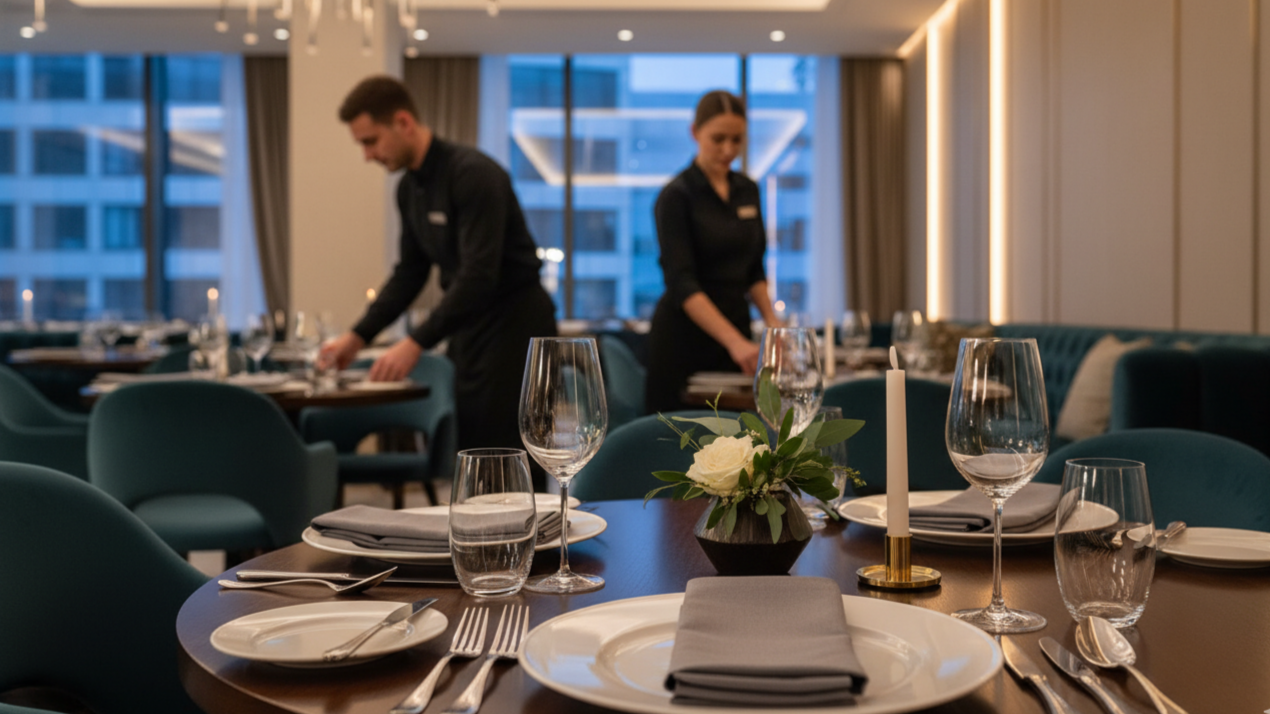

Before guests taste the food, they quietly evaluate something else: the table. Is it clean, balanced, welcoming, and thoughtfully arranged? In many cases, guests decide how much they trust your restaurant within the first few seconds of sitting down. A carefully designed restaurant table setting communicates professionalism, pricing expectations, and attention to detail without anyone saying a word.
Have you ever noticed how guests behave differently when seated at a beautifully arranged table compared to a rushed or cluttered one? Or how a neat setup makes service feel faster and smoother even when the kitchen timing stays the same?
In this guide, we will walk through how restaurant table setting works not only as décor but as a practical operational system. You will learn the components, rules, common mistakes, and how the right setup can directly improve guest satisfaction, team efficiency, and revenue.
What Is Restaurant Table Setting?
Restaurant table setting is defined as the well-organized placement of dinner, flatware, glassware, linens, and accessories on a table before serving the table. Although it is perceived as a visual component by many operators, it is a service system that helps to provide workflow, time, and uniformity. The arrangement is different in accordance with the positioning of the restaurant:
- Casual restaurants are concerned with little to no placement that will enable them to turn tables quickly and reset easily.
- Full-service restaurants strike a balance between presentation and functionality, setting tables to be used to eat more than one course without overwhelming the guests.
- Fine dining restaurants have strict rules of placement, as the symmetry and distance, as well as the tools used in specific dishes, form a high-quality ambiance.
Guests may not consciously analyze each detail, but they quickly sense when a table feels professional and organized. This immediate perception influences how they evaluate pricing, food quality, and service expectations.
Why Restaurant Table Setting Matters for Businesses?
The visual presentation of the restaurant table setting is not the only one, but it has a direct influence on the business outcomes that the owners and managers are interested in.
- It establishes pricing expectations.
Customers usually perceive a good table arrangement as an indicator of better service and food. They have the restaurant in their mind even prior to ordering it in a specific price range.
- It reduces service errors.
With the right cutlery, glassware, and plates already in place in the flow of the menu, the servers need to make minimal errors and waste less time running back to the service station.
- It improves service speed.
Ready tables will enable the team to concentrate on hospitality rather than rushing to get missing things during service.
- It enhances brand recognition.
The same table setting throughout the locations enhances brand trust. Visitors are at ease revisiting the place due to the predictable and smooth experience.
- It enhances the satisfaction and reviews of the guests.
Care is conveyed in a subtle manner through clean, symmetrical tables. In their reviews, guests frequently refer to ambience and presentation, and when they cannot articulate what made the experience feel better.
Essential Elements of a Restaurant Dining Table
A good restaurant table is constructed of five major parts in harmony with each other.
A. Dinnerware
Dinner plates consist of charger plates, dinner plates, and bread plates.
- Charger plates are often used in fine dining to create an elegant base and maintain visual balance before the first course arrives.
- Dinner plates may be pre-set in formal settings or served with the first course in casual restaurants to keep tables uncluttered.
- Bread plates are usually placed on the upper left side of the guest’s setting when bread service is standard.
Plate pre-setting ought to be in line with the style of service. Casual dining may be over-set, resulting in a slower reset and the establishment of unneeded handling.
B. Flatware
Flatware placement follows a simple psychological rule: clarity reduces hesitation. The dining experience becomes easier when the guest immediately knows which utensil should be used.
- Forks are put on the left side.
- Knives and spoons are put on the right side with the blade of the knife turned towards the plate.
- The outside-in rule guarantees that the utensils to be used with the first course are as far away as possible.
Depending on the type of service at the restaurant, the dessert cutlery can either be put on the plates horizontally or served with the dessert course.
C. Glassware
The positioning of the glass has an effect on comfort and aesthetic appeal.
- The glass of water is placed over the knife.
- Water glass is used first, followed by wine glasses.
- When the glasses are not in demand, it is better not to keep them in the room since a crowded table will not provide comfort to the guests and will cause difficulties in cleaning.
Minimalistic and roomy displays often make it appear more high-end than a crowded one.
D. Linens
Linens define the experience of touch on the table.
- Napkins should be neatly folded according to the restaurant's style. Casual restaurants may use simple folds, while upscale venues may adopt structured designs.
- Tablecloths create a classic dining look, while bare tables with placemats suit modern casual restaurants.
- Wrinkle-free linens are crisp and are an indicator of hygiene and professionalism.
Visitors are not going to praise linens, but a wrinkled or stained fabric will automatically reduce the perceived quality.
E. Table Accessories
The dining experience must be enhanced by accessories, but not be distracting.
- Salt and pepper shakers are to be put in the middle and accessible.
- The centerpieces must not be so high that the guests are unable to look across the table.
- Do not overload with advertising materials, several holders, or unneeded decorations.
Perceived space is more with a clean table, and this makes a table more comfortable and invites longer and more relaxed eating.
Types of Restaurant Table Settings
Various models of services demand varying degrees of preparation.
- Casual Table Setting
This arrangement is speedy and practical in nature. The general amount of space is limited to essential flatware, napkins, and water glasses. Extra products are provided alongside every dish. The approach is effective in cafes, fast-service restaurants, and high-turnover restaurants.
- Full-Service Setting
Full-service restaurants usually cook two or three courses ahead of time. The layout is both graceful and functional, as the servers can minimize the number of trips made during meals and still have tables that look comfortable to sit in.
- Fine Dining Table Setting
The fine dining arrangements are characterized by charger plates, the use of more than one wine glass, and adherence to rules of alignment. Precision is essential here. Visitors who spend high prices are expecting visual perfection, and minor flaws can influence the perceived quality.
Symmetry and spacing are significant. The spacing of utensils is even, and it creates a perception of peace and order, which indirectly enhances the perception of the quality of service by the guests.
Restaurant Table Setting Rules Staff Should Always Follow
Many restaurants lose perceived quality not because of food or service but due to small presentation issues.
- Overcrowded tables make guests feel uncomfortable and reduce usable space.
- Mismatched or chipped tableware signals poor maintenance standards.
- Dirty glassware or wrinkled linens immediately affect trust in hygiene.
- Incorrect cutlery placement creates confusion and awkward moments during service.
- Unstable or oversized centerpieces interrupt conversation flow and reduce comfort.
Regular floor audits help identify these issues before they impact reviews.
How Table Setting Impacts Service Efficiency?
Table setting plays a direct role in operational efficiency.
When tables are prepared correctly, servers make fewer trips to the service station, reducing physical workload and speeding up service. Proper placement also helps servers anticipate the flow of courses, ensuring each item is delivered smoothly without interruptions.
Guests often interpret smooth service as faster service, even if actual kitchen timing remains the same. This perception improves satisfaction and allows better table turnover planning. Over time, this operational improvement translates into higher revenue during peak hours.
Using Systems and Technology to Support Perfect Table Setup
The table management system is modern and enables restaurants to align table setups with the types of reservations made, e.g., couple, big group, tasting menu, or celebration. Reservation notes may assist in directing personnel regarding special preparation so that the appropriate number of settings is made, and it is presented accordingly.
The course pacing devices also assist in synchronizing the table preparation and service time. With the smooth flow of orders within the system, employees do not have to devote as much time to the process of corrections, but rather specific to the presentation and interaction with the guests. This integration will make the restaurant table setting a component of a broader operational strategy and not an activity on its own.
Training Your Team on Restaurant Table Setting
Table setup should be made easy to duplicate across shifts through training.
- Put visual diagrams of table layouts in the staff areas.
- Make pre-shift inspections to check that all tables are up to standard.
- Divide the responsibility of sections to have accountability.
- Incentivize floor managers to carry out impromptu audits when giving service.
Training based on repetition and visual instruction can help the new employees learn quicker and the old staff to remain consistent without any reminders.
How NOVA Elevates Guest Experience, Efficiency, and Revenue?
When reservations, table allocation, and service pacing are connected, the restaurant table setting transforms a routine task into a strategic advantage that directly influences guest satisfaction, staff productivity, and revenue growth.
NOVA enables this shift by turning table preparation into a data-supported, coordinated process.
Ways in which NOVA supports restaurants:
- Aligns reservations with table setup so staff can prepare the correct number of place settings, glassware, and layout before guests arrive.
- Enables smart table allocation based on reservation type such as couples, families, tasting menus, or celebrations, ensuring every table is prepared with intention.
- Reduces unnecessary staff movement, allowing teams to spend more time engaging with guests instead of managing logistical corrections.
- Improves table turnover efficiency without making guests feel hurried, helping restaurants serve more covers during peak hours.
- Minimizes seating gaps through accurate table tracking and smarter reservation planning.
- Increases operational consistency across shifts, helping new and experienced staff follow the same structured table preparation standards.
- Drives measurable revenue growth, as smoother seating, faster service flow, and better floor utilization compound across every service period.
Final Word: Turning Table Setting into a Revenue Strategy with NOVA
A properly designed restaurant table environment influences the impression of guests, service quality, and the general comfort of the experience, and its strength is achieved when reinforced with the appropriate technology. NOVA restaurant management software is turning the process of table setting into a strategic process that coordinates the reservations, pacing of the service, and operational planning.
Experiences in restaurants that combine well-organized table-setting requirements and intelligent management technologies make them feel effortless to visitors and generate greater revenue performance. This presentation consistency, coupled with operational intelligence, is a competitive advantage that can be measured over time.