.svg)
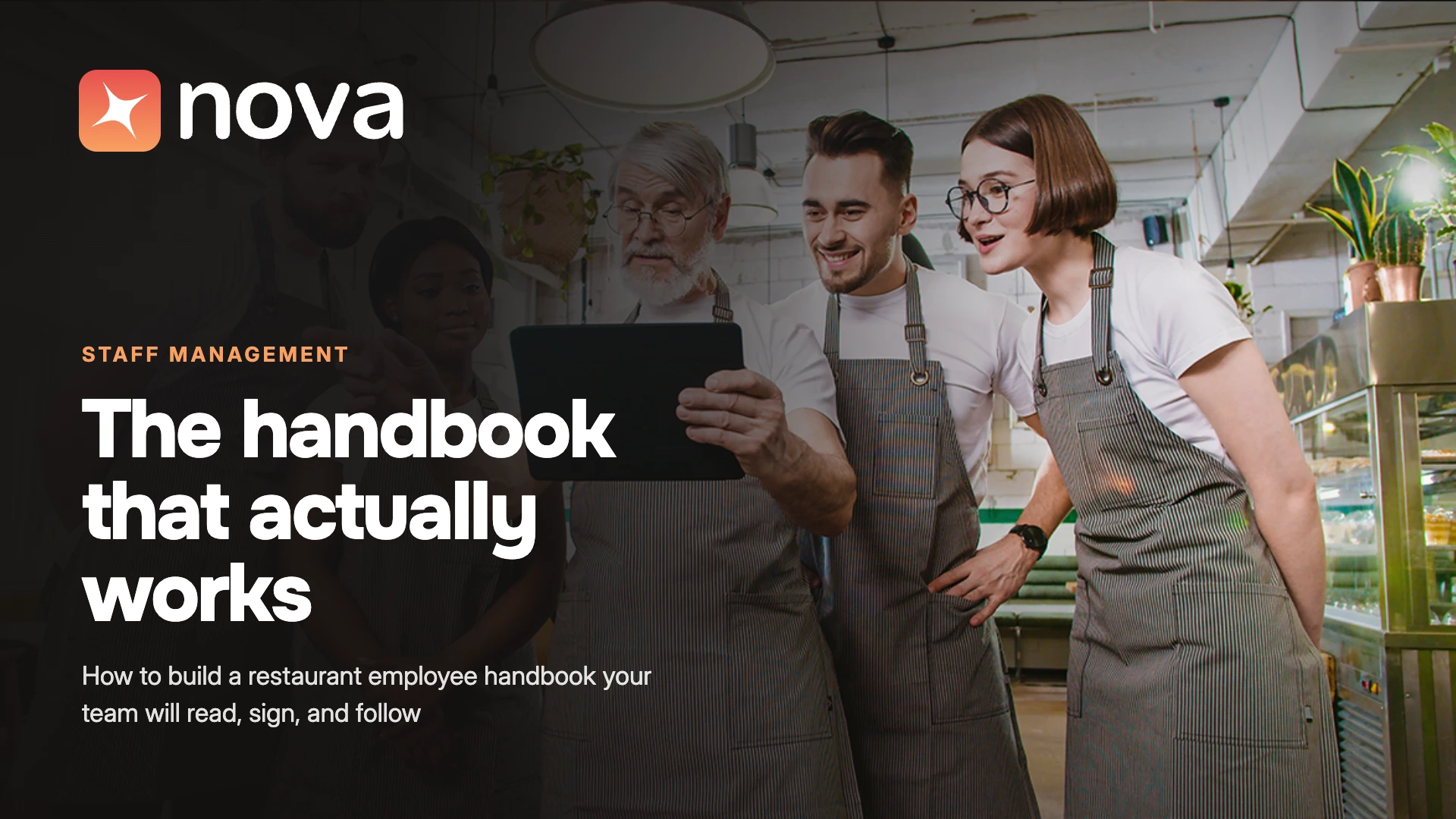
A restaurant employee handbook is a written reference document that explains how your restaurant operates: your mission and culture, your code of conduct, your pay and scheduling practices, your safety procedures, and the disciplinary process staff can expect if a policy is broken. In HR terms, it is the primary written vehicle a business uses to communicate its policies and expectations to staff, and restaurants are no exception.
Unlike a generic corporate handbook, a restaurant employee handbook has to work for a workforce that is often young, hourly, tipped, multilingual, and split across front-of-house and back-of-house roles with very different daily realities. It functions as both a training tool for new hires and a reference guide that existing staff can return to when a question comes up mid-shift, which is why a restaurant employee handbook has to be written for the floor, not just for HR.
What is a Restaurant Employee Handbook?
A restaurant employee handbook is a written reference document that explains how your restaurant operates: your mission and culture, your code of conduct, your pay and scheduling practices, your safety procedures, and the disciplinary process staff can expect if a policy is broken. In HR terms, it is the primary written vehicle a business uses to communicate its policies and expectations to staff, and restaurants are no exception.
Unlike a generic corporate handbook, a restaurant employee handbook has to work for a workforce that is often young, hourly, tipped, multilingual, and split across front-of-house and back-of-house roles with very different daily realities. It functions as both a training tool for new hires and a reference guide that existing staff can return to when a question comes up mid-shift, which is why a restaurant employee handbook has to be written for the floor, not just for HR.
Why Your Restaurant Needs an Employee Handbook in 2026
Establish Consistent Expectations
A restaurant employee handbook acts as a centralized guide so that both a server on their first shift and a ten-year kitchen veteran are working from the same set of standards. Without one, expectations live only in each manager's head, and they shift depending on who is running the floor that night.
Reduce Misunderstandings and Disputes
Clear, written policy on scheduling, shift swaps, tip pooling, and interdepartmental handoffs cuts down on the kind of miscommunication that spills over into guest-facing mistakes. When a dispute does happen, a documented restaurant employee handbook gives managers a consistent, defensible standard to point to instead of making a judgment call on the spot.
Speed Up Training and Onboarding
Hospitality has some of the highest turnover of any industry, which means restaurants are almost always onboarding someone. A restaurant employee handbook shortens the ramp-up period because new hires are not relying entirely on a manager's memory to explain how things work; they have a reference they can read before day one and return to afterward.
Protect Your Restaurant Legally
A handbook is also a legal instrument. A well-drafted restaurant employee handbook that includes an at-will employment disclaimer, an equal opportunity statement, and a documented disciplinary process gives your restaurant a consistent record to point to if a termination, wage claim, or harassment complaint is ever challenged. An outdated or missing handbook, by contrast, can actively work against you in a dispute because there is no documented standard the business was following.
The 2026 Restaurant Labor Market, By the Numbers
The case for a current restaurant employee handbook is stronger this year than in most. The restaurant and foodservice workforce is projected to reach 15.8 million jobs in 2026, with the industry forecast to add more than 100,000 net new positions, and nearly three-quarters of operators say they plan to hire this year, according to the National Restaurant Association's 2026 State of the Restaurant Industry report (published February 12, 2026). Operators report the greatest difficulty filling experienced management and culinary roles, and the report flags a long-term structural pressure: a shrinking 16-to-24-year-old population, historically the industry's core labor pool.
Turnover pressure hasn't gone away either. The U.S. Bureau of Labor Statistics' Job Openings and Labor Turnover Survey (JOLTS) put the quits rate for accommodation and food services at 3.5% in July 2026 (503,000 workers), roughly 50% higher than the quits rate across the private sector as a whole. Every one of those departures means a new hire who needs to be brought up to speed fast, which is exactly the job a well-built restaurant employee handbook is designed to do.
At the same time, restaurant technology is changing how that onboarding happens: the National Restaurant Association reports that 26% of restaurant operators are now using AI-related tools in their restaurants, most commonly for marketing (19% of full-service operators) and administrative tasks (10% of operators). A digital, searchable restaurant employee handbook delivered through your restaurant management platform fits naturally into that shift, rather than sitting as a printed binder no one opens after week one.
The Essential Sections of a Restaurant Employee Handbook
A comprehensive restaurant employee handbook typically includes the following sections. Treat this as a baseline; tailor it to your concept, service style, and jurisdiction.
1. Mission, Vision, and Values
Define the core principles behind your hospitality: what "good service" looks like at your restaurant, how you expect the team to treat guests and each other, and what your brand stands for. This section sets the cultural tone for everything that follows.
2. Code of Conduct and Dress Code
Spell out expectations for punctuality, professionalism, communication, and appearance, including grooming and uniform standards for both front-of-house and back-of-house staff.
3. Attendance, Scheduling, and Time-Off Policy
Cover how the schedule is built and posted, how far in advance, expectations around arrival time and tardiness, the process for shift swaps, how to request time off, and sick-leave protocols. If your restaurant operates in a jurisdiction with a predictive scheduling or fair workweek law (more on this below), this is where those specific notice periods and predictability-pay rules belong.
4. Role-Specific Responsibilities and Expectations
Because front-of-house and back-of-house roles differ so much day to day, this section should clarify individual job responsibilities, reporting lines, teamwork expectations, and performance standards for each position.
5. Health and Safety Procedures
Document hygiene and food-safety standards, cleaning schedules, emergency procedures, and injury-reporting protocols. Reference your food safety certification requirements (such as ServSafe) and any state-specific food handler card rules.
6. POS and Technology Usage Policies
Set clear guidelines for how staff use your restaurant management platform, POS terminals, and handheld ordering devices, as well as personal device and phone policies during shifts.
7. Training and Development
Cover onboarding steps, initial training timelines, skill-development programs, cross-training opportunities, and how staff can pursue promotion pathways.
8. Anti-Harassment and Equal Opportunity Policies
State a zero-tolerance policy for discrimination, harassment, and bullying, and lay out how employees can report a concern, including at least one reporting channel outside their direct manager. This section carries real legal weight; see the compliance section below for state-specific training requirements.
9. Disciplinary Procedures
Most restaurants use a progressive discipline model: verbal warning, written warning, suspension, and termination, reserved for the most serious violations. Being explicit about the steps protects both the employee and the business.
Restaurant Employee Handbook Legal Requirements and Compliance Checklist
This is the section most restaurant employee handbooks get wrong, either by skipping it entirely or by copying boilerplate language that does not reflect actual restaurant operations. A handbook that is not legally sound will not hold up if it is ever challenged, no matter how well-written the culture section is.
At-Will Employment and Equal Opportunity Disclaimers
In most U.S. states, employment is presumed "at-will," meaning either the employer or the employee can end the relationship at any time, for any lawful reason. Your restaurant employee handbook should state this explicitly, alongside an Equal Employment Opportunity statement confirming that hiring, promotion, and discipline decisions are made without regard to protected characteristics. This disclaimer should also make clear that the handbook itself is not an employment contract.
Tip Credit, Tip Pooling, and the 80/20 Rule
If your restaurant takes a tip credit toward the minimum wage for tipped employees, federal law requires you to provide written notice of that practice, and your handbook is the natural place to document it. The federal "80/20 rule," which limited how much non-tipped side work a tipped employee could perform while still being paid the tipped minimum wage, was vacated following the Fifth Circuit's 2024 ruling in Restaurant Law Center v. Department of Labor, and the Department of Labor has since withdrawn it from its regulations. That said, compliance is not uniform nationwide: employers in the Fifth Circuit (Texas, Louisiana, Mississippi) operate under the more permissive "dual jobs" standard, while the rule's status elsewhere remains subject to ongoing litigation and state-level wage law, which is often stricter than federal law. Your restaurant employee handbook should reflect the rule that actually applies in your jurisdiction, not a national default, and should be reviewed whenever tip credit or tip pooling regulations change.
State-Mandated Anti-Harassment Training
A growing number of states require documented harassment prevention training, and several call out hospitality specifically. Illinois, for example, requires hospitality employers to provide supplemental sexual harassment prevention training tailored to restaurant and bar environments, delivered in both English and Spanish, in addition to the state's general annual training requirement. California mandates two hours of training for supervisors and one hour for non-supervisory staff at employers with five or more employees. New York State requires annual training for every employer regardless of size, and Washington State added a targeted training requirement for isolated hospitality workers effective January 1, 2026. Your restaurant employee handbook should name the specific training your restaurant provides and how often, not just assert a generic anti-harassment policy.
Predictive Scheduling and Fair Workweek Laws
If you operate in a jurisdiction with a predictive scheduling ("fair workweek") ordinance, your handbook needs to spell out the specific rules that apply to your location. Oregon's statewide law and city ordinances in San Francisco, Los Angeles, Chicago, Seattle, Philadelphia, Emeryville, Berkeley, Evanston, and New York City (for fast food and retail) each set their own advance-notice periods, typically 14 days, along with rest-period requirements between shifts and predictability pay owed when a posted schedule changes with insufficient notice. Getting this wrong is a common source of wage claims, so this is one of the highest-value sections to keep current.
Meal and Rest Break Requirements
Meal and rest break rules vary significantly by state, and several states (including California, Colorado, Oregon, and Washington) mandate specific break lengths and timing for shifts over a certain duration. Your restaurant employee handbook should state your restaurant's break policy in the specific terms required by your state, not a generic "breaks as scheduled" line.
Employee Acknowledgment Forms
Every restaurant employee handbook should end with a signed acknowledgment form confirming the employee received, read, and understands the handbook, and that they understand it is not a contract. Keep signed acknowledgments in each employee's personnel file, and re-issue and re-sign the acknowledgment whenever you publish a materially updated version of the handbook.
Because employment law varies by state and changes frequently, have your restaurant employee handbook reviewed by an employment attorney or HR professional at least once a year, and immediately after any major legal or operational change.
How to Tailor the Employee Handbook for Your Restaurant?
Etiquette and Service Standards
Your employees must boost customers’ fine dining experiences by delivering attentive, professional, and polished service. Hence, your employee handbook must include standards for greeting and seating etiquette, body language, tone of voice, eye contact, and posture. Likewise, it must help employees understand when they should remain present in and stay out of the guest space.
Handling High-End Guests
High-end guests do not hesitate to pay more for getting attention and personalized services when visiting upscale restaurants. Your restaurant employee manual must define the best practices for meeting the expectations of high-end guests. When tailoring the handbook, you should cover important topics like discretion, professionalism, guest preference understanding, formal behavior, complaint handling, meeting unusual guest requests, and recovering from service errors.
SOPs for Wine Service, Upselling, and Guest Recovery
Your employees must maintain professionalism and consistency across shifts by following standard operating procedures (SOPs). Hence, your restaurant's guest manual must define SOPs for wine service and guest recovery. At the same time, it must prepare FOH staff to leverage upselling opportunities by recommending premium items, appetizers, desserts, and wine pairings. Likewise, they must boost guest experiences using approved solutions for specific mistakes.
How to Make the Restaurant Employee Handbook Engaging and Easy to Use?
Along with creating a well-structured employee handbook, you ensure an employee can access and understand relevant information without any hassles and delays. Hence, you must implement these tips to make the restaurant employee handbook useful.
Keep It Short and Simple
Use plain language, avoid legal and corporate jargon where you can, and break content into small, scannable sections rather than dense paragraphs.
Include Visuals or Infographics
Charts, diagrams, icons, and images help staff retain procedural information faster than text alone, especially for safety and food-handling steps.
Include Real-Life Examples
Concrete scenarios, such as how to handle a guest complaint or when to escalate an upsell, help staff apply policy in the moment rather than trying to recall an abstract rule.
Ensure Digital and Mobile Accessibility
A restaurant employee handbook that only exists as a printed binder in the back office does not get read after the first week. Hosting the handbook digitally, ideally inside the same restaurant management platform staff already use for scheduling and POS tasks, means employees can search it from their phone mid-shift instead of guessing or interrupting a manager.
Common Restaurant Employee Handbook Mistakes to Avoid
Even well-intentioned restaurant employee handbooks tend to repeat the same errors. Watch for these:
- Copying a generic template without customizing it. A handbook that never mentions your actual POS system, your actual tip pooling structure, or your actual service style reads as boilerplate, and staff treat it that way.
- Skipping the legal disclaimers. An at-will statement, an EEO statement, and a "not a contract" clause are not optional extras; without them, the handbook can create legal exposure instead of reducing it.
- Letting the handbook go stale. Minimum wage, tip credit rules, scheduling ordinances, and harassment training requirements all change. A handbook that has not been reviewed in two or three years is very likely out of date somewhere.
- Writing policy that does not match actual practice. If the handbook says breaks are mandatory, but managers routinely skip them during rushes, the written policy becomes a liability rather than a protection.
- No signed acknowledgment on file. Without a signed acknowledgment, it is difficult to prove an employee actually received and reviewed the handbook if a dispute arises later.
- Treating it as a one-time project. A restaurant employee handbook is a living document, not a launch deliverable. It needs an owner and a review cadence, not a one-time write-up.
How to Maintain and Evolve Your Restaurant Employee Handbook Over Time
Treat your restaurant employee handbook as a living document rather than a one-time project.
- Schedule an annual review at minimum, to confirm policies still reflect actual operations and current law.
- Update immediately after major changes, such as a new POS rollout, a new location in a different state, or a change to your tip pooling structure.
- Track compliance with regional labor law, since minimum wage, scheduling ordinances, and harassment training requirements shift frequently and vary by city and state.
- Gather employee feedback on which sections are unclear or unused in practice.
- Use version control, numbering each revision and dating it, so managers and staff can tell at a glance whether they are looking at the current version.
Success Metrics: How to Know Your Handbook Is Working
A restaurant employee handbook is only doing its job if it changes outcomes. Track these indicators over time:
- Onboarding time to productivity: how long it takes a new hire to work an independent shift without close supervision. A well-used restaurant employee handbook should shorten this measurably quarter over quarter.
- Policy compliance: fewer attendance disputes, fewer scheduling grievances, and fewer guest complaints mishandled due to unclear procedures.
- Employee turnover: track retention specifically among employees hired after a handbook update, since the JOLTS quits rate of 3.5% for the sector gives you a useful external benchmark to compare against.
- Manager workload: a drop in repetitive policy questions reaching managers is a strong signal the handbook itself is answering them.
- Employee satisfaction: include a question about handbook clarity and usefulness in your regular staff feedback surveys.
How NOVA Helps Restaurants Standardize Employee Onboarding
A restaurant employee handbook sets the policy. What actually determines whether that restaurant employee handbook holds up on a Friday night rush is whether the systems your staff touch every shift reinforce it or work against it. NOVA is an AI-native, end-to-end restaurant technology platform that unifies POS, front-of-house, back-of-house, inventory, loyalty, and analytics on a single codebase, so the operational side of onboarding and policy enforcement does not require staff or managers to juggle separate, disconnected systems.
FOH and BOH Consolidation
Because NOVA consolidates front-of-house and back-of-house workflows into a single application, new hires learn one system instead of several. That matters directly for onboarding speed: a new server or line cook who only has to master one interface reaches independent productivity faster, which is precisely the "onboarding time to productivity" metric your restaurant employee handbook should be tracking.
Staff Scheduling That Matches Your Written Policy
Your restaurant employee handbook's attendance, scheduling, and predictive-scheduling sections are only as good as the system that executes them. NOVA's staff scheduling tools align staffing with anticipated demand and give managers a single system of record for shifts, swaps, and coverage, so the schedule employees actually see matches the notice periods and rest-period rules documented in your handbook, rather than a manager's memory of what the ordinance requires.
Consistent Policy Across Multiple Locations
Multi-unit operators face a specific version of the restaurant employee handbook problem: policy that is enforced one way at the flagship location and loosely at a newer one. NOVA's multi-location management and centralized menu and operations controls give ownership a single place to confirm that POS usage rules, role-specific workflows, and other handbook-governed procedures are actually configured the same way across every location, instead of relying on each general manager to interpret the handbook independently.
Reporting Tied to the Metrics That Matter
NOVA's real-time and enterprise reporting turns labor, sales, and operational data into the kind of evidence your restaurant employee handbook's Success Metrics section calls for: onboarding time to productivity, attendance and policy-compliance trends, and manager workload, tracked by location rather than estimated at the end of the quarter. That makes it possible to see whether a recent handbook update actually changed behavior on the floor, not just whether it was distributed.
User-Friendly, Image-First Interface
An image-first interface helps new staff get comfortable with tableside ordering, table assignments, and day-to-day POS tasks quickly, reducing the hands-on training burden that a written handbook alone cannot solve. Pairing a clear, current restaurant employee handbook with a platform staff can actually learn quickly is what turns policy into practice.
Restaurant Employee Handbook FAQs
How long should a restaurant employee handbook be?
Most restaurant employee handbooks run 15 to 30 pages, or roughly 4,000 to 8,000 words, depending on the number of locations and the complexity of your compliance requirements. Length matters less than clarity; a shorter handbook that staff actually read beats a comprehensive one that sits unopened.
Does a restaurant employee handbook need to be reviewed by a lawyer?
Yes. Because wage, scheduling, and harassment-training requirements vary by state and change frequently, an employment attorney or HR professional should review your restaurant employee handbook at least annually and after any major legal or operational change.
What is the difference between a restaurant employee handbook and a training manual?
A restaurant employee handbook covers policy: conduct, pay, scheduling, safety, and legal disclosures. A training manual covers task-level how-to instructions, such as how to run a specific POS workflow or plate a specific dish. Many restaurants maintain both, with the handbook referencing the training manual for role-specific procedures.
Do employees need to sign the restaurant employee handbook?
Yes. A signed acknowledgment form confirming the employee received and understands the handbook, and that it is not an employment contract, should be kept in every employee's personnel file and re-signed whenever the handbook is materially updated.
How often should a restaurant update its employee handbook?
At minimum, once a year, plus immediately after any major operational change or relevant change in employment law, such as a new minimum wage, a new predictive scheduling ordinance, or a new state harassment-training mandate.
Conclusion
A well-built restaurant employee handbook does three things at once: it sets consistent expectations for your team, it protects your restaurant legally, and it makes onboarding faster in an industry where turnover is a fact of life. In 2026, with the sector adding jobs faster than it can easily fill them and labor regulations shifting by state and city, a restaurant employee handbook that is current, specific to your operation, and easy to access on the floor is not a nice-to-have. It is operational infrastructure. Building or refreshing your restaurant employee handbook now, rather than waiting for a dispute to expose the gaps, is one of the highest-leverage HR investments a restaurant owner can make this year. Restaurants that pair a strong handbook with a unified technology platform like NOVA give both new hires and veteran staff one place to find the answer, instead of guessing.