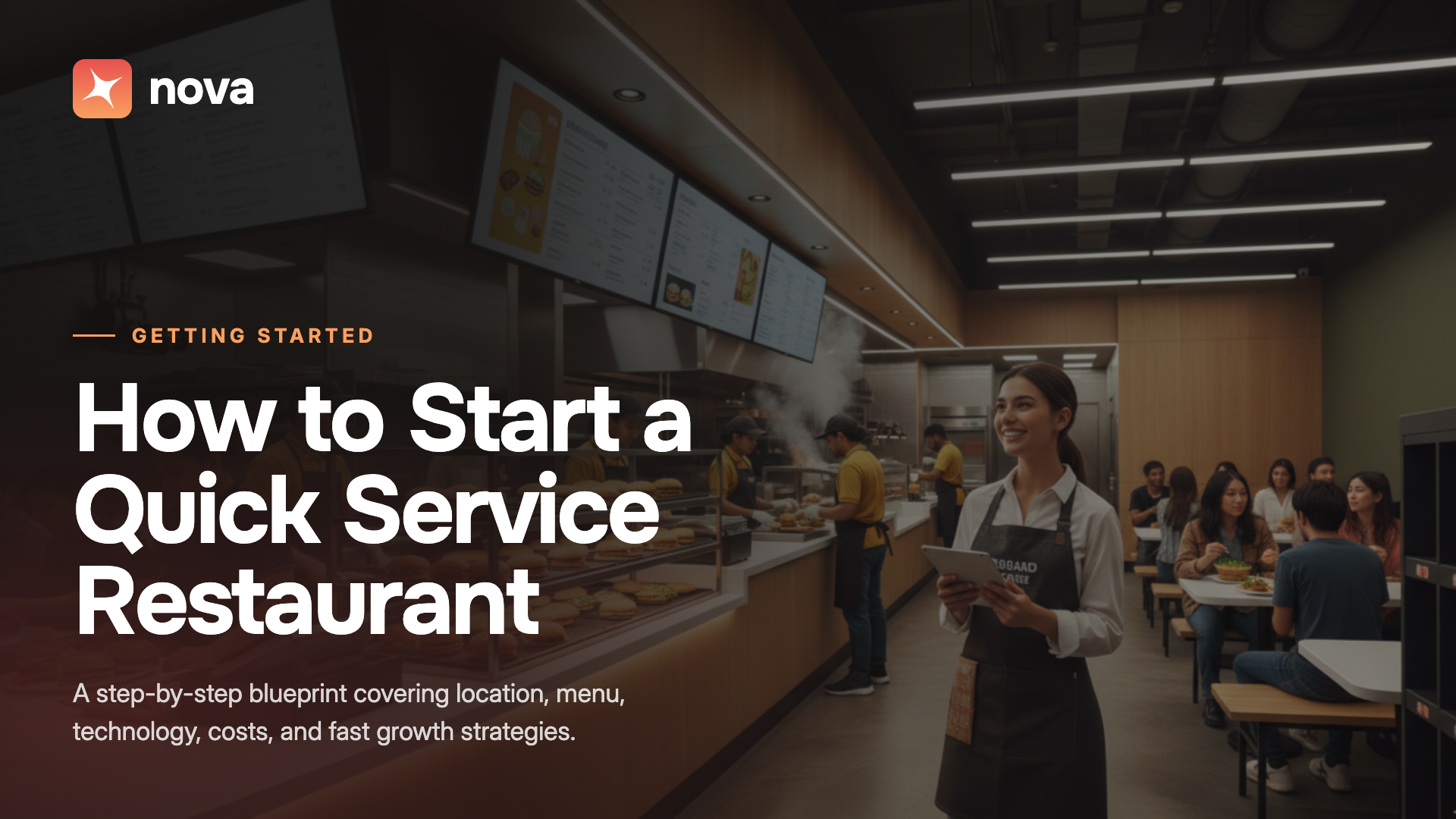
How to Start a Quick Service Restaurant in 2026: Step-by-Step Blueprint for Growth

The quick service restaurant (QSR) industry has been growing steadily with a CAGR of 3.7% in the last five years, with even higher expectations in 2026. As new QSRs are opening every year (1.7% increase from 2024 to 2023), it becomes even more challenging for new restaurateurs to navigate the competitive landscape. They also need to overcome the rising customer expectations and adopt the latest trends, such as sustainable kitchens, contactless payments, and health-focused menus.
However, with advanced planning and a strategic approach, QSRs can ensure a smooth entry into the restaurant business. Here is a step-by-step guide to starting a quick-service restaurant in 2026.
Choosing a Business Model
Before you start planning the opening of your quick-service restaurant, you must finalize its business model. You can consider opening an independent restaurant or a franchise model. Based on operations, you can either consider opening a traditional QSR (with dining and takeaway), food truck, food kiosk, etc. However, you must select the model based on factors like location, funding, risk tolerance, and scalability.
Define Your Restaurant’s Concept
After you have decided on the business model, it is time to think about the restaurant’s concept. A unique concept attracts customers quickly, as the current generation is constantly looking for new experiences. Although speed and affordability are common features of every QSR, you can still differentiate yourself from other restaurants with innovative concepts. For instance, as Domino’s and Taco Bell created a niche in the industry by specializing in a single item, you can project your quick service restaurant as a “plant-based only” spot.
Defining the concept gives you clarity about the menu, layout, aesthetics, and more. It also helps you optimize marketing efforts and enhance brand image. However, you must ensure that the concept, albeit niche, aligns with the local community’s sensitivities.
Build a Lean, Investor-ready Business Plan
A restaurant business plan defines all the core objectives, procedures, and concepts for your restaurant. It sets a clear path to achieve your present and future goals. With a restaurant business plan, you can ensure your efforts align with the brand image you want to portray.
Your QSR business plan should include:
- Executive summary
- Restaurant concept and brand identity
- Market analysis
- Menu strategy
- Operations plan
- Staffing strategy
- Marketing and sales plan
- Financial projections
The quick service restaurant’s business plan must be comprehensive, detailing all the necessary sections. However, you must ensure that it is realistic as well.
Conduct Market Analysis
No quick-service restaurant can cater to all demographics, age groups, and ethnicities. When you are opening a restaurant, it is essential to conduct a thorough market analysis. You must analyze:
- Local Demand - Understanding the local demographic is important. You must analyze their meal preferences, trending items, dominant age groups, and ethnic sensibilities. You must also examine the gender and professions that prefer quick-service restaurants and markets around them.
- Competitor Analysis - Study all competitors within your business scope. Check out their USPs, menu pricing, promotional strategies, social media presence, food quality, and portion size.
- Market Gaps - Identifying market gaps helps you capitalize on lost opportunities. You can identify what the competitors are not providing and capitalize on it. For instance, there can be a lack of healthy options in the area. Other gaps may include a lack of late-night food QSRs, a poor ordering experience, overpricing, and more.
Evaluating Costs
There are various costs associated with opening a quick-service restaurant, including both startup and operational costs (recurring).
Startup Costs: Lease, kitchen equipment, furniture, interior decoration, digital tools (quick-serve restaurant POS, Kitchen Display Systems, etc.), staff recruitment, and marketing
Operating Costs: Rent, power bills, software subscriptions, maintenance, and salaries
Hence, you need to draft a cash flow and expense projection to evaluate the break-even point. It also helps you estimate the funding or investment you require in the initial phases.
---------------------------------------------------------------------
Must Read: How to Get a Restaurant Business Loan
----------------------------------------------------------------------
Build Your Menu
Efficient menu engineering and management can ensure instant success for your quick-service restaurant. From the item list and design to pricing - everything should be optimized. Focus should be on:
Menu Items: You should not be rigid in your menu management approach and look to alter the menu according to seasons, events, holidays, bestselling items, and more. As you are just beginning, try to go deeper than broader. Keep the menu concise, but ensure you don’t compromise on quality. Once your quick-service restaurant flourishes, menu expansion is always on the cards. Moreover, you should provide multiple add-ons and modifiers to enhance upselling opportunities.
Menu Design: A quick service restaurant is all about agility and convenience. Therefore, your menu should be visually appealing with pictures of the items. You must also make the menu easy to navigate for quick ordering.
Menu Pricing: The average profit margin in the QSR industry is 5-8%. Therefore, you must analyze the profit margin of each item before setting up the pricing. Moreover, try to highlight the high-profit items on the menu.
Handle Legal Requirements
Each restaurant type and location has different legal requirements. These can include business registration, Food Handler Certifications & Manager Certifications, Employer Identification Number, and more. You must make a checklist of all the required permits, certifications, and licenses, and ensure everything is in order, thereby avoiding heavy penalties and reputational damage.
Choose the Right Location
Selecting the right location is a critical consideration, as it is very challenging to relocate afterwards. Before choosing any location, you must check the local surroundings. The location should preferably be in a visible area, such as a main street or shopping complex, to ensure high footfall. Try to finalize a location that is close to colleges or offices. You must also analyze other factors, such as parking availability and crime-free locations.
You must compare the amount you are willing to spend on the location (rent, utility, etc.) with the earning potential of that area and decide accordingly.
Optimize Your Layout
A quick-service restaurant’s success relies on agility, quality, and convenience. When a customer enters the restaurant, they should be able to order and settle without any assistance. Moreover, the kitchen staff must be able to navigate freely in the back end.
Hence, you must keep the layout inviting for the guests with clear markings for order, takeaways, and delivery. The tables must be optimally spaced to ensure that you can have maximum occupancy without guests feeling stuffed. Ensure consistent ventilation and air conditioning on all tables. For curbside pickups, create a dedicated parking spot with proper signage. For the kitchen staff, you must assign a distinct section for preparation and service and keep the high-usage equipment (like refrigerators) easily available.
Acquire Kitchen Equipment
While opening a quick-service restaurant, acquiring kitchen equipment is a vital consideration. The equipment you choose will directly impact your food quality, service speed, labor efficiency, and long-term operating costs. The equipment stack includes refrigerators/ cooling units, cleaning supplies, utensils, food prep equipment, storage racks, packaging material, etc.
Ask yourself:
- Do you want to lease or purchase the equipment
- What is your budget?
- Have you conducted proper market research?
- What are the must-have features you want in the equipment?
- Is there proper spacing and ventilation for the equipment?
- Are electronic tools energy efficient?
- What are the long-term and short-term costs?
Additionally, you must analyze the vendors based on customer service, market reputation, discounts, deployment time, etc.
Hire and Train Your Team
Your team represents your brand as much as your food. Disgruntled guests lead to not only a dip in revenues but also a loss of reputation. With rising wages and employee turnover, quick-service restaurants must ensure they hire skilled employees and implement flexible policies to ensure retention.
For your QSR, you must hire employees who can work in fast-paced environments. Moreover, the employees’ personal goals should be aligned with the restaurant’s objectives.
Once hired, ensure a comprehensive training program to enable delightful customer service from the outset. Make them well-adapted to all technological tools, including quick serve POS, kitchen display systems, etc. Moreover, giving them a live simulation of peak traffic hours will help them adjust quickly.
Market in Advance
Marketing should be one of the core functions of your restaurant operations. Don’t wait until the opening to start your marketing efforts. Look for opportunities in the planning phases to create visibility even before the inauguration.
You should diversify your marketing efforts and promote them across all the traditional and advanced media, including print, telemarketing, social media, email, Google Ads, and more. Offer discount coupons and free items for early customers and collaborate with local influencers. Also, it is crucial to utilize advanced marketing tools to measure and track the performance of marketing channels.
Implement the Best Technology
Adopting the right technological tools facilitates automation in restaurant operations, reducing human errors, enhancing efficiency, and minimizing labor costs. However, you must ensure the tools integrate seamlessly with each other for real-time data sync.
The essential (hardware and software) tools include:
- POS
- Kitchen display system
- Payroll
- Workforce management
- Digital ordering system (mobile app, website, third-party delivery platforms)
- Inventory management
You can either procure these tools from multiple vendors or opt for an all-inclusive restaurant management solution, such as NOVA. NOVA offers all Front of House and Back of House tools a QSR requires, infused with AI-native intelligence and deep data insights. Opt for NOVA and get:
Advanced Analytics
NOVA’s AI native architecture uses data to optimize inventory, reduce costs, manage shifts, reduce wastage, enhance guest satisfaction, boost sales, and more. As all the FoH and BoH tools are part of the NOVA ecosystem, the data syncs in real-time, facilitating deep data insights.
Inventory Management
NOVA offers advanced reports to optimize inventory management. Prevent overstocking and understocking, and get real-time alerts on item status. Reduce food wastage and prevent cost leakages.
Workforce Scheduling
Track employee time and manage shifts with NOVA’s workforce scheduling. Get AI-based prompts on scheduling, based on past footfall history. Reduce payroll costs and ensure employee satisfaction.
AI-native Marketing Campaigns
A restaurant’s marketing process takes up 3-6 percent of the budget. You can avoid this marketing expenditure with NOVA’s native-marketing solution. Launch marketing campaigns within minutes, backed by AI-based insights. Create personalized messages to ensure sales and guest satisfaction.
Tableside Ordering
Elevate guest experiences by optimizing tableside ordering with NOVA’s handhelds. Servers can reduce the waiting time for navigating between the table and the POS to register orders. Moreover, the handhelds are integrated with the kitchen display system to minimize preparation time. In addition, you can set course pacing to serve customers well. The AI-powered handhelds can offer tip suggestions and item recommendations to streamline ordering and payments.
Easy Onboarding
Reduce training costs and onboarding time with the easy-to-use NOVA platform. NOVA’s user interface is built on an image-first interface that enables even new employees to adopt it quickly.
----------------------------------------------------------------------------------------------------------
Recommended Case Study: How NOVA's Easy-to-Use Interface Transformed Restaurant Operations
----------------------------------------------------------------------------------------------------------
Integrated Online Ordering
NOVA offers an integrated digital ordering system with the NOVA mobile app and NOVA Webstore. You can customize these platforms to suit your brand aesthetics and requirements. These online ordering platforms are integrated with loyalty programs to offer real-time visibility of rewards and offers. The menu is synced with all platforms in real time. Integrate all third-party delivery platforms with NOVA.
.png)
AI and Automation in QSR Operations
Technology has moved from a nice to have to the operational backbone of a modern QSR. National data now shows that 79 percent of US restaurants have implemented or are actively considering AI across order taking, food prep, marketing, and back office functions. New operators who build automation into their operations from the start avoid the harder, more expensive retrofit that older restaurants are now going through.
The clearest early win is the phone. A typical quick service restaurant fields 50 to 75 calls a day, and industry estimates suggest around 150 of those calls go unanswered every month. At a modest average order value of 25 dollars, that adds up to more than 27,000 dollars in lost annual revenue from calls that simply never got picked up during a lunch rush. An AI-powered phone or voice ordering system closes that gap without adding headcount, and it is one of the fastest payback investments a new restaurant can make.
Drive-thru and counter ordering are following the same path. Early trials of AI ordering assistants, including Wendy's FreshAI system, have cut average order time by about 22 seconds per transaction, a small number per order that compounds into significant throughput gains during peak hours. For a new QSR planning drive thru or high-volume counter service, evaluating an AI order-taking layer at launch is far cheaper than adding one after your process and staff habits are already set.
Behind the counter, automation extends to kitchen display systems that route tickets intelligently, inventory tools that flag waste and reordering needs before they become a crisis, and labor forecasting software that matches staffing to predicted demand rather than a fixed weekly schedule. This is also where a unified platform like NOVA pays off twice over, since AI ordering, kitchen operations, and labor forecasting run on connected data rather than as separate bolt-on tools that do not talk to each other.
None of this replaces your team. Diners still value human connection, with 87 percent saying staff interaction matters to them and 63 percent expressing some concern about losing that human touch as AI expands. The winning approach for a new QSR is to let automation absorb repetitive, error-prone tasks such as order entry and phone answering, freeing your staff to focus on speed, accuracy, and the moments of service that actually build customer loyalty.
Start Your Quick Service Restaurant with Conviction
Starting a quick-service restaurant in 2026 requires in-depth knowledge of industry trends, competitors, demographics, and technology. You must be able to control the budget whilst procuring the best location, infrastructure, and equipment for the restaurant. Also, marketing in advance around the restaurant’s concept and procuring all legal permits is essential.
Moreover, you require the help of an advanced restaurant management platform to get deep data analytics on cost reduction, revenue optimization, staff management, and inventory control. If you want to see how a restaurant management solution works, get a free demo of NOVA now.
Post-Launch: Measuring Success and Scaling to Multiple Units
Opening day is the starting line, not the finish line. The real test of your business model happens in the first 90 days, when your actual numbers either confirm your business plan or tell you it needs adjusting. Track a small set of numbers consistently rather than drowning in data you will not act on.
Food cost percentage should be your first checkpoint, calculated as the cost of goods sold divided by food revenue, and compared weekly against the target you set in your original business plan. Labor cost percentage matters just as much, and industry benchmarks put labor at 25 to 35 percent of total operating expenses for most restaurants, so tracking your actual figure against that range early will tell you quickly whether your staffing model is sustainable. Order throughput and table turn time tell you whether your layout and workflow decisions from earlier in this guide are actually working under real volume, not just on paper. Finally, repeat customer rate is the clearest signal of whether your concept, menu, and service are earning loyalty rather than one-time curiosity visits.
Staff retention deserves its own attention here, since it directly affects every other number on this list. Restaurants with effective internal communication see turnover drop by as much as 50 percent, and adding a basic staff recognition program can reduce turnover by a further 31 percent. Given how disruptive and costly retraining a new hire is in a fast-paced QSR environment, investing in team communication and recognition in your first few months pays for itself many times over.
Once your first location is consistently hitting its targets for three to six months, it is time to think seriously about a second unit. Before you sign a second lease, document your systems: recipes, prep procedures, opening and closing checklists, training materials, and your technology setup should all be written down and repeatable, not held in one manager's head. This is also the point to decide whether you will grow through company-owned locations, where you retain full control and full financial risk, or through franchising, where you trade some control and margin for faster expansion funded largely by franchisee capital. Many successful QSR founders prove the model with one or two company-owned locations first, refine their playbook, and only franchise once they have a system reliable enough to hand to someone else.
Frequently Asked Questions
How much does it cost to start a quick service restaurant?
Costs vary widely by city, format, and whether you go independent or franchise, but most new QSRs land somewhere between build out, equipment, initial inventory, licensing, and working capital for the first few months of operations. The cost breakdown in the Evaluating Costs section of this guide walks through each line item, and your local market analysis will narrow the range further based on rent and labor costs in your area.
Is it cheaper to open an independent QSR or buy a franchise?
An independent concept usually has a lower upfront cost since you are not paying a franchise fee or ongoing royalties, but you take on all the marketing, recipe development, and brand building yourself. A franchise costs more to enter but comes with a proven playbook, national marketing, and often faster financing approval. The right choice depends on how much you value control versus a tested system, which is covered in the Choosing a Business Model section above.
What profit margin should a quick service restaurant expect?
Industry wide, QSR profit margins typically fall in the 5 to 8 percent range after all costs, including food, labor, rent, and marketing. Labor alone commonly makes up 25 to 35 percent of operating expenses, so tight scheduling and low turnover, discussed in the Post-Launch section above, have an outsized effect on whether you land at the low or high end of that range.
How long does it take to open a quick service restaurant from planning to launch?
Most new QSRs take somewhere between six months and a year from concept to opening day, depending on how quickly you secure a location, complete permitting, and finish build-out. Legal and permitting timelines, covered in the Handle Legal Requirements section, are usually the biggest variable, since health department approvals and construction permits can take longer than expected in many cities.
What licenses and permits do I need to open a QSR?
At minimum, you will need a business license, a food service permit from your local health department, and sign-off from a health inspection before opening. Depending on your menu and location, you may also need a liquor license, signage permits, and fire department approval. The Handle Legal Requirements section above lists the full checklist to work through with a local attorney or licensing consultant.
Do I need a POS system and a delivery app before opening day?
Yes. A modern point of sale system is not optional for a quick service restaurant, since it handles orders, payments, inventory, and reporting from day one, and retrofitting it later means migrating data and retraining staff mid-operation. Whether you also launch on a third-party delivery app immediately depends on your off-premise strategy, outlined in the Off-Premise, Delivery and Digital Ordering Strategy section, though most operators find it easier to launch with at least one delivery channel live rather than adding it after opening.