Restaurant Self Ordering System: How Modern Self-Service Tech Boosts Speed, Revenue & Guest Experience

It has been seen that people naturally gravitate toward convenience and control. A restaurant self-ordering system taps right into that instinct. The rapid rise of self-order kiosks across the service industry is evidence of this human behavior.
According to Tillster’s 2025 Report, out of 1,500 QSR and fast-casual consumers in the U.S., 61% of them now want more self-service kiosks in restaurants. This digit has steadily climbed from 57% in 2024. Consumer behavior is changing, too. 1 out of 4 respondents said they rely less on cashiers than they did a year ago. In parallel, 42% of kiosk users place orders through kiosks at least once a week.
Rising costs of staff, constant hiring challenges, and the demand for faster service have pushed restaurants to rethink how orders are taken. It has been noticed that guests now expect the same convenience from restaurants that they get from retail checkouts.
In this blog, we will break down what a restaurant self-ordering system really is, why it has become essential, and how it boosts speed and revenue. Further, how modern AI-native restaurant management systems like NOVA are reshaping the guest experience from the ground up.
What Is a Restaurant Self-Ordering System?
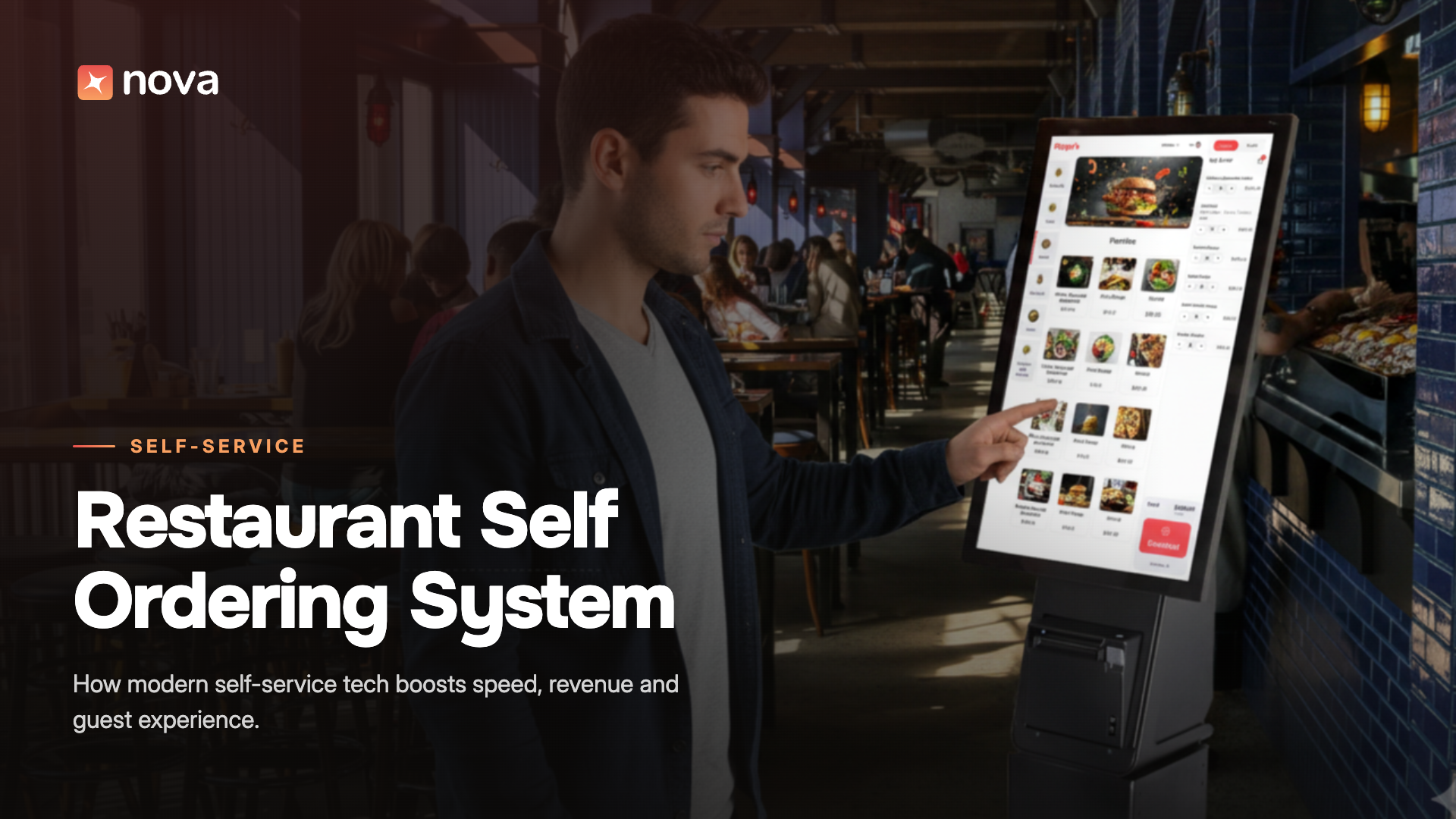
A self-ordering kiosk is a standalone digital screen, usually set up inside a restaurant. It lets customers go through the menu at their own pace, customize what they want, and pay directly on the screen, without waiting in line or depending on a cashier or server.
Some kiosks come with a built-in POS system, such as in the case of Nova. This feature makes things even smoother. When the kiosk and the restaurant POS work as a combined system, the entire workflow becomes more efficient. Orders are sent straight to the kitchen display, side-by-side receipts are generated instantly, and payments are processed through your chosen payment gateway.
Key Benefits of a Restaurant Self-Ordering System
Restaurant owners do not invest in technology for novelty. They invest for results. A well-designed restaurant self-ordering system delivers clear, measurable benefits across operations and revenue.
Faster ordering and reduced wait times
Guests place orders instantly without waiting for staff. Lines move quicker, tables turn faster, and peak hours feel manageable instead of chaotic.
Higher order accuracy
Orders come straight from the guest to the kitchen. Fewer miscommunications mean fewer remakes and less frustration on both sides.
Increased average check size
Automated upsells work quietly and consistently. Add-ons like sides, upgrades, and drinks are suggested at the right moment, leading to a 15–25 percent increase in ticket size for many restaurants.
Lower labor dependency
With self-ordering for restaurants, fewer staff are needed at the counter or on the floor, allowing teams to focus on food quality and hospitality.
Better guest experience
Guests feel in control. They can browse calmly, customize freely, and pay without pressure. This sense of autonomy builds satisfaction.
Must-Have Features in a Modern Self-Ordering System
Not all systems are created equal. A modern restaurant self-ordering system should be built for speed, reliability, and growth.
The interface must be intuitive and fast. Guests should understand how to order within seconds, without staff assistance. Smart upsell recommendations should appear naturally, not aggressively. Real-time menu updates are essential, so sold-out items never appear.
Multi-language support matters more than many owners realize, especially in urban and tourist-heavy locations. Payment integration should cover cards, wallets, UPI, and contactless options.
AI-driven personalization is a powerful advantage. It allows the system to recommend items based on time of day, popular combinations, or past behavior. Offline mode is equally critical. Orders should continue even if the internet drops.
Finally, deep integration with POS, kitchen display systems, and loyalty programs ensures smooth operations from order to fulfillment.
How AI-Native Self-Ordering Improves Restaurant Performance
Traditional digital ordering systems digitize the menu. An AI-native restaurant self-ordering system actively improves performance. This is where NOVA stands apart.
With dynamic upselling, the system adapts suggestions based on demand, inventory, and time of day. A lunch rush may highlight quick combos, while evenings push premium add-ons. Intelligent menu optimization shows high-margin and fast-moving items first, subtly shaping guest choices.
Orders are routed smartly to the kitchen, balancing load and reducing bottlenecks. NOVA’s MCP-powered insights give owners visibility into throughput, wait times, menu performance, and staff efficiency.
The biggest shift is reduced staff dependency. When ordering, payment, and routing are automated, teams can focus on speed and service quality. Faster table turnover and smoother peaks become the new normal.
Types of Self-Ordering Solutions & What Restaurants Should Use
Different formats serve different restaurant models. Choosing the right restaurant self-ordering system depends on your service style and guest flow.
Self-ordering kiosks
Best suited for QSRs, food courts, and high-volume locations where speed at peak hours matters most. Kiosks handle large crowds efficiently by taking multiple orders in parallel instead of funneling everyone through one register line, and they consistently drive higher average order values through visual upsell prompts guests are less likely to decline than when asked verbally. The trade-off is upfront cost and floor space: kiosks need hardware investment and a dedicated footprint, so they pay off fastest where transaction volume is high enough to justify it.
QR code ordering systems
Ideal for cafes, bars, and full-service restaurants where guests are already seated and prefer ordering (and often paying) from their table without flagging down a server. Because guests use their own phones, there's no hardware cost beyond printed table codes, making this the lowest-capex option to deploy across an entire dining room at once. The catch is that adoption depends entirely on guest comfort and connectivity. Slow Wi-Fi, low battery, or hesitant older guests can push some orders back to staff, so most full-service restaurants keep it as an add-on to table service rather than a full replacement.
Mobile app self-ordering
Suits brands with loyal, repeat customers rather than one-time or walk-in traffic, since the value compounds as guests reorder favorites, redeem loyalty rewards, and skip the line entirely. It's particularly strong for pre-orders and takeaway, where a guest can order ahead and walk straight to pickup. The limitation is that it only works if you can get guests to download and keep the app, which takes sustained marketing investment; it's rarely the first self-ordering channel a restaurant should launch, but it's the highest-leverage one once a loyal base exists.
Countertop or mini kiosks
Built for small QSRs and counter-service concepts that want the speed benefits of a kiosk without dedicating floor space to a full standing unit. They help small QSRs speed up decisions at the counter by giving guests a visual menu to browse while still standing in line, which shortens the time each order takes once they reach the register. Because the footprint is small, throughput gains are more modest than a full kiosk bank, so this fits operations with moderate rather than extreme volume.
Drive-thru self-ordering screens
Purpose-built for reducing errors and improving throughput during peak drive-thru traffic, when misheard orders and long queues cost both revenue and guest satisfaction. AI-native versions can now take orders through natural voice interaction, cutting order time meaningfully compared to a human-only lane during rush periods. The consideration is accuracy under real-world noise and accents. Systems need a fallback to a human operator for edge cases, so this works best paired with staff oversight rather than fully unattended.
The key is matching the format to guest behavior rather than forcing a one-size solution.
Operational Challenges Self-Ordering Solves
Restaurant self-ordering systems remove friction from daily restaurant operations by reducing dependence on staff during high-pressure hours. They streamline the ordering flow, cut down errors, and create consistency across every shift. Most importantly, they replace long waits and confusion with a faster, calmer, and more predictable guest experience.
Peak Hour Traffic Congestion: Allows for several customers to place orders simultaneously, thus easing workflow during busy periods
Employee Turnover Rate: Maintain a smooth operational flow, as orders are not dependent upon the
Order Mistakes: Guests can input their own choices regarding quantity and customization.
Inconsistent Upselling: Automated & consistent upsell prompts without relying upon the staff’s confidence in recommendations.
Cash Handling Risk: Secure digital payment options minimize errors and theft.
Long Lines and Walk Away: Shorter waiting times will provide less opportunity for guests to leave without placing orders.
Confusion Over the Menu: Provides images and modifiers to make it easier to make selections.
Guest Displeasure: Reduces long waits and repetitive questions, thus making the dining experience more enjoyable.
ROI of Adding a Restaurant Self-Ordering System
Return on investment is where the decision becomes clear. A restaurant self ordering system increases throughput, meaning more orders per hour without expanding staff. Revenue per labor hour rises as fewer people handle more volume.
Staffing costs decrease while order capacity grows. Data from the digital ordering system highlights best-selling items, slow movers, and peak times, allowing smarter decisions. Guest satisfaction improves, leading to repeat visits.
A simple ROI structure looks like this:
- Increase in average ticket size
- Reduction in labor hours
- Additional orders processed per hour
- Monthly technology cost
When the gains outweigh the cost, the system pays for itself quickly.
How to Choose the Right Restaurant Self-Ordering System?
Before choosing, owners should run through a practical checklist.
Step 1: Evaluate Speed and Reliability
Start with performance. The system should load quickly, respond instantly, and function smoothly during peak hours. If ordering feels slow or confusing to guests, it will hurt both experience and revenue.
Step 2: Assess AI Capabilities That Drive Outcomes
Look beyond buzzwords. The AI should actively support upselling, menu optimization, and actionable insights that help improve order value and throughput.
Step 3: Check Customizability and Brand Fit
Your menu layout, visuals, modifiers, and flow should reflect your brand. A rigid system limits flexibility and guest comfort.
Step 4: Ensure Seamless POS and Kitchen Integration
The self-ordering system must connect directly with your POS and kitchen display system to avoid double entries, delays, and order mismatches.
Step 5: Review Payment Flexibility
Support for cards, wallets, UPI, and contactless payments ensures no guest is blocked at checkout and improves conversion rates.
Step 6: Match Hardware to Your Space
Choose kiosks, QR ordering, tablets, or drive-thru screens based on your layout and service model, not trends.
Step 7: Understand Total Cost of Ownership
Go beyond setup costs. Factor in software fees, hardware maintenance, upgrades, and support to avoid surprises.
Step 8: Prioritize Support, Analytics, and Insight
Reliable support keeps operations running. Clear dashboards and actionable analytics turn data into better decisions, separating average systems from high-performing ones.
.png)
Why Restaurants Switch to NOVA’s AI-Native Self-Ordering System
Restaurants switch to NOVA because it simplifies complexity. Workflows become faster and smoother. Upselling runs automatically without feeling forced. Guests enjoy a consistent ordering experience every visit.
One System Instead of Many Disconnected Tools
Restaurants switch to NOVA to escape tool overload. Ordering, POS, kitchen display, and payments work as one connected system, removing friction, delays, and manual coordination that slow teams down during busy hours.
Faster Workflows When It Matters Most
NOVA is built for peak pressure. Orders flow directly from guests to the kitchen with zero confusion, reducing wait times and keeping service moving smoothly even during rush periods.
Upselling That Feels Natural, Not Pushy
Smart, AI-driven upsell prompts adapt to time of day, demand, and best-selling items. This increases average order value consistently without relying on staff or making guests feel pressured.
Consistent Guest Experience Across Every Visit
Every guest gets the same clean, intuitive ordering experience, regardless of staff availability, shift changes, or location. Consistency builds trust and repeat visits.
Real-Time Menu Control Across Locations
Menu updates, pricing changes, and item availability reflect instantly across all ordering channels, helping owners stay in control and avoid costly mistakes.
Built for Owners Who Want Control
NOVA is not just a self-ordering solution. It is an AI-native operating system for restaurants that want speed, higher margins, and full operational visibility without chaos.
Frequently Asked Questions
Does a self-ordering system replace my waitstaff or cashiers?
No, it shifts their focus, not their jobs. Self-ordering systems handle repetitive order-taking so staff can spend more time on hospitality, order expediting, and upselling in person. Most restaurants that adopt self-ordering redeploy labor toward service quality rather than cutting headcount.
How much does a restaurant self-ordering system cost to implement?
Costs vary by hardware (kiosk, tablet, or QR-based), number of terminals, and whether it's bundled with your POS. Expect upfront hardware and setup costs plus an ongoing software fee. Most restaurants recover the investment within months through higher order value and lower labor strain; see the ROI breakdown above for specifics.
Will my customers actually use a self-ordering system instead of ordering with staff?
Adoption is high when the interface is intuitive and staff lightly prompt first-time users. Guest comfort with self-service has grown sharply across quick-service and fast-casual dining, and well-designed systems typically see the majority of eligible orders shift to self-service within weeks of rollout.
Does a self-ordering system work with my existing POS?
It depends on the provider. Tight, real-time POS integration is essential; orders need to route straight to the kitchen without manual re-entry. When evaluating vendors, confirm native integration with your specific POS rather than a generic export/import workaround.
Is self-ordering worth it for small or independent restaurants, or just chains?
It's not just for large chains. Smaller restaurants often see a bigger proportional impact because self-ordering frees up scarce staff hours and captures upsell revenue without adding headcount - the same benefits chains use it for, at a scale that fits a single location.
How secure is customer payment data on a self-ordering system?
Reputable systems process payments through PCI-compliant gateways and don't store raw card data on the device itself. When choosing a system, confirm PCI-DSS compliance and how payment data is encrypted and tokenized end-to-end.
Can a self-ordering system handle modifiers, allergens, and special requests accurately?
Yes, this is one of the core accuracy gains. Guests select modifiers and flag allergens directly on-screen, removing the miscommunication that happens between a guest, a server, and a kitchen ticket. The order that hits the kitchen display is exactly what the guest chose.
How long does it take to implement a self-ordering system?
Timelines depend on hardware procurement and POS integration complexity, but most restaurants can go live within a few weeks of signing, faster for cloud-based or tablet/QR solutions than for hardware-heavy kiosk rollouts.
Enhance Your Restaurant with Advanced Self-Ordering Technology
When it comes to your restaurant, what do you value most? Fast service, correct orders, and ensuring every customer leaves satisfied.
NOVA provides an AI-powered restaurant self-ordering system that protects and enhances these experiences for you, your team, and your customers. It creates a frictionless ordering experience for customers. In addition, it allows you to increase your revenue through upselling in a non-intrusive manner while providing accurate order submissions to the kitchen.
While NOVA provides you with technology, it also provides you with freedom, allowing your employees to concentrate on delivering excellent food and an exceptional experience to your customers, while NOVA will take care of the rest.
Schedule a demo with us to experience it firsthand!