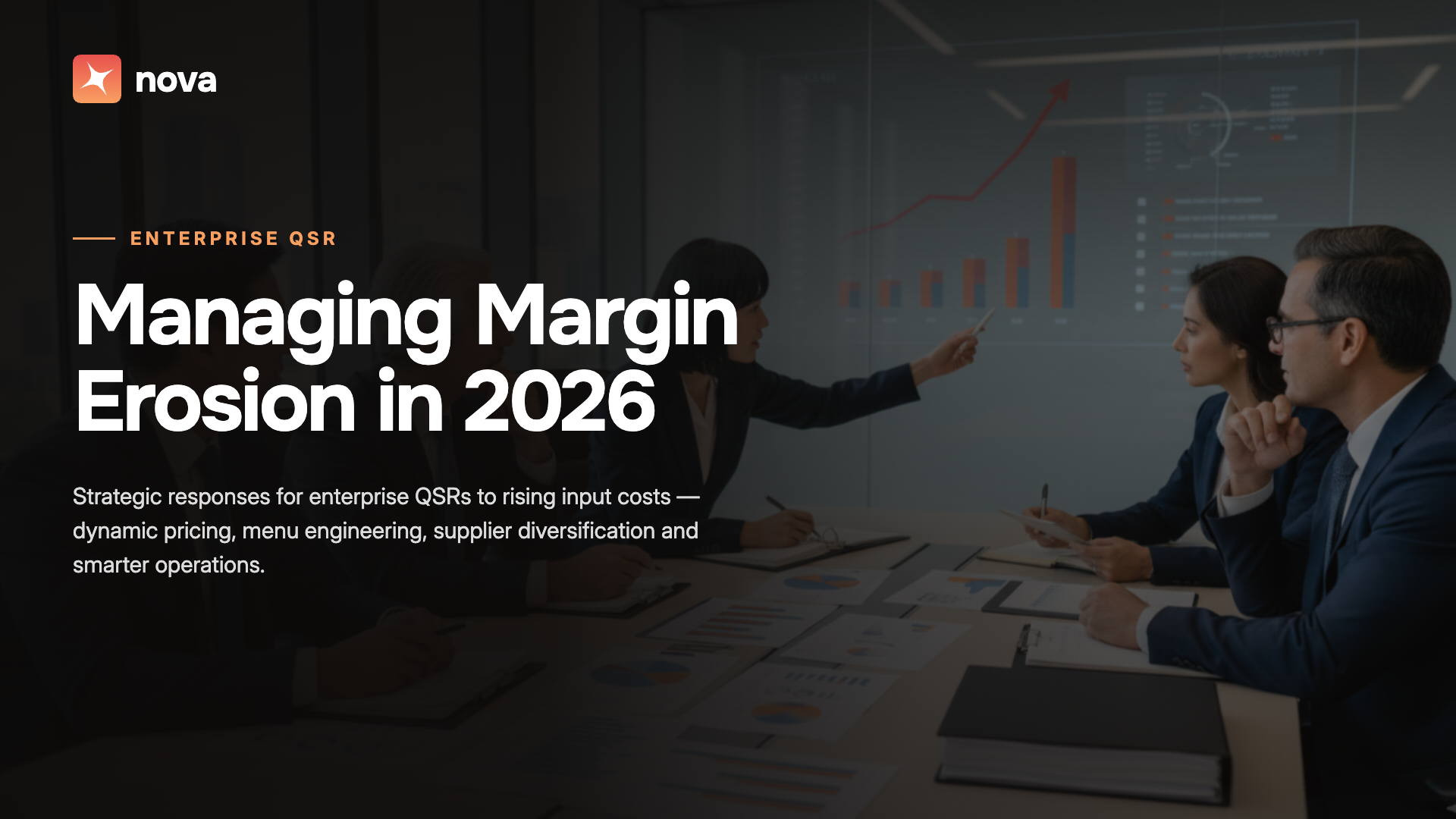
Managing Margin Erosion in 2026: Strategic Responses for Enterprise QSRs to Rising Input Costs

Enterprise restaurant chains are entering 2026 with a familiar but intensifying challenge: costs are rising faster than pricing power.
Recent industry reporting from Restaurant Dive underscores the ongoing impact of minimum wage hikes across states, food inflation, and tariff-driven supply chain pressures. What looked like a temporary post-pandemic cost spike has now become a structural operating environment.
For large QSR and fast-casual brands, the conversation is no longer “How do we absorb this?”
It’s now “How do we architect our operations to survive permanent volatility?”
Industry Reality Check: Cost Pressure Is Structural, Not Cyclical
Operators are facing simultaneous pressure from multiple fronts:
- Minimum wage increases continuing across major states and markets
- Tariff-related cost increases on imported ingredients, packaging, and equipment
- Ongoing food price inflation, especially in proteins, oils, and produce
- Higher logistics and distribution costs driven by global supply chain realignment
For enterprise chains operating at scale, even small percentage shifts create an outsized impact.
A 4–8% increase in food and input costs may sound manageable until you apply it to a model where store-level operating margins often sit in the 5–6% range.
That means:
A few points of cost movement can erase half or more of restaurant-level profit.
This is not a pricing problem alone. It’s a systems problem.
Why Enterprise QSRs Feel Margin Erosion Faster
Large brands face unique exposure:
Smaller independents can improvise.
Enterprise brands need data-driven precision at scale.
Strategic Responses for 2026
Winning chains will not rely on a single lever, like price increases. They’ll deploy multi-layer margin defense strategies.
Dynamic Pricing Aligned to Real Costs
Static, quarterly price reviews are becoming obsolete.
Enterprise leaders are shifting toward:
- Location-based pricing adjustments
- Daypart pricing optimization
- Bundling strategies to protect perceived value
- Selective price moves on low-elasticity items
The key shift:
Pricing becomes a continuous operational function, not a periodic financial decision.
Supplier Diversification & Tariff Risk Mitigation
Procurement teams are now acting like risk managers.
Forward-looking chains are:
- Reducing dependence on single-origin imports
- Developing secondary and regional suppliers
- Negotiating flexible contracts tied to commodity benchmarks
- Strategically hedging key ingredients
This reduces exposure to sudden tariff or trade shocks.
Menu Engineering for Margin Protection
In volatile cost environments, menu design becomes a financial instrument.
Leaders are:
- Promoting high-margin items through digital upsell prompts
- Reformulating recipes to reduce exposure to volatile ingredients
- Using limited-time offers to steer demand
- Simplifying SKUs to improve purchasing leverage
The goal is not just selling more, it’s shifting the mix toward profit-rich items.
Predictive Inventory & Waste Optimization
With tighter margins, waste is now a strategic risk, not just an ops issue.
Best-in-class chains use predictive models to:
- Align prep levels with forecasted demand
- Reduce spoilage in high-volatility categories
- Optimize ordering frequency
- Prevent overproduction during slow periods
Even a 1–2% reduction in food waste can offset a large portion of ingredient inflation.
Labor Cost Optimization: The Overlooked Lever
Labor is shifting from a fixed cost center to an active lever.
- Scheduling in 15-minute demand increments instead of full shift blocks
- Cross-training staff across roles to increase scheduling flexibility
- Using AI tools to automate shift planning and cut manager admin time
- Tracking real-time labor cost against sales at each location
- Reducing reliance on overtime during unpredictable demand spikes
- Freeing managers to spend more time on service and team performance
The Technology & Operations Lens: Speed Is the New Advantage
Margin defense now depends on how fast operators can see, understand, and act on cost signals. This is where integrated operational data becomes decisive.
Platforms like NOVA Platform enable enterprise brands to:
- Track real-time item-level performance across locations
- Identify margin compression by SKU, store, or region
- Adjust pricing and promotions faster
- Use AI-driven forecasting for demand and labor alignment
- Reduce waste through smarter prep and inventory planning
When POS, operations, and analytics work together, leaders move from reactive cost control to proactive margin management.
Turning Cost Volatility Into Competitive Advantage
Cost pressure will not disappear in 2026. In fact, volatility is becoming a permanent feature of the industry.
The advantage will not go to the chains with the lowest costs.
It will go to the chains with the fastest operational intelligence loops.