.svg)
If you have spent time running or managing a restaurant in the United States, you have likely heard terms like “we did 180 covers tonight” during shift reviews or daily reports. While the phrase is commonly used across the industry, many restaurant owners do not fully understand how powerful this metric can be. Knowing what is a restaurant cover can help you make better decisions around revenue, staffing, and growth.
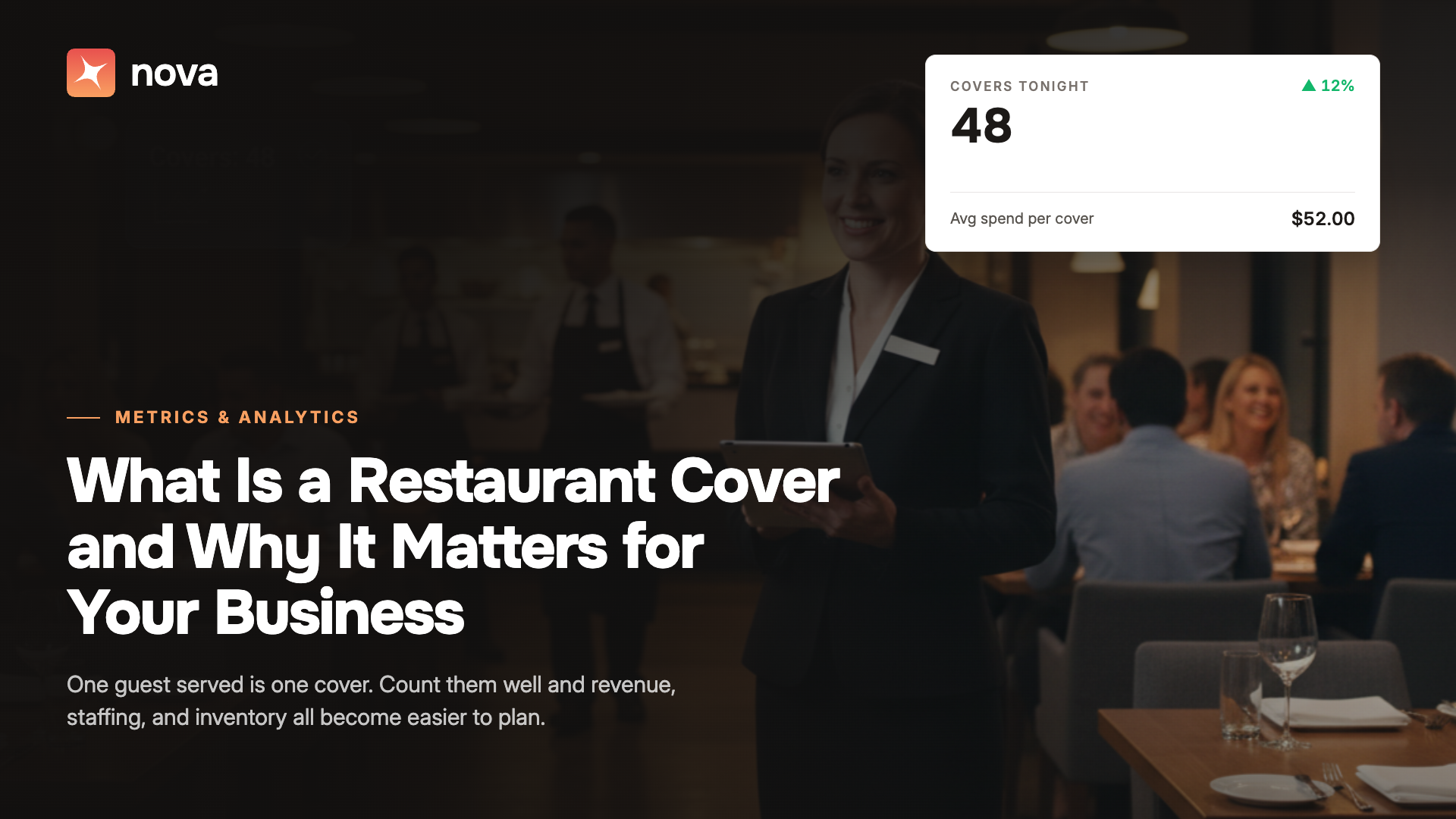
A restaurant cover simply refers to one guest served. Every individual customer who dines at your restaurant counts as one cover, regardless of what they order or how much they spend. If a party of four walks in, that translates to four covers. If that same table is seated again later in the evening with another group, those additional guests are added to your total covers for the day.
This makes covers one of the most important ways to measure customer volume in any restaurant. While the definition is simple, the impact of this metric on your business is far-reaching.
What is a restaurant cover in simple terms?
To understand what is a restaurant cover, think of it as a standardized way to count how many guests your restaurant serves over a period of time. Instead of focusing on tables or orders, covers focus on people, which gives a clearer picture of demand.
A typical day might look like this:
- Lunch service serves 75 guests
- Dinner service serves 120 guests
- Total for the day equals 195 covers
This number tells you exactly how many people experienced your restaurant that day. It becomes the foundation for calculating revenue and analyzing performance.
What is covers in restaurant analytics and why it matters
When restaurant owners ask what is covers in restaurant analytics, the answer goes beyond just counting guests. Covers are directly tied to your revenue model and operational efficiency.
Every restaurant’s revenue is driven by two core variables:
- The number of covers served
- The average spend per customer
When you multiply these, you get your total revenue. This means covers are one of the primary levers you can use to grow your business.
Covers influence several critical areas:
- Revenue forecasting becomes more predictable when you understand expected customer volume
- Staffing can be aligned with peak and off-peak hours
- Inventory planning improves because demand can be estimated more accurately
- Performance tracking becomes clearer when you know whether changes are driven by traffic or spending
Many successful restaurant operators treat covers as the starting point for all performance analysis.
Difference between covers and cover charge
While exploring what is a restaurant cover, it is important to clear up a common confusion: Covers and cover charges are not the same thing.
A cover refers to a guest served. A cover charge is a fee that some restaurants or bars may charge for entry, seating, or entertainment. This fee is more common in certain dining formats such as fine dining or live entertainment venues.
For operational decision making, covers are far more relevant because they directly reflect customer volume and impact revenue.
Types of covers every restaurant should track
Understanding what is covers in restaurant operations also means breaking this metric down into meaningful categories. Looking only at total covers can limit your ability to identify trends and optimize performance.
Here are key ways to analyze covers:
- Daily covers, which represent the total number of guests served in a day and help track overall demand
- Covers by service period, such as brunch, lunch, and dinner, which help identify peak revenue windows
- Covers per table, which show how effectively your seating capacity is being utilized
- Covers per server, which help measure staff productivity and workload distribution
- Covers per hour, which provide insights into peak times and slower periods
This level of detail allows you to move from basic tracking to actionable insights.
Average spend per cover and its impact on revenue
Covers alone do not tell you how much revenue you are generating. That is where average spend per cover becomes essential. It is calculated by dividing total revenue by the number of covers.
For example, if your restaurant generates 20,000 dollars in revenue from 400 covers, the average spend per cover is 50 dollars.
This metric helps you understand customer behavior and pricing effectiveness. It also highlights opportunities to increase revenue without necessarily increasing traffic.
Ways to improve average spend per cover include:
- Training staff to recommend add-ons, appetizers, and desserts
- Designing menus that highlight high-margin items
- Offering bundled meals or prix fixe options
- Introducing premium dishes or beverages
Balancing higher covers with increased average spend is key to maximizing revenue.
Key metrics derived from covers
Once you understand what is a restaurant cover, you can build several important performance metrics around it. These metrics provide deeper insight into how your restaurant is operating.
Some of the most valuable ones include:
- Revenue per cover, which shows how much income each guest generates on average
- Table turnover rate, which indicates how many times a table is used during a service period
- Seat occupancy rate, which reflects how much of your seating capacity is being utilized
- Break-even covers, which tell you the minimum number of guests needed to cover costs
- Covers forecasting, which helps predict future customer volume based on historical trends
These metrics allow you to make more informed decisions and optimize performance across the board.
How covers affect profitability in real scenarios
To understand what is covers in restaurant profitability, consider a practical example.
A restaurant currently serves 120 covers per day with an average spend of 45 dollars. This results in a daily revenue of 5,400 dollars.
If the restaurant increases covers to 150 while maintaining the same average spend, daily revenue rises to 6,750 dollars. This growth comes from serving more guests.
Alternatively, if covers remain at 120 but the average spend increases to 55 dollars, revenue increases to 6,600 dollars. In this case, growth comes from higher spending per customer.
The most successful restaurants focus on improving both factors at the same time to drive consistent revenue growth.
Practical ways to increase covers in your restaurant
Increasing covers is not just about attracting more customers. It also involves improving how efficiently you serve them.
Here are some practical strategies:
- Improve table turnover by streamlining ordering and kitchen operations
- Optimize reservations to reduce empty tables and manage demand effectively
- Reduce wait times to prevent losing potential customers
- Use targeted promotions during off-peak hours to drive additional traffic
- Invest in local marketing and loyalty programs to increase repeat visits
- Design menus that support faster preparation during peak hours
Each of these approaches helps you serve more guests within your existing capacity.
Using technology to track and optimize covers
As your restaurant grows, manual tracking of covers becomes less reliable and harder to scale. Modern restaurant technology platforms provide a more accurate and efficient solution.
Solutions like the NOVA restaurant management platform allow restaurant owners to track covers in real time and connect this data with other operational metrics. This creates a comprehensive view of performance.
With the right system, you can:
- Monitor covers by hour, shift, and location
- Identify peak demand periods and slow intervals
- Forecast future covers using historical data
- Align staffing and inventory with expected demand
- Understand how covers translate into revenue
This level of insight helps you move from reactive decisions to proactive growth strategies.
Common mistakes restaurant owners make with covers
Even when owners understand what is a restaurant cover, they often fail to use it effectively.
Some common mistakes include:
- Focusing only on revenue without analyzing covers
- Ignoring average spend per cover and its impact on margins
- Not tracking covers by time or service period
- Overstaffing or understaffing due to the lack of accurate data
- Relying on manual tracking instead of using modern systems
Avoiding these mistakes can significantly improve both operational efficiency and profitability.
Final thoughts on what is a restaurant cover
Understanding what is a restaurant cover and what is covers in restaurant operations is essential for any restaurant owner looking to grow sustainably in the US market. Covers represent the flow of customers through your business and directly influence revenue, efficiency, and profitability.
When you combine cover data with insights on average spend, table turnover, and occupancy, you gain a clearer picture of how your restaurant performs. This enables smarter decisions across staffing, marketing, and menu strategy.
For restaurant owners aiming to scale, mastering covers is not just about tracking numbers. It is about using those numbers to improve customer experience, optimize operations, and drive long-term growth.
FAQs: What Is a Restaurant Cover
1. What is a cover in a restaurant
A cover in a restaurant refers to one guest served during a meal period. Each individual customer counts as a single cover, regardless of what they order.
2. What is a restaurant cover
A restaurant cover is a standard metric used to measure the number of customers served. It helps restaurant owners track customer volume and analyze business performance.
3. What is covers in restaurant operations
Covers in restaurant operations refer to the total number of guests served over a specific period such as a shift, day, or week. This metric is widely used for planning and forecasting.
4. How do you calculate covers in a restaurant
Covers are calculated by counting the number of guests served. For example, a table of four guests equals four covers, and if the table is used twice, it results in eight covers.
5. Why are covers important in restaurants
Covers are important because they directly impact revenue, staffing, and inventory planning. They help restaurant owners understand customer demand and make better operational decisions.
6. What is the difference between covers and cover charge
Covers refer to the number of guests served, while a cover charge is a fee some restaurants charge for entry, seating, or entertainment. The two terms are not related in terms of performance metrics.
7. How can a restaurant increase covers
Restaurants can increase covers by improving table turnover, optimizing reservations, reducing wait times, running targeted promotions, and enhancing overall customer experience.