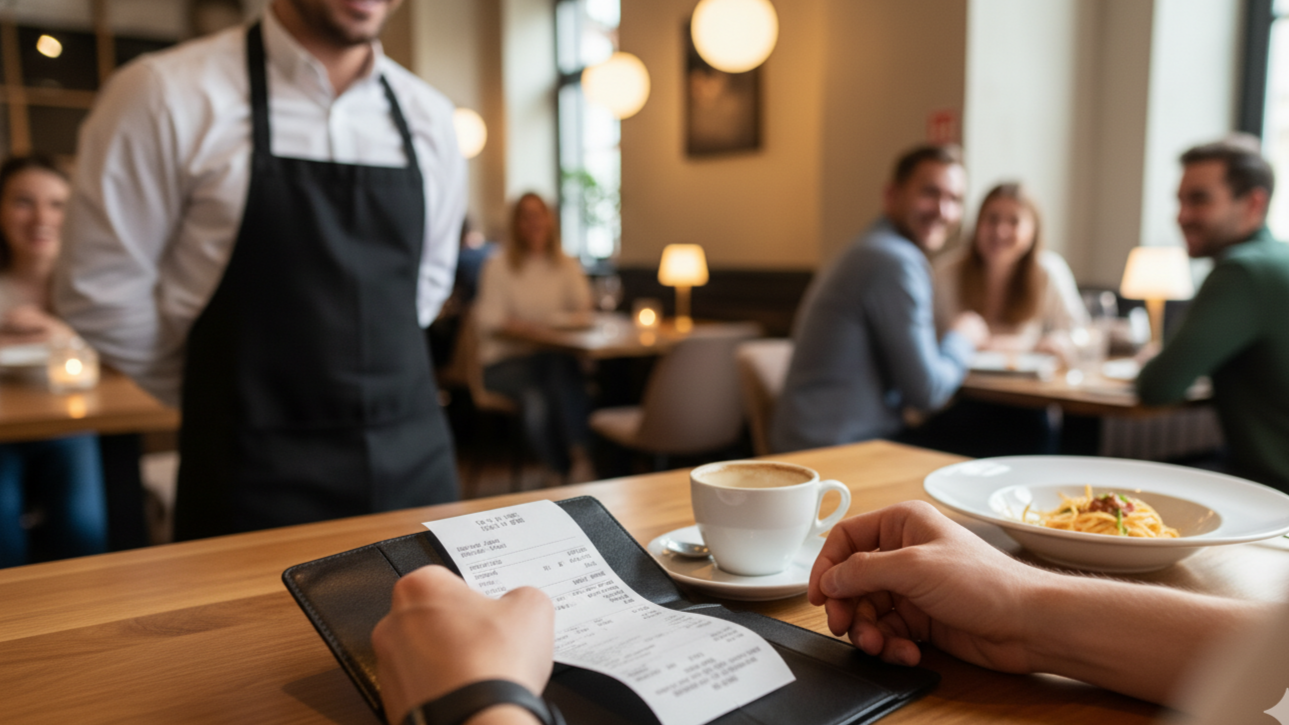

You have just finished a delicious meal; the bill falls on the table, and all at once you stop. Ah, what’s a good amount to tip here? Have you ever been at a loss or embarrassed at this time? Well, so has somebody else.
Restaurant tipping has been a combination of math, courtesy, and feeling. It is even more confusing in 2025. Digital tip screens propose numbers before you even blink, service charges are reflected on bills, and social media discussions make it sound like there is an answer that is right and the other one, wrong. Nevertheless, there is something that will not change. Knowing how much to tip at a restaurant environment makes diners feel safe and relaxed by the time they are through with their meal.
This blog is here to simplify things. We will discuss typical percentage tips, when it is better to tip bigger or smaller, and divide tipping in various restaurants.
How Much to Tip at a Restaurant: The Standard Percentages
Let’s start with the question most diners ask straight away: how much to tip at a restaurant in the US?
For full-service restaurants, these ranges are still widely accepted:
- 15-20% for good service
- 10-12% for average or just-okay service
- 20-25% for excellent or memorable service
These percentages are calculated on the pre-tax total of your bill. So if your meal costs $80 before tax, a 20% tip comes to $16.
Why does this range matter? Due to the fact that the majority of servers in the US are paid less base wage, with tips constituting a larger portion of their earnings.
Service charges can also be found on a few of the bills, but they are usually between 15-22 percent. In that case, read the fine print. Certain service markups are distributed directly to employees, whereas others are distributed or utilized in paying higher hourly salaries.
When a service charge completely replaces tipping, restaurants tend to make that point clear. Otherwise, there are still numerous clients who leave a small tip as an additional tip in case of excellent service.
When Should You Tip More?
There are moments when tipping above 20% feels natural, and honestly, deserved. The most obvious reason is exceptional service. Imagine a server who knows your name, orders something, and before it hits the table, they pick up and correct the error, or they make considerate menu recommendations that make what would be a good meal absolutely fabulous.
However, there are multiple other circumstances where you might consider tipping the server a generous amount. These include:
- Large groups where the server is juggling many orders and personalities
- Special requests, food allergies, or off-menu changes handled smoothly
- Split checks that require extra time and patience
- Long table times when you stay well past the rush
- Peak hours when the restaurant is packed, yet service stays calm and friendly
From a psychology standpoint, tipping more reinforces positive behavior. Servers remember guests who show appreciation, and that goodwill often circles back the next time you visit. A higher tip says, “I noticed the effort.”
When Is a Lower Tip Acceptable?
Tipping less can feel uncomfortable, but it’s sometimes fair. The key is understanding why the experience fell short.
If your food is late, cold, or incorrect, ask yourself this first: Was it a kitchen issue or a service issue? Servers don’t control how fast food cooks or when a busy kitchen gets backed up. If they communicated clearly and checked in often, that still counts for something.
A lower tip may be reasonable when there are:
- Repeated mistakes with no apology
- Long waits with no updates
- A dismissive or rude attitude
- Forgotten items that never arrive
Even then, many diners choose not to drop below 10% unless the service was truly poor. Another option is to tip moderately and share feedback with a manager. Calm, respectful feedback helps restaurants improve without punishing someone unfairly.
Tipping in Different Dining Settings
Not all restaurants work the same way, so tipping norms change depending on where you eat.
Quick-Service and Fast-Casual Restaurants
Places where you order at a counter and pick up your own food usually don’t require tipping. That said, tip jars and screens are common. A dollar or two is a nice gesture, not an obligation. Digital payments have changed how diners think about how much to tip at restaurant checkouts.
Bars and Pubs
At bars, tipping is standard. Most of them tip 15-20 percent of the check. Tipping will go far, in case you are a regular or are attended to in a hurry.
Buffet Restaurants
Buffets can be confusing to the diners. Although you are self-service, employees continue to empty dishes and replace beverages. A 10-15% tip is typical.
Fine Dining
In expensive restaurants, service is elaborate and consumes time. Gratuities ranging between 20-25% are the norm, particularly when the service experience is smooth and intimate.
Delivery and Takeaway
Delivery drivers usually receive 15-20%, with a higher tip for long distances, bad weather, or late hours. For takeaway, tipping is optional, but many diners leave a small amount if the service was friendly and fast.
Digital Ordering and Tip Screens: What Diners Should Know
Tablet screens that flip toward you with tip options have changed the dining experience. Suddenly, you’re choosing between 18%, 22%, and 25% while someone waits.
Here’s what matters: those numbers are suggestions, not rules. Many diners still rely on social cues to decide how much to tip at restaurant experiences in the US.
Restaurants set default tip ranges in their POS systems, often to encourage fair tipping or simplify choices. You can always select “custom” or “no tip” if it fits the situation.
The pressure you feel is real. Psychologically, people tend to choose the middle or highest option when watched. Knowing this helps you pause and decide based on service, not guilt. A confident choice feels better than a rushed one.
What Restaurant Owners Want Customers to Know?
From a restaurant owner’s point of view, tipping plays a bigger role than most diners realize. Modern dining tools now guide diners subtly on how much to tip at restaurant tables without pressure.
Tips help attract and retain skilled staff. When servers earn consistently, they stay longer, learn the menu better, and provide smoother service. That stability improves the guest experience for everyone.
Owners also want diners to know that tip distribution varies. Some restaurants pool tips and share them among servers, hosts, bartenders, and support staff. Others let servers keep their own tips. Transparency builds trust, and many restaurants are now clearer about how tips and service charges are handled.
Consistent tipping also affects morale. A busy shift with strong tips feels rewarding. A night of low tips, even with hard work, can be discouraging. That emotional side often shapes how staff show up the next day.
Global Comparison: Tipping Norms Around the World
Understanding tipping abroad helps put US customs in perspective. Consistent awareness of how much to tip at restaurant meals helps support fair wages in the service industry.
In the United States, tipping is expected and built into the wage system.
In much of Europe, service is often included in menu prices. Leaving a small extra amount is polite but not required.
In Asia, tipping may be rare or even discouraged, as good service is considered part of the job.
For travelers, this comparison is helpful. It reminds us that tipping is cultural, not moral. Back home in the US, though, knowing how much to tip at a restaurant keeps things respectful and smooth.
Final Tips for Customers
When diners understand how much to tip at a restaurant situations, the overall dining experience feels smoother. If you ever feel unsure, keep these simple rules in mind:
- Stick to 15-20% for standard service
- Check your bill for service charges before adding a tip
- Tip more when service stands out
- Don’t punish servers for kitchen issues
- Tip in a way that feels fair and comfortable
Tipping isn’t about perfection. It’s about appreciation. When you focus on the human effort behind the service, the decision becomes easier.
Powering Better Service, and Smarter Tipping, with NOVA
Knowing how much to tip at a restaurant demonstrates appreciation of the effort put in by the servers as you take your food. Having a set of simple rules, the customer can be sure of the tipping amount in a restaurant, nice service, and still enjoy his/her meals without worrying about the last part.
The appropriate technology frequently drives that convenience. The NOVA Restaurant Management Software assists restaurant managers in running their restaurants better in the background and serving their customers in a faster and more efficient manner, coupled with happier employees. And Tap-to-Tip and Pay-at-the-Table functions, NOVA will make tipping a natural thing, rather than an enforced one. One can review his or her bill, select an amount to tip, and then pay within a few seconds at the table, at their own price.
To the owners of the restaurant, it will be a reduced time of turning around tables, clear tipping, and stable staff income. To the diners, it equates to control, transparency, and zero embarrassment. Everyone is a winner when the service is good, and it is easy to tip. NOVA offers great hospitality, but it does not begin and end with the meal, but on an optimistic, positive tap.