How to Create a Winning Customer Loyalty Program for Quick Serve Restaurants
Learn how to create a successful customer loyalty program for your quick serve restaurant with these actionable tips. From choosing the right structure to offering meaningful rewards, discover how to boost repeat business and customer engagement. Start building lasting customer loyalty today!
.svg)
For quick-service restaurants, customer loyalty is no longer a soft metric. It is a measurable growth lever. Industry data consistently shows that returning customers spend more per visit, order more frequently, and cost significantly less to retain than acquiring new ones. At the same time, rising food costs, labor pressure, and third-party delivery commissions have made margin discipline critical for QSR operators in 2026.
Yet many quick-service restaurants struggle to translate loyalty strategy into execution. Disconnected systems, manual campaign management, and limited visibility into customer behavior prevent loyalty programs from delivering consistent ROI. Without real-time POS data and automation, loyalty efforts often become discount-heavy and difficult to scale.
NOVA addresses this gap by embedding customer loyalty directly into a modern, AI-native quick serve restaurant POS and management platform. By unifying ordering, payments, customer data, and intelligence into a single system, NOVA enables restaurant owners to build loyalty programs that are measurable, automated, and designed to increase repeat visits and average order value—without adding operational complexity.
What Is a Customer Loyalty Program in a Quick Serve Restaurant?
A customer loyalty program for a quick-serve restaurant is a structured system that rewards repeat customers based on their ordering behavior. Unlike traditional punch cards or static point systems, modern loyalty programs are directly connected to the quick-serve restaurant POS and customer data.
In 2026, loyalty programs focus on:
- Increasing repeat visits
- Encouraging higher-value orders
- Creating personalized guest experiences
- Building first-party customer data
For QSRs, loyalty success depends on speed, simplicity, and relevance. Customers expect rewards that feel effortless, immediate, and tailored to their preferences.
Why Customer Loyalty Programs Matter More for Quick Serve Restaurants in 2026
Quick-serve restaurants operate in a high-frequency, low-margin environment. Even small improvements in retention can significantly impact profitability.
Customer loyalty programs help QSRs:
- Reduce dependence on paid ads and third-party delivery platforms
- Improve revenue predictability through repeat visits
- Strengthen brand preference in crowded local markets
- Capture customer insights that inform pricing, menu, and promotions
As Gen Z and younger millennials become the dominant dining audience, loyalty expectations have changed. These customers value personalization, digital-first experiences, and convenience over traditional discounts.
👉 You can explore this shift in more detail in our guide on Gen Z loyalty and modern restaurant engagement.
Why Loyalty Gets Harder as Quick-Service Restaurants Scale
For multi-location quick-service restaurant owners, loyalty challenges multiply with scale. Ensuring consistent reward structures, unified customer experiences, and accurate performance tracking across locations becomes increasingly complex as the footprint grows. Without a centralized POS-led loyalty system, customer data remains fragmented, campaigns perform unevenly, and insights are limited to individual outlets rather than the brand as a whole. In 2026, scalable customer loyalty programs require a single source of truth that connects every location, channel, and customer interaction: enabling operators to standardize loyalty strategy while still allowing flexibility at the store level.
At scale, an effective QSR loyalty system must enable:
- Centralized loyalty management to launch, update, and monitor programs across all locations from a single dashboard
- Consistent customer experiences where rewards, points, and redemptions work the same way at every outlet
- Location-level performance visibility to identify which stores, offers, and campaigns drive the highest repeat visits and revenue
- Brand-level customer insights that track lifetime value, visit frequency, and engagement across locations, not in silos
- Controlled local flexibility allowing individual outlets to run targeted promotions without breaking brand-wide loyalty rules
Why Traditional QSR Loyalty Programs Fail
Many quick-serve restaurant loyalty programs fail because they were designed for a pre-digital era.
Common issues include:
- One-size-fits-all discounts that reduce margins
- Loyalty tools that are disconnected from the POS
- No visibility into customer lifetime value
- Manual campaign management that does not scale
- Lack of personalization or behavioral insights
When loyalty operates separately from the POS and CRM, restaurants cannot measure real impact or adapt offers based on performance.
What You Must Consider to Create a Winning Customer Loyalty Program?
Loyalty Program Goals
Before launching a loyalty program, it's crucial to determine what you want to achieve. Are you looking to increase repeat visits, boost average order value, or improve customer engagement? Setting clear goals will help guide the design and implementation of your program, ensuring it delivers the desired results.
Tip: Use data from your restaurant's point of sale (POS) system to identify customer trends and behaviors. This will help you tailor your loyalty program to meet specific business objectives, such as encouraging customers to try new menu items or visit during slower hours.
Loyalty Program Structure
The structure of your loyalty program can make or break its success. The most common loyalty program models include point-based systems, tiered rewards, and visit-based incentives.
Point-based System: Customers earn points for every purchase, which can be redeemed for rewards like discounts, free items, or exclusive offers. This structure works well for QSRs because it encourages frequent visits and gives customers a clear incentive to return.
Tiered Rewards: Customers advance through levels based on their spending or visit frequency, unlocking increasingly valuable rewards as they progress. This can encourage higher spending and foster a sense of exclusivity.
Visit-based incentives: Customers receive a reward after a set number of visits, such as a free item after their 10th purchase. This is a simple and effective way to boost repeat business.
Tip: You can boost customer satisfaction by choosing from several loyalty program models. However, it is always essential to decide on a customer loyalty program model that resonates with your customers. New-age quick-serve restaurant POS systems make it easier to choose the right model based on real-time data.
Reward Personalization
For a loyalty program to be effective, the rewards need to be enticing enough to keep customers coming back. Think about what your customers value most. Do they prefer discounts, free items, or exclusive experiences? Offering a mix of rewards can appeal to a broader audience and keep your program exciting.
Tip: Use customer data from your POS system to identify the most popular menu items and promotions. Offering rewards that align with customer preferences can increase participation and satisfaction.
Enrollment and Accessibility
A loyalty program is only effective when customers can join easily and engage with it regularly. Simplify the sign-up process by allowing customers to enroll through multiple channels, such as your website, mobile app, or in-store. The easier it is to join, the more customers are likely to participate.
Tip: You must leverage technologies to enable customers to sign up for the loyalty program directly at the point of sale or through your online ordering platform. The software will make it easier for your customers to track and redeem rewards without putting in extra time and effort.
Awareness and Promotion
Even the best loyalty program needs effective promotion to succeed. Make sure customers are aware of the benefits by promoting your program across all customer touchpoints. This includes in-store signage, social media, email campaigns, and your website.
Tip: You must make customers aware of the loyalty program using various channels – websites, social media, food delivery apps, and text messages. The marketing and promotion initiatives will make customers sign up for the customer loyalty program regularly.
Key Metrics to Track for QSR Loyalty Programs
To measure success, quick-serve restaurant owners should track:
- Repeat visit frequency
- Average order value of loyalty members
- Reward redemption rates
- Incremental revenue driven by loyalty
- Customer lifetime value trends
A POS-connected loyalty system makes these insights accessible and actionable.
Must Read: Why Retention is the New Growth? Building a Long-Lasting Loyalty Program
How does NOVA Help Your Quick-Service Restaurant Create a Winning Customer Loyalty Program?
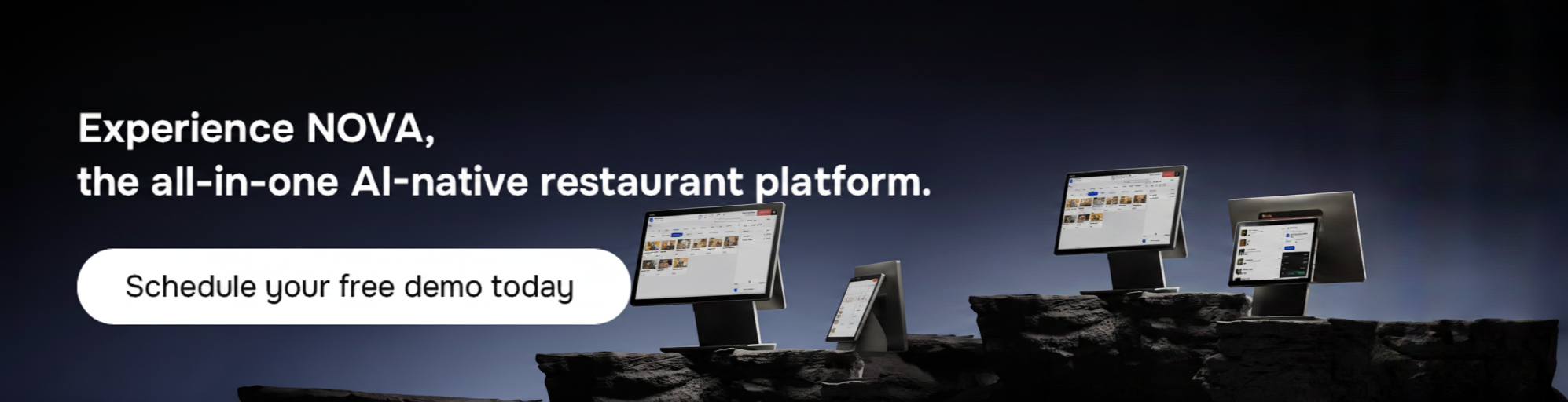
NOVA is designed by restaurateurs as a modern quick-serve restaurant POS system and restaurant management platform built for the realities of quick-service operations. It helps your quick-service restaurant automate critical workflows such as menu and pricing management, QR code ordering, payment processing, and online order management.
At the same time, NOVA’s feature-rich quick serve restaurant POS enables you to design, launch, and scale high-impact customer loyalty programs that drive repeat visits and long-term growth.
Choose Flexible Reward Options
NOVA allows you to experiment with multiple customer loyalty program models, from points-based rewards to visit-based incentives and targeted offers. You can combine different reward types to match customer preferences and business goals. This flexibility helps quick-service restaurants strengthen customer relationships without relying on blanket discounts.
Set a Clear and Transparent Reward Structure
NOVA helps you define a clear reward structure that customers can easily understand. Rewards are automatically calculated and displayed based on order value, creating transparency at every interaction. This clarity encourages customers to increase their order size and return more frequently to earn additional rewards.
Strengthen Customer Engagement Across Channels
Customers can track their rewards and incentives directly within the NOVA ecosystem. They can also redeem loyalty points seamlessly at checkout, whether they are ordering in-store or online. This frictionless engagement increases program adoption, improves customer satisfaction, and encourages organic word-of-mouth promotion.
Make Data-Driven Decisions With Real-Time Insights
NOVA analyzes large volumes of transactional and behavioral data to deliver actionable insights. These insights help you measure the effectiveness of your customer loyalty program, identify what rewards are driving repeat visits, and optimize the program continuously based on real-time performance.
Automate Loyalty Campaigns With AI Intelligence
In 2026, successful loyalty programs require automation. NOVA uses AI to trigger loyalty actions automatically based on customer behavior, such as repeat visits, inactivity, or changes in spending patterns. This reduces manual effort while ensuring every customer receives timely and relevant incentives.
Connect Loyalty Directly With Your Quick Serve Restaurant POS
Because loyalty is built directly into the NOVA POS, every order contributes to a unified customer profile. This POS-first architecture ensures accurate reward tracking, faster redemption, and consistent execution at the point of sale without slowing down service.
Build a Strong First-Party Customer Database
NOVA helps quick-service restaurants capture and organize first-party customer data through loyalty participation. This data becomes the foundation for long-term customer retention, personalized marketing, and CRM initiatives, reducing reliance on third-party delivery platforms.
Measure Loyalty ROI, Not Just Participation
Beyond sign-ups, NOVA enables you to track meaningful loyalty metrics such as repeat visit frequency, average order value of loyalty members, and incremental revenue. This allows restaurant owners to understand the true business impact of their customer loyalty programs and invest confidently in what works.
Manage Loyalty at Scale Across Multiple Locations
NOVA is built for multi-store quick-service restaurant operators who need both control and flexibility. Loyalty programs can be managed centrally across all locations while still allowing store-level customization based on local demand, performance, or promotions. Restaurant owners and operators get a unified view of loyalty performance across the entire brand, along with location-specific insights that help standardize what works and optimize what doesn’t, without creating operational complexity at the store level.
Conclusion
Speed and efficiency will always define success in quick-service restaurants. But in 2026, they are no longer enough to sustain growth. Long-term success depends on how well a restaurant builds, understands, and nurtures customer relationships at scale.
Modern customer loyalty programs, when powered by a POS-first and AI-driven platform like NOVA, enable quick-service restaurants to turn everyday transactions into repeat visits, higher order values, and predictable revenue. By combining clear reward structures, flexible incentives, and real-time data, restaurant owners can move beyond one-time promotions and build loyalty programs that continuously improve performance.
With the right technology foundation, loyalty becomes more than a retention tactic. It becomes a measurable growth engine that helps quick-service restaurants compete more effectively, operate more intelligently, and grow sustainably across locations.
Ready to turn loyalty into a measurable growth engine? Book a NOVA demo to see how modern QSRs build repeat business with POS-driven, AI-native loyalty.